
Beyond the Hype: Inside a High-Security Facial Recognition Lock Factory and What It Means for Your Business
The global shift towards frictionless, contactless security is no longer a trend; it is a fundamental operational requirement. For facility managers, security consultants, and hotel owners, the phrase "facial recognition lock" has shifted from a futuristic novelty to a viable procurement category. However, there is a vast chasm between a consumer-grade smart lock found on retail shelves and a high-security facial recognition lock factory solution designed for industrial-scale reliability.
As the market hurtles toward a projected valuation of $24.67 billion by 2031 (growing at a CAGR of 18.3%), the pressure on businesses to source robust, hack-proof, and scalable technology has intensified . But what actually happens inside the facilities that manufacture these devices? What separates a cheap module from a certified high-security solution capable of protecting sensitive data and physical assets?
This article takes you behind the factory doors. We will explore the engineering philosophies, the non-negotiable security certifications, and the OEM capabilities that define a world-class manufacturer. If you are looking to move beyond spec sheets and understand the concrete value of high-security manufacturing, this is your blueprint.
The Anatomy of "High-Security": What Factories Must Engineer Differently
In the context of a high-security facial recognition lock factory, "high-security" is not a marketing adjective; it is a systems engineering mandate. Unlike standard smart locks that prioritize convenience, high-security variants are built to operate in environments where a breach is catastrophic—think data centers, pharmaceutical labs, or government annexes.
Moving Beyond 2D: The Non-Negotiable Shift to 3D & IR
The most critical distinction in manufacturing lies in the optical hardware. Low-cost factories may still push 2D camera systems, which can be fooled by high-resolution photos or videos. A genuine high-security facility prioritizes 3D structured light and dual-IR camera arrays . These sensors map the topography of a face—measuring the distance between your eyes, the curve of your brow, and the contour of your cheekbones.
High-security factories invest in precision calibration rooms to ensure that every camera module can distinguish between a living human and a silicone mask. For instance, advanced modules now feature 50ms recognition speeds with a FAR (False Acceptance Rate) as low as 0.0001% , ensuring that the probability of a wrong identity gaining access is virtually zero .
Liveness Detection: The War Against Spoofing
The hallmark of a high-security manufacturing process is the integration of dedicated liveness detection chips. It is no longer enough to just see a face; the system must ensure a heartbeat exists behind it. Top-tier factories embed algorithms that analyze micro-movements, such as involuntary blinking or subtle skin texture shifts, to thwart spoofing attempts using photos, videos, or even sophisticated silicone masks . This requires factories to maintain massive datasets of "attack" vectors to train their AI models before the hardware is ever shipped.
Technical Pillars of a High-Security Manufacturing Line
To truly serve commercial clients, a factory must demonstrate mastery over three specific technical domains: environmental resilience, data protection, and system integration. Without these, a lock is just a fragile gadget.
Weatherproofing and Durability Standards (IP & IK Ratings)
A lock destined for a factory loading bay or a university campus must survive the elements. High-security manufacturers build to survive. This means utilizing aviation-grade aluminum alloys and sealing electronics to achieve IP65 or IP66 ratings, making them impervious to dust, water jets, and corrosion .
Furthermore, the operational temperature range is a key differentiator. While consumer locks might fail in freezing conditions, high-security units are rigorously tested in factory environmental chambers to operate reliably in extremes ranging from -30°C to 70°C . This ensures that employees heading to work in a blizzard aren't locked out because the infrared sensors have failed.
On-Device Data Encryption and Edge Computing
Privacy regulations like GDPR and CCPA have changed the manufacturing landscape. Sending sensitive biometric data to the cloud for processing is a liability. Leading high-security facial recognition lock factories now champion edge computing. They design boards where the enrollment and verification happen locally on the device's secure chip.
This involves soldiering dedicated security elements that perform AES-256 encryption of the facial template directly onto the motherboard . If the device is ever tampered with, the data stored is mathematically useless to a hacker. For multinational buyers, a factory offering "local storage only" options is a massive compliance win.
The OEM/ODM Advantage: Customizing Security for Your Brand
For businesses looking to enter the smart lock market or upgrade their security offerings, partnering with an original equipment manufacturer (OEM) is the fastest route. However, not all factories are created equal when it comes to customization.
White-Labeling and Firmware Customization
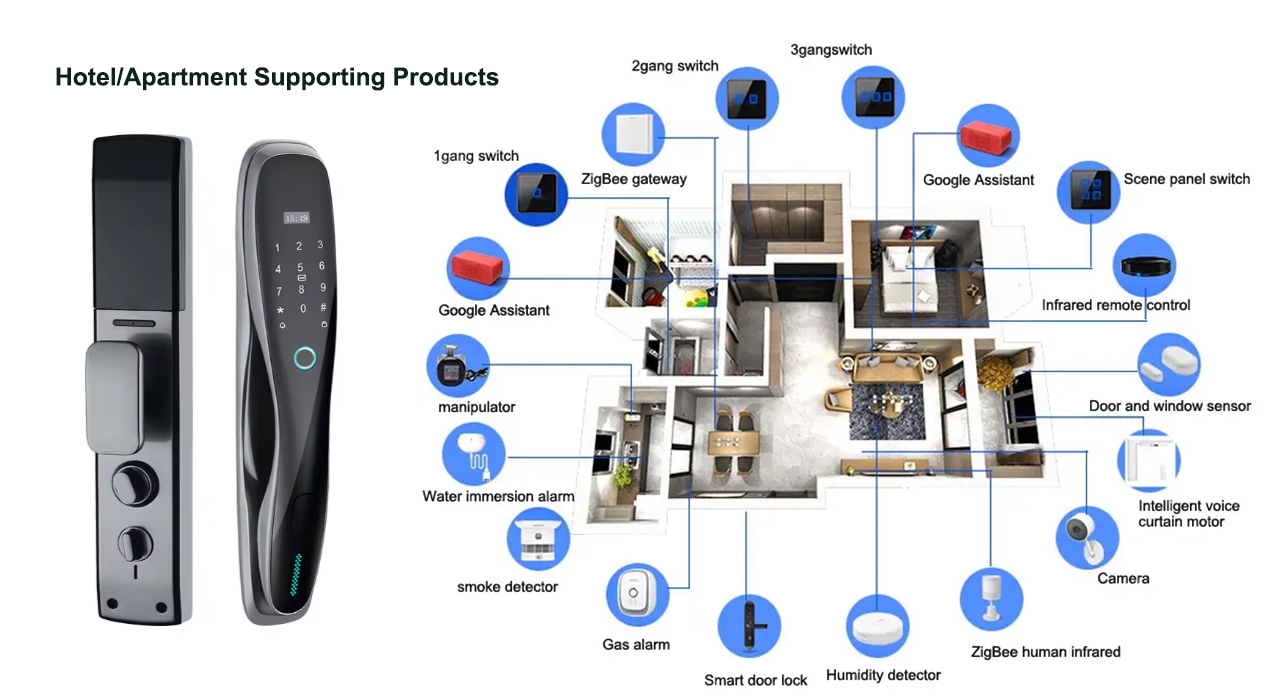
A sophisticated factory partner offers more than just putting a logo on a box. They provide SDK (Software Development Kits) and open APIs that allow your IT team to integrate the locks with existing building management systems . Whether it’s syncing with a specific hotel Property Management System (PMS) like Oracle Opera, or integrating with a Bosch or Honeywell security panel, the factory’s engineering team should be able to modify the firmware to speak the correct protocol .
Tailoring Hardware for Specific Verticals
The physical design often needs to change based on the application. A high-security factory offers flexibility in:
-
Material Finishes: Providing specific anodized colors to match corporate branding.
-
Mounting Options: Designing locks that fit specific door thicknesses (e.g., 50mm to 120mm) or retrofitting existing European/Mortise lock preparations .
-
Accessory Integration: Incorporating biometric readers with temperature sensors for post-pandemic healthcare facilities, or integrating them with turnstile controllers for stadiums .
Quality Control: The Factory Floor as the First Line of Defense
When you purchase from a high-security factory, you are essentially buying the rigor of its testing protocols. Mass production without mass testing leads to high failure rates in the field.
Stress Testing and Lifecycle Simulation
Before a single unit is shipped, high-security factories perform brutal stress tests. Locks are subjected to 50,000+ cycle durability tests to simulate years of slamming and opening . They test battery depletion rates at extremes, ensuring that the low-power AI chips can maintain the advertised 6 to 12 months of battery life even with heavy traffic .
Anti-Tamper and Fail-Safe Mechanisms
A critical component of physical security is the fail-state. What happens if the electronics fry? A well-engineered product always includes a mechanical key override and a USB-C emergency power port . Factories also test for electrostatic discharge (ESD), ensuring that a random static shock from a user's hand doesn't brick the device, with top modules supporting contact 8KV and non-contact 15KV protection .
Why Global Buyers Are Turning to Specialized Factories
The procurement landscape is shifting. Major players in the hospitality and industrial sectors are moving away from off-the-shelf retail products and toward direct factory partnerships. This is driven by the need for reliability at scale.
Consider a real-world case involving a major automotive manufacturer. Facing issues with "buddy punching" (employees clocking each other in) and security breaches in sensitive R&D areas, they didn't buy consumer locks. They integrated with a specialized manufacturer to deploy 3D structure light terminals that could handle 20,000+ employees and operate flawlessly in outdoor, high-glare environments . The result was a reduction in access times from minutes to seconds and the elimination of badge sharing .
Similarly, large-scale industrial sites, like petrochemical plants, require solutions that can recognize workers even while wearing full-face safety equipment (helmets, goggles, masks). High-security factories develop algorithms specifically trained to focus on the periocular region (the area around the eyes) to grant access even when the rest of the face is obscured, a task impossible for standard 2D systems .
Conclusion: Making the Strategic Choice
Navigating the world of biometric access control requires looking past the glossy photos and diving into the manufacturing DNA of the product. A legitimate high-security facial recognition lock factory distinguishes itself through a commitment to 3D hardware, rigorous environmental testing, on-device data security, and flexible OEM partnerships.
As security threats evolve and privacy regulations tighten, the provenance of your hardware becomes your strongest risk mitigation tool. Whether you are securing a luxury hotel penthouse or a sprawling manufacturing campus, the engineering that happens at the factory level dictates the safety you experience at the door.
Ready to source security solutions that meet global compliance and performance standards?
Contact our engineering team today to discuss your OEM requirements and request a sample kit for durability testing. [Contact Sales for a Consultation]
SUBSCRIBE
INQUIRY