
Architecture and Deployment Guide for Smart Lock Hotel Infrastructure
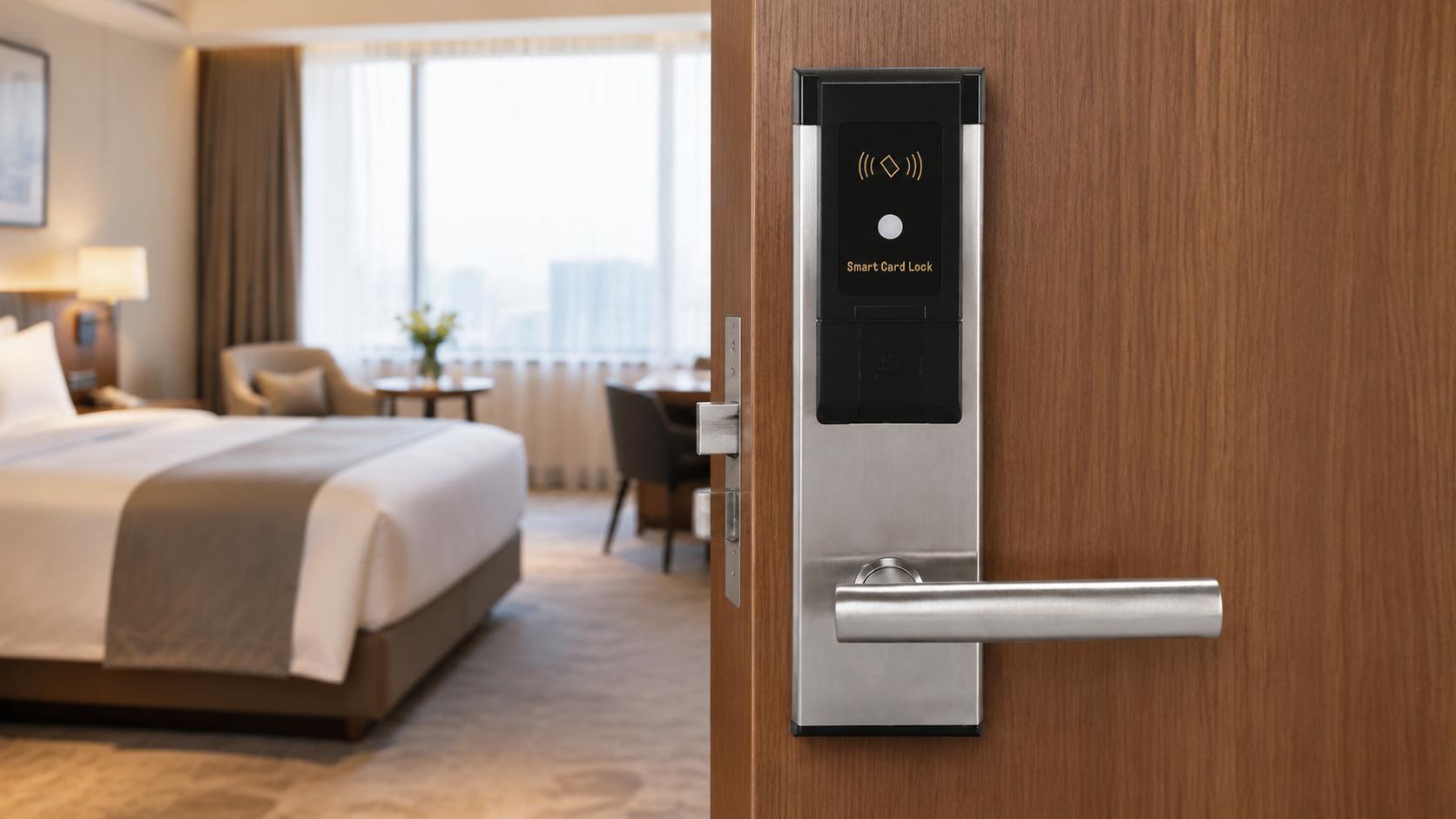
Modern lodging operators face an escalating operational challenge at the guest room door. Implementing a dependable smart lock hotel access architecture can ease the chronic bottleneck of front desk check-in lines while giving properties a stronger platform for room security, provided the credential technology and system configuration are chosen deliberately. When legacy magnetic stripes fail or unencrypted legacy keycards encounter physical wear, guest satisfaction drops immediately. Transitioning to a well-configured smart lock hotel ecosystem can address these guest friction points through suitable credential technology, wireless status reporting where supported, and robust physical mortise engineering that withstands continuous high-volume turnover.
1. Operational Vulnerabilities of Legacy Access Hardware
1.1 The Operational Drain on Front Desk Throughput
Magnetic keycards can fail when exposed to sufficiently strong magnetic fields or when the encoded stripe suffers physical wear and scratching over repeated use. When that happens, frustrated travelers have to trek back to the lobby for a replacement, and front desk staff lose shift hours re-encoding dead cards rather than attending to hospitality services.
This kind of card failure generates operating overhead that varies by property and card quality. Hotels that rely heavily on magnetic stripe cards generally budget for ongoing replacement stock, which adds procurement cost and plastic waste over time. A well-chosen smart lock hotel system can reduce this overhead by sustaining credential integrity across repeated touchpoints, depending on the card technology deployed.
1.2 Cryptographic Vulnerabilities in Legacy Systems
Early radio-frequency identification systems introduced known security weaknesses into hospitality facilities. Legacy cards running outdated proprietary algorithms like basic MIFARE Classic rely on the Crypto-1 cipher, which has documented cryptographic weaknesses that researchers have shown can enable key recovery or card cloning under vulnerable configurations. The practical outcome depends heavily on the specific card, key setup, and attack conditions involved.
It is also worth separating an individual guest credential from a hotel's master key structure. Compromising one card's sector keys does not automatically hand an attacker a property-wide master credential; that depends on how the hotel's key hierarchy and card system are configured. Properties evaluating a hotel smart lock upgrade should ask vendors directly which card technology and key management approach a given lock supports, since protection levels vary considerably across products.
1.3 The Disconnected Hardware Island
Standalone mechanical door locks operate with limited built-in reporting. When a room experiences unauthorized entry or a dispute over missing belongings occurs, staff may not be able to retrieve instantaneous access logs unless the lock and surrounding system are set up for it. Engineering technicians often must carry handheld data interrogators to extract audit files manually at the door on purely offline hardware.
This manual auditing latency can leave hotel managers at a disadvantage during disputes. Unconnected hardware generally cannot alert central security teams when a latch remains ajar or when a deadbolt fails to throw. A smart lock hotel deployment that includes compatible sensors, gateways, and management software can turn doors into endpoints that report status more promptly, though this depends on the specific hardware and network chosen rather than being automatic with any lock purchase.
2. Core Engineering of Commercial Smart Locks
2.1 Mechanical Integrity and Clutch Architecture
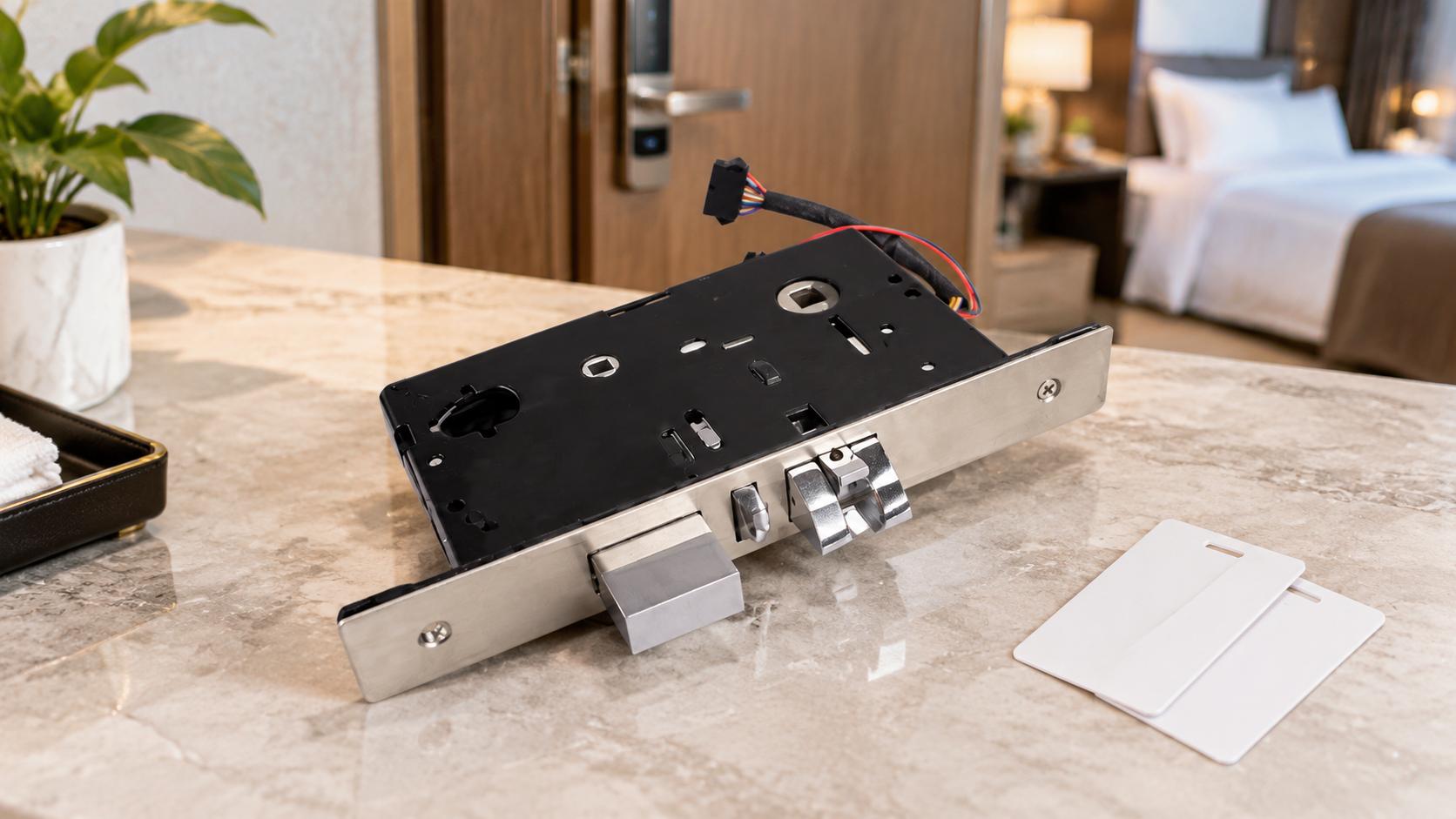
A commercial door lock succeeds or fails on the strength of its internal mechanics, and hotel doors see considerably more daily cycling than a typical residential entry door. According to the manufacturer's product specifications, this hotel door lock utilizes a stainless steel body construction featuring a 304 stainless steel self-elastic lock tongue and an anti-theft buckle, intended for high-traffic environments such as hotels, apartments, and offices. Buyers comparing locks for hospitality use should check the specific cycle rating, grade classification, and structural specifications of any given model rather than assuming suitability from material or category alone.
The mechanical clutch is a common point of interest in motorized lock sets, since it governs how the exterior handle interacts with the latch bolt when the door is locked. In some lock designs, a clutch mechanism disengages the exterior lever when locked, letting the handle pivot without transferring force to the latch bolt, which can help protect internal components from forced handle manipulation. This remains a design-dependent outcome rather than a universal property of all motorized locks, so the specific clutch design and its field performance should be confirmed with the manufacturer for any given model, including this one.
2.2 Multi-Modal Credential Processing
Different hospitality guest profiles favor distinct authentication workflows, and a lock's value often comes down to how well it serves the mix of guests actually staying at a property. Corporate guests frequently prefer direct-to-room mobile keys where a compatible system supports them, bypassing human interaction entirely during a late check-in. Vacationing families and international groups often favor physical smart cards instead, since a card works intuitively across all age brackets without requiring a smartphone app or a reliable data connection at arrival.
According to its listed specifications, this lock supports the following access methods:
-
Wi-Fi connectivity, supporting network-based management where the surrounding system is configured for it
-
Fingerprint recognition for staff entry and frequent-guest convenience
-
Smart card access for universal guest convenience and rapid issuance at check-in
-
A numeric code option and a mechanical key backup for emergency override and maintenance access
The product data identifies the credential as a smart card without naming a specific cryptographic standard. Operators who need a particular protection level, such as mutual authentication between card and reader, should confirm the exact card technology and its security properties directly with the lock vendor rather than assuming a given feature set, since protection against card cloning varies by the credential standard actually implemented.
2.3 Environmental Hardening and Circuit Sealing
Internal electronics face real environmental stress inside coastal resorts and humid continental climates. Air conditioning can create meaningful temperature differentials between interior corridors and outdoor balconies, and condensation becomes possible once humid air contacts a component surface that sits at or below that air's dew point. This is a condition-dependent outcome rather than an automatic result of running an air conditioner, but where it does occur repeatedly, moisture exposure around circuit components can eventually contribute to corrosion, parasitic battery drains, or logic faults in electronics that are not adequately sealed.
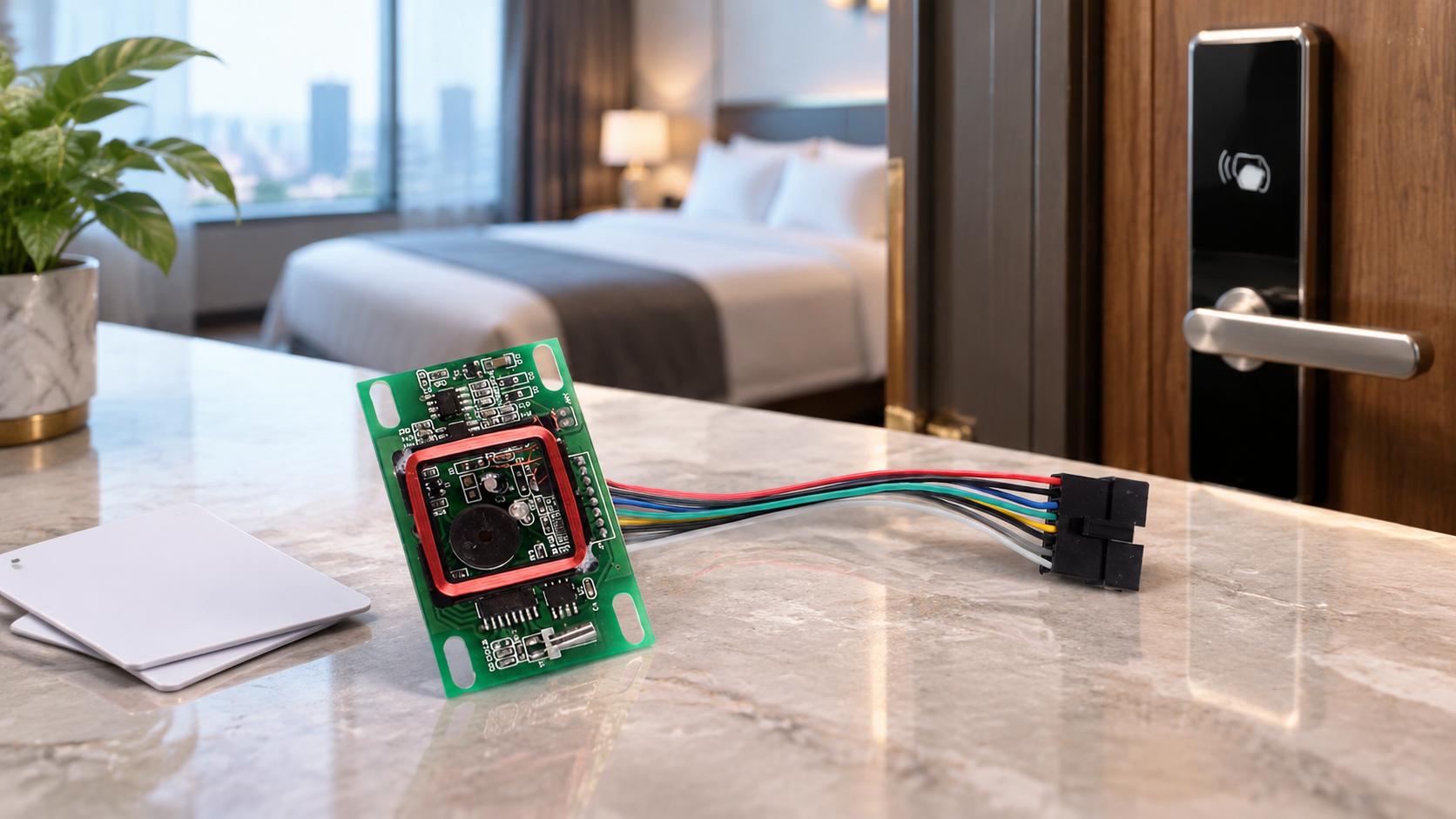
This lock's manufacturer describes its cloud-connected smart chip system as waterproof, moisture-proof, and anti-static. The supplied product information does not detail the specific construction or mechanism behind that protection, so this description should be understood as a manufacturer-stated design characteristic rather than an independently verified test result or a documented protective process. Operators who need a specific ingress-protection rating or test standard for planning purposes should request that documentation directly from the manufacturer.
3. Communication Protocols and Energy Budgets
3.1 Network Topology and Power Consumption
Selecting the transmission protocol can meaningfully affect property operating costs over time. As a general pattern across the access-control industry, connecting door locks directly to standard Wi-Fi access points tends to create heavier battery penalties than offline or mesh alternatives, since maintaining a router association typically draws more current than periodic low-power communication.
Sub-gigahertz networks, ZigBee mesh, and Bluetooth Low Energy architectures are generally designed to prioritize deep microprocessor sleep states between events. This is an industry-wide pattern rather than a figure specific to any single model. The manufacturer behind this lock states elsewhere that its product line can target battery life of up to 18 months under typical use, but that figure is a general company-level claim and is not confirmed in this specific lock's own technical specifications, which list Wi-Fi as an access method without a stated battery life. Operators should request model-specific battery data before planning replacement cycles.
3.2 Offline Autonomy and Network Redundancy
Cloud-managed properties generally want to avoid leaving guests stranded outside rooms during network outages, and offline-capable architectures are one common way the industry addresses this. Some lock systems store local authorization rules and credential data directly inside onboard memory so that validation can continue without a live server connection, but this capability depends on the specific lock and system design.
For this particular model, the supplied product information confirms a mechanical key backup as a listed feature, which provides a manual path into the room if electronic systems are unavailable. The specifications do not describe a specific offline credential-validation scheme or stored checkout-timestamp logic for this lock, so operators needing guaranteed offline electronic access should confirm that behavior with the manufacturer before relying on it.
3.3 Architectural Protocol Comparison
Property engineers generally evaluate wireless topology based on scale, physical building materials, and maintenance capacity. The ranges below reflect broad industry patterns reported across various commercial lock deployments rather than figures tied to one specific product, since actual performance varies by lock design, usage intensity, and network configuration.
| Network Protocol | Typical Battery Life Pattern | Infrastructure Requirements | Typical Audit Reporting | Common Deployment Scenario |
|---|---|---|---|---|
| Standalone RFID (Offline) | Longer battery life in general, varies by lock | None (Handheld encoder only) | Limited (Often requires manual interrogation) | Budget properties and remote motel cabins |
| Direct Wi-Fi | Shorter battery life in general, varies by lock | Existing commercial Wi-Fi APs | Can support direct cloud connection where configured | Small boutique properties and distributed serviced villas |
| ZigBee / Sub-GHz Gateway | Moderate to longer battery life in general, varies by lock | Dedicated corridor IoT gateways | Can support frequent status updates where configured | Mid to large-scale high-rise hotels |
| BLE Mobile Mesh | Moderate to longer battery life in general, varies by lock | Gateway bridges and mobile app ecosystem | Reporting speed depends on gateway or phone relay setup | Modern lifestyle hotels prioritizing digital keys |
4. Integration with Property Management and Energy Systems
4.1 PMS Integration via Standardized Interfaces
A lock system generally works best when it can exchange data with property management software rather than operating in isolation, since the front desk and the door hardware are really two halves of the same guest-facing process. Some deployments bridge a lock management server to central PMS platforms using interfaces such as FIAS or vendor-supported APIs, where both the lock system and the PMS support a compatible integration. When a guest registers at the front desk, a properly connected system can carry that registration through to the door without a separate manual programming step.
Where such an integration exists and is properly configured, it can help automate room assignments and key programming, update credential authorization when a guest changes rooms or extends a stay, and invalidate digital tokens after a cancellation. These outcomes depend on the specific PMS, the lock vendor's software, and the scope of the verified integration between them, rather than being guaranteed by installing any given lock. Properties evaluating a new system should ask vendors for a concrete list of supported PMS platforms before assuming compatibility.
4.2 Linking Door Locks with Room Control Systems
Integrating a room lock with a Guest Room Management System is one approach some properties use to pursue energy savings, since unoccupied guest rooms can otherwise consume excess energy through unchecked HVAC cooling and forgotten lighting. In systems designed for this purpose, access events from the door may serve as one input among several that a room control system uses to infer occupancy.
An unlock event or a deadbolt engagement is not on its own a reliable confirmation that a room is occupied or vacant, since guests can leave doors unlocked or step out briefly. Energy-saving actions such as HVAC setbacks or lighting changes should rely on the system's configured sensors and rules rather than on the door lock alone, and operators should confirm with their GRMS vendor exactly which signals the lock reports and how those signals are used.
4.3 Frictionless Self-Service Workflows
Self-service check-in kiosks and web check-in links can reduce operational staffing pressures during afternoon arrival rushes for properties that have deployed compatible mobile-credential systems, and this kind of workflow has become a meaningful differentiator for travelers who want to skip the lobby line entirely. Where a lock supports an app-based or Bluetooth mobile key, a traveler may receive an encrypted access credential on a personal device after check-in, turning the phone into the primary way of reaching the room.
The access methods listed for this particular lock are Wi-Fi, fingerprint, a numeric code, smart card, and a mechanical key; the product specifications do not list an app-based or Bluetooth mobile-key feature for this model. Properties wanting a phone-based self-service workflow should confirm mobile-credential support directly with the lock vendor before building that workflow around a specific product, since retrofitting a kiosk process around hardware that cannot issue a digital key will create friction rather than remove it.
5. Engineering Selection and Deployment Framework
5.1 Mortise Compatibility and Dimensional Retrofitting
Retrofitting existing doors requires precision planning to protect fire-door integrity. Re-drilling mortise pockets across hundreds of doors inflates labor bills and can create complications for existing fire ratings if not handled correctly. Property engineers must evaluate backset dimensions, center-to-center spacing, and faceplate cutouts against existing mortise standards.
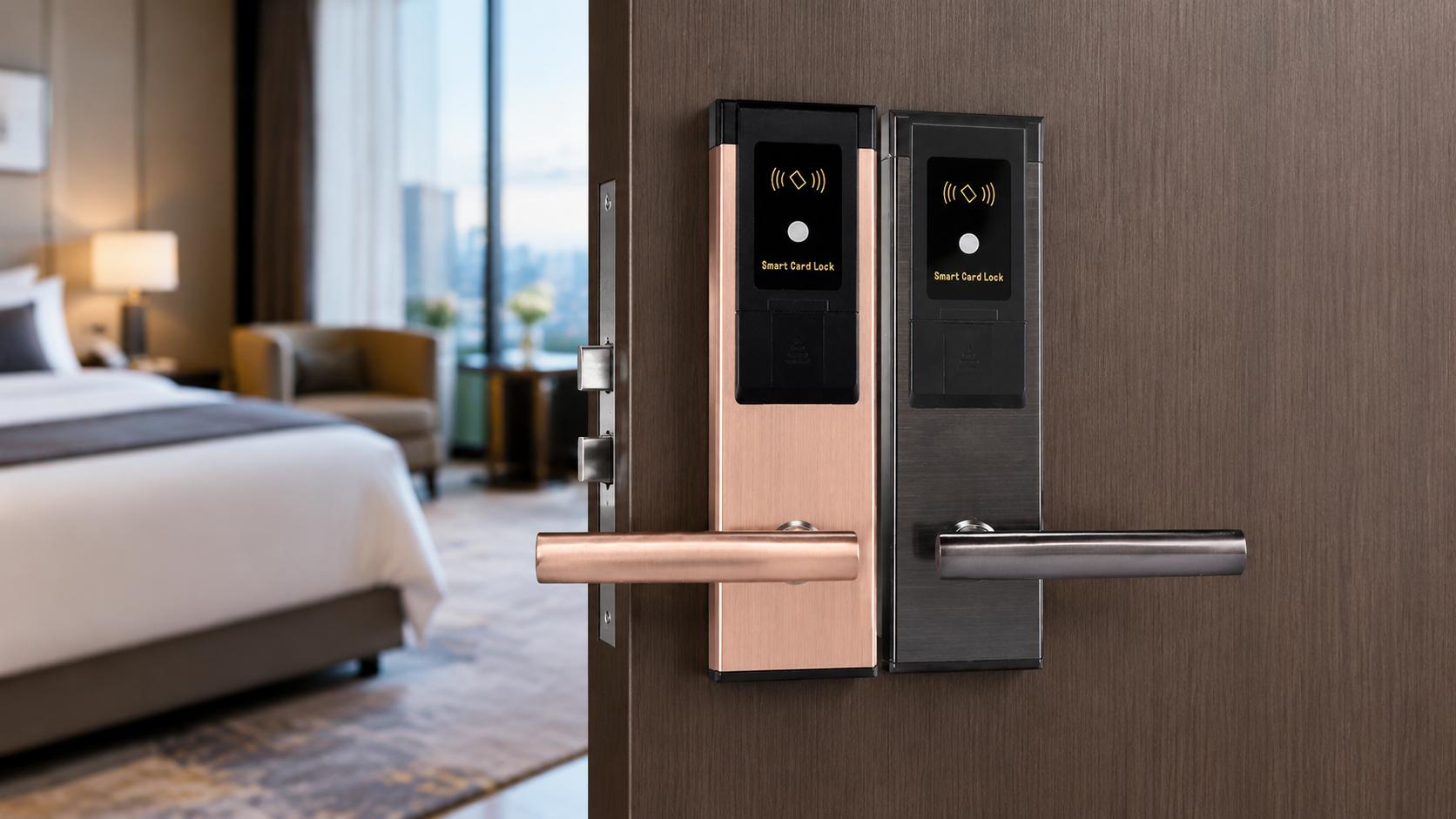
According to its listed specifications, this lock has an exterior panel measuring 240mm by 60mm, finished in silver, gold, black, or copper options. Panel dimensions alone do not establish that a given lock aligns with a property's existing drillings or preserves a fire-door rating; compliance depends on the full listed hardware assembly and on whether the installation method is permitted under the door's fire listing. Installers should check actual door preparation and confirm applicable listing or code requirements with the manufacturer and the relevant authority before modifying any fire-rated opening.
5.2 Mechanical Durability and Certification Benchmarks
Procurement directors should look beyond external aesthetics and review the documented specifications behind a lock's claimed service life. Hospitality door hardware must withstand accidental baggage impacts, forceful handle yanks, and constant latch cycles without structural play developing in the escutcheon. High-traffic environments call for clear, verifiable mechanical benchmarks.
-
A 12-year warranty rated for 100,000 cycles, as specified by the manufacturer for this lock model
-
CE and RoHS compliance, documented in the product's listed certifications
-
A cast-construction clutch architecture, as shown in the manufacturer's product imagery, though its specific resistance to forced lever manipulation or motor gear damage is not detailed in the supplied specifications
-
A smart chip system described by the manufacturer as waterproof, moisture-proof, and anti-static
5.3 Step-by-Step Property Rollout Protocol
Executing a smooth door lock transition requires rigorous field staging, and most of the operational pain in a hotel-wide rollout comes from skipped preparation rather than the hardware itself. Engineering teams should execute deployment using a structured operational sequence such as the following, adapting steps to the specific lock and management system chosen, and building in a buffer for doors that do not match the expected hardware template:
-
Conduct a comprehensive door schedule audit measuring door thickness, backset dimensions, and frame strike clearances.
-
Provision central management software, configuring property codes, room hierarchies, and master card structures as supported by the chosen system.
-
Install any required corridor wireless gateways, mapping signal strength across corridors to reduce dead zones before hanging lock hardware, where the chosen protocol requires a gateway.
-
Mount the lock bodies onto prepared doors, securing internal connection harnesses and verifying free latch movement without door binding.
-
Test the clutch mechanism along with keycard entry, deadbolt operation, and the mechanical key override to confirm each function works as documented.
-
Where a cloud or network connection is part of the deployment, verify that door events reach central management logs within an acceptable response window for the property's needs.
6. Frequently Asked Questions
What happens to hotel door locks during an unexpected power or network failure?
Behavior during a power or network failure depends on the specific lock design. Many commercial hotel locks run primarily on internal battery packs independent of mains electrical grids, so a property-wide power failure may not by itself stop the lock from operating. For this model, the supplied specifications confirm a mechanical key backup as a listed feature, which can provide manual access if electronic access is unavailable. Whether the lock also validates electronic credentials locally during a network outage is not established in the supplied specifications, so operators should confirm offline behavior with the manufacturer.
How do encrypted smart cards help prevent unauthorized key duplication?
Protection against unauthorized duplication depends heavily on the specific card technology and system configuration in use. Cards built on older static-data formats are generally easier to clone with inexpensive equipment, while cards using mutual authentication and encrypted communication between card and reader are generally harder to clone, though outcomes still depend on implementation details. The supplied specifications for this lock describe its credential as a smart card without naming a specific cryptographic standard, so operators seeking a particular protection level should confirm the exact card technology with the manufacturer.
Can existing hotel doors be retrofitted without altering existing fire certifications?
Whether a retrofit preserves fire ratings depends on the full hardware assembly and the door's specific fire listing, not on panel dimensions alone. A panel sized to align with existing drill holes can simplify installation, but operators should still check actual door preparation requirements and confirm with the manufacturer and the relevant local authority or fire inspector whether the complete lock assembly is permitted on a fire-rated opening before proceeding.
What maintenance schedule supports a long battery lifecycle in hotel smart locks?
Battery lifecycle depends on the specific lock model, its communication protocol, and usage patterns, so operators should request model-specific guidance from the manufacturer rather than relying on a general industry figure. Across lock types generally, using quality battery cells and checking latch alignment tends to help; if door frames warp and force the latch tongue to bind against the strike plate, internal motors can consume excess current attempting to throw the bolt. Inspecting latch friction on a regular schedule is a reasonable general practice for maintaining efficient power consumption.
How do smart locks maintain guest privacy during audit logging?
Log contents and privacy implications vary by system and are not guaranteed to exclude personal data. Audit trails commonly record hardware credential identifiers, key types, and transaction timestamps, and these fields may still constitute personal data if they can be linked back to an identifiable guest through hotel records. Properties should review which fields their chosen system logs, who can access those logs, how long they are retained, and what privacy obligations apply under relevant local regulations.
7. Strategic Value of Modern Property Access
Upgrading door hardware represents an infrastructural investment in operational resilience and guest experience. Properties that replace failing legacy systems with a carefully selected smart lock hotel solution, matched to verified specifications rather than assumed features, can work toward reducing chronic keycard failure complaints, lowering front desk labor overhead, and strengthening room access control over time. By pairing stainless steel mortise mechanics with cloud-connected management features where properly configured, hoteliers can protect their physical asset value while working toward the smoother arrival experience that today's travelers expect from a well-planned smart lock hotel deployment. For reference, this lock is manufactured by SUMMAO, and prospective buyers should confirm all performance figures against that manufacturer's current documentation before finalizing a purchase.
SUBSCRIBE
INQUIRY