
Commercial Digital Door Lock Guide: Engineering, Selection, and Deployment for High-Traffic Facilities
A residential smart deadbolt on a busy hotel corridor or office floor is a bicycle tire bolted onto a freight truck. Choosing the right commercial digital door lock means checking mechanical cycle limits, environmental protection, and credential flexibility before anyone drills a single hole. Facility managers who specify a commercial digital door lock for hotels, apartments, or offices are not buying a consumer gadget. They are installing a checkpoint that must survive thousands of lever pulls, suitcase collisions, and rapid tenant turnover.
Understanding how commercial-grade electronic access hardware is built separates smooth operations from midnight lockout calls. The sections below explain why standard hardware struggles under commercial use, how a stainless steel lock body and protected circuitry can reduce downtime, and how procurement teams can match multi-modal credentials to real facility workflows. Along the way, we flag which details come from the supplied product data and which need confirmation before purchase.
Why Commercial Access Demands More Than Consumer Smart Hardware
The Hidden Operational Cost of Mechanical Key Turnover
Managing physical brass keys across a hundred-room property or a multi-floor office complex creates a quiet financial drain. Every time a tenant moves out, a contractor finishes a project, or a guest leaves with a room key, the security of that door is in question. Ordinary, unrestricted keys carry no audit trail and may be copied without the facility ever knowing. Restricted key systems can limit duplication to authorized parties, but they add cost and administration.
To restore security, maintenance staff must remove cylinders, re-pin them, and hand out new keys. That labor pulls technicians away from preventive maintenance. Digital credentials change the equation, because a lost card or retired code can be cancelled in software instead of by replacing hardware. Even so, mechanical backup keys still need careful control, and their cylinders can still require rekeying.
Mechanical Fatigue Under High-Frequency Daily Cycles
Foot traffic wears out lightweight locks through plain mechanical fatigue. A family door might open a handful of times a day. An office entry, school corridor, or hotel suite takes far more cycles. Over time, springs can lose force and gears can wear, contributing to loose or poorly operating hardware. The familiar result is lever droop, where handles sag below the horizontal plane.
Industry standards such as ANSI/BHMA A156.13 for mortise locks and A156.25 for electrified locking systems exist because busy doors punish internal parts. Citing a standard does not prove that a given product meets it, though. The supplied data for this lock lists a warranty of 12 years at 100,000 cycles, which is a manufacturer-listed warranty condition rather than a confirmed cycle rating. The supplied information does not establish ANSI/BHMA testing or certification for this model, so ask the manufacturer for supporting documentation.
Core Architecture of a Commercial Digital Door Lock
Lock Body Mechanics, Self-Elastic Lock Tongue, and Anti-Theft Buckle
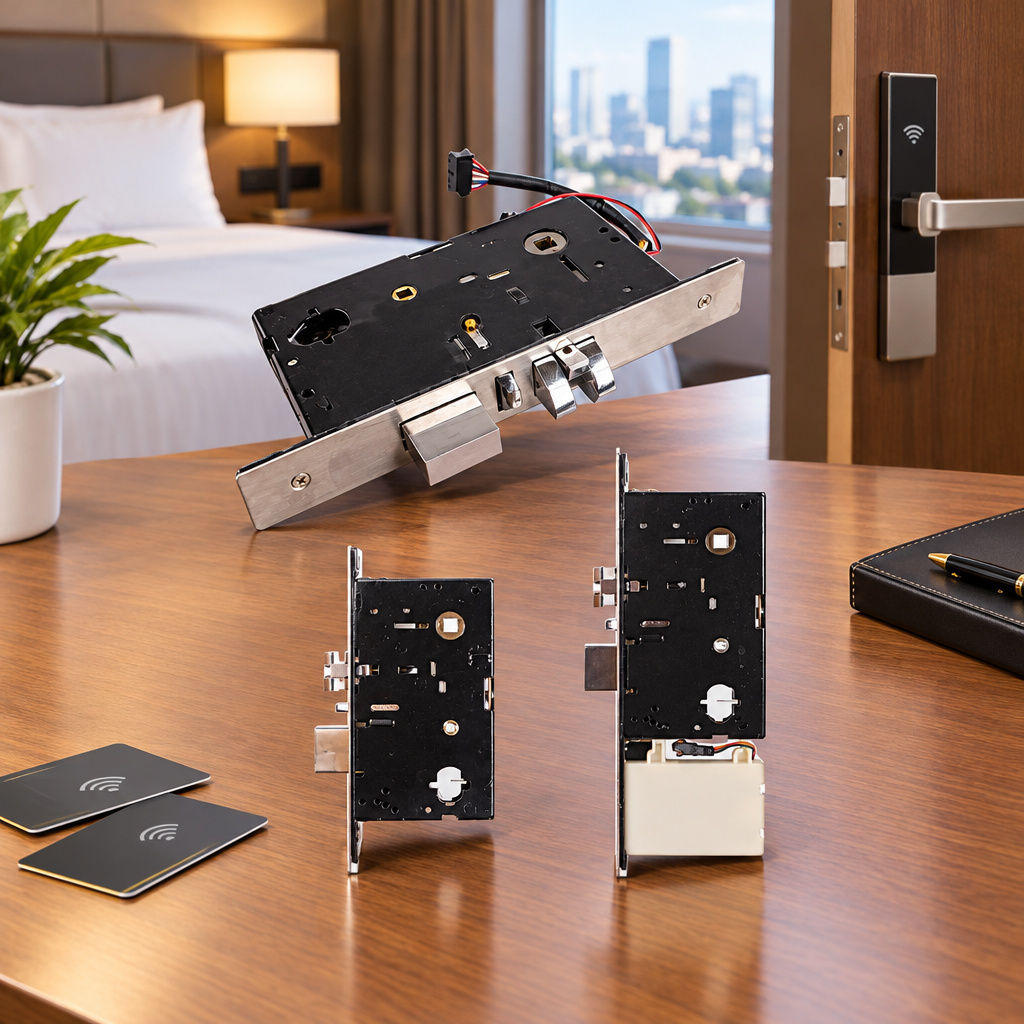
The structural core of a commercial electronic smart door lock sits inside the door rather than on the decorative trim. The product data describes a lock body with a cast steel clutch, a 304 stainless steel self-elastic lock tongue, and an anti-theft buckle. These parts carry the mechanical load, while the outer panel handles the user interface. A technical diagram of this lock body shows how the clutch, tongue, and buckle relate to the cylinder dimensions, which is useful when checking fit against an existing door.
Each component has a distinct job in resisting forced entry and mechanical binding, so it helps to look at them one at a time. The descriptions below separate what the product data states from the general purpose such parts usually serve in an electronic lock, and they stay deliberately conservative about performance.
- 304 Stainless Steel Self-Elastic Lock Tongue: 304 stainless steel is a widely used grade known for corrosion resistance, and the self-elastic design is intended to ease the latch into the strike plate when a heavy door closes.
- Anti-Theft Buckle: This feature is meant to make it harder for someone to slip a thin card or tool into the frame gap and push the latch back.
- Cast Steel Clutch: A clutch in an electronic lock typically separates the exterior handle from the latch until a valid credential is read, which helps protect internal gears when someone forces a locked lever.
Circuit Board Protection Against Moisture and Static Discharge
A static spark or humid air can disable a reader board no matter how strong the steel around it is. An unprotected circuit board inside a metal door behaves like an exposed nerve ending. In carpeted hotel corridors during dry months, a guest can build up thousands of volts of static charge and release it into the handle or keypad on contact.
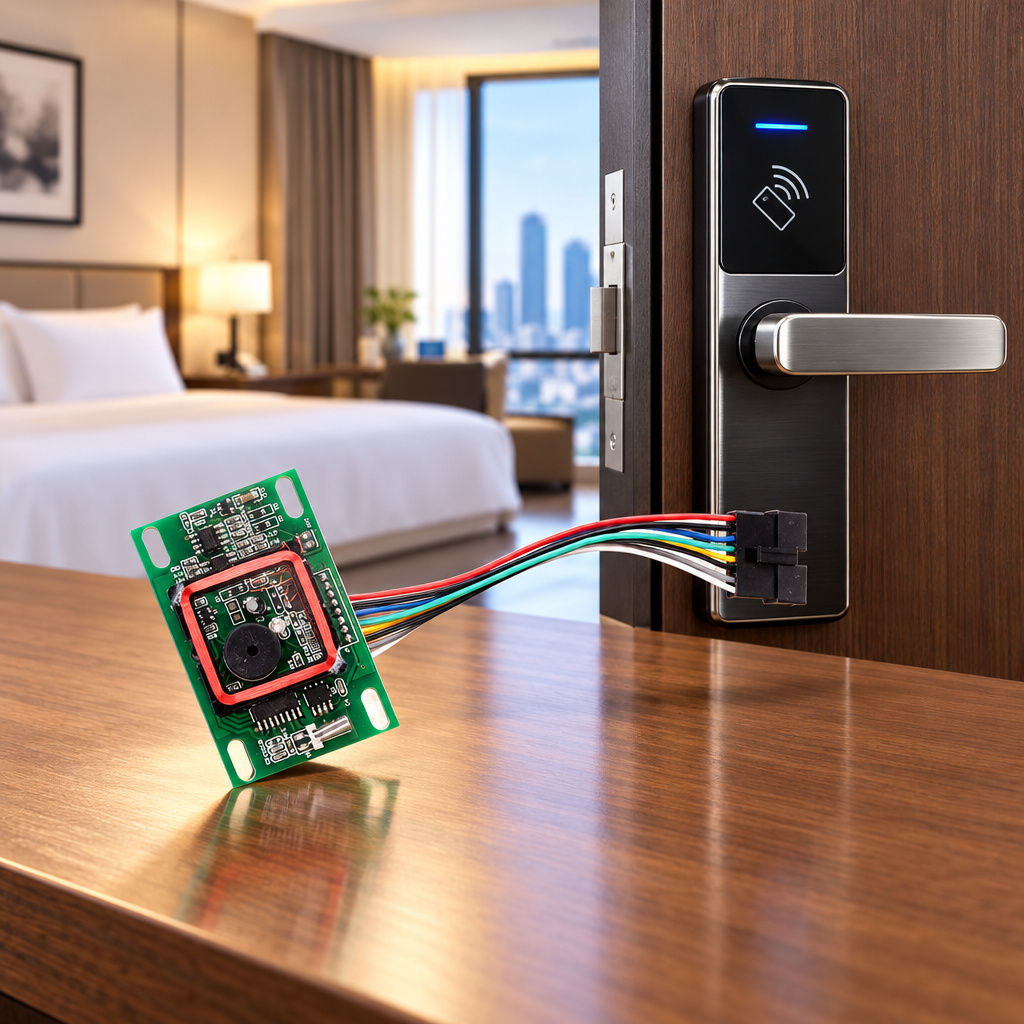
The product data describes a cloud-connected smart chip system that is waterproof, moisture-proof, and anti-static. Those traits address two common field problems: condensation when cold air-conditioned rooms meet humid hallways, and static discharge near the electronics. Buyers who need specific test ratings should request the supporting documents, because the supplied data lists CE and RoHS certifications only.
Exterior Panel Ergonomics and Material Finishes
The exterior panel is the point where the building meets its occupants. On this model it is made of stainless steel and measures 240mm in length by 60mm in width, a slim vertical profile that may suit many commercial door slabs. Door thickness, stile width, and existing cutouts all affect whether a given panel fits cleanly over an older mortise or cylindrical hole pattern, so measure the door carefully before ordering rather than relying on the panel dimensions alone.
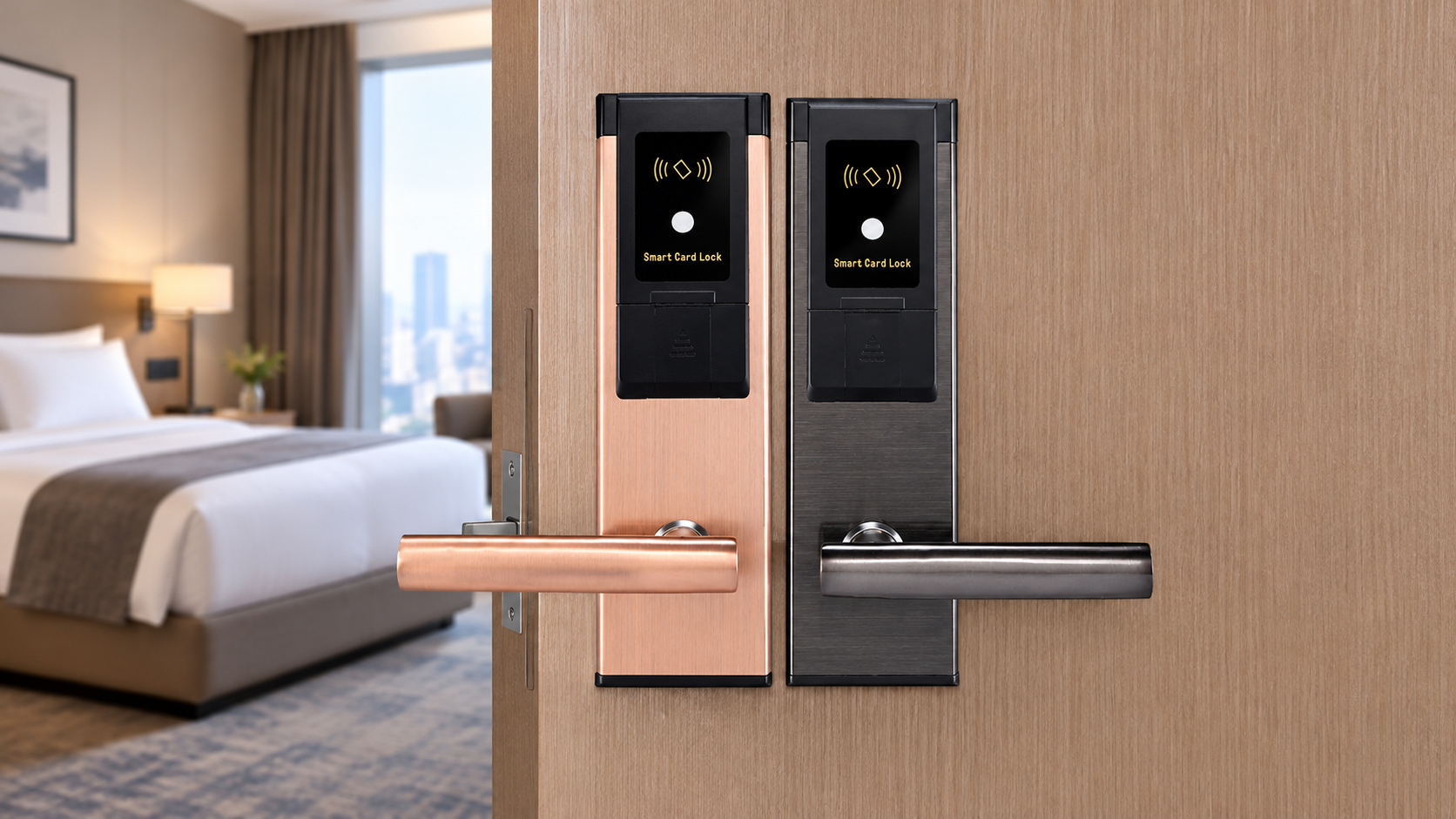
Architects and asset managers also want hardware that matches interior palettes. The lock is offered in silver, gold, black, and copper finishes, with custom logo branding available. Product imagery shows the card induction area above the handle and a mechanical keyhole covered on the panel, so the backup entry stays available without cluttering the design.
Evaluating Multi-Modal Access Credentials for Commercial Properties
Comparing Access Technologies Across Commercial Scenarios
No single credential fits every door in a commercial portfolio. A housekeeping supervisor, a weekend hotel guest, and a corporate IT director all interact with doors differently. A commercial digital door lock that combines several entry methods lets operators assign the right credential to each user group without swapping hardware. The table below separates the actual access credentials from Wi-Fi and cloud storage, since those two describe connectivity and data handling rather than a method a person uses to open the door.
| Access Method | Primary User Group | Management Overhead | Best Commercial Application |
|---|---|---|---|
| Smart Card | Hotel guests, students, shift workers | Low cost per card; encoded through the management software | Guest rooms, dormitories, general office suites |
| Fingerprint | Property staff, executives, long-term residents | No physical token to issue; one-time enrollment | Executive offices, supply rooms, apartments |
| PIN Code | Short-term tenants, visitors, contractors | Codes can be issued and changed without handing over hardware | Serviced apartments, meeting rooms, after-hours entry |
| Mechanical Key | Maintenance engineers, authorized emergency staff | Requires strict control of a small set of master keys | Backup entry when electronic access is unavailable |
Connectivity and data storage, by contrast, describe how the lock communicates rather than how a person unlocks it:
| Feature | What the Product Data Confirms | What Depends on the Software Platform |
|---|---|---|
| Wi-Fi Access | Listed as a supported connection type for this model | Whether a specific app or dashboard is included |
| Cloud Data Storage | Listed as the data storage method for this model | Remote permission changes, entry-record review, and multi-site control |
Smart Cards and Credential Issuance
Despite the rise of smartphones, smart cards remain the operational backbone of hospitality and campus housing. Asking a tired traveler at midnight to download an app, register an account, and enable Bluetooth creates a queue at the front desk. Handing over an encoded card is quick and works for guests of any age.
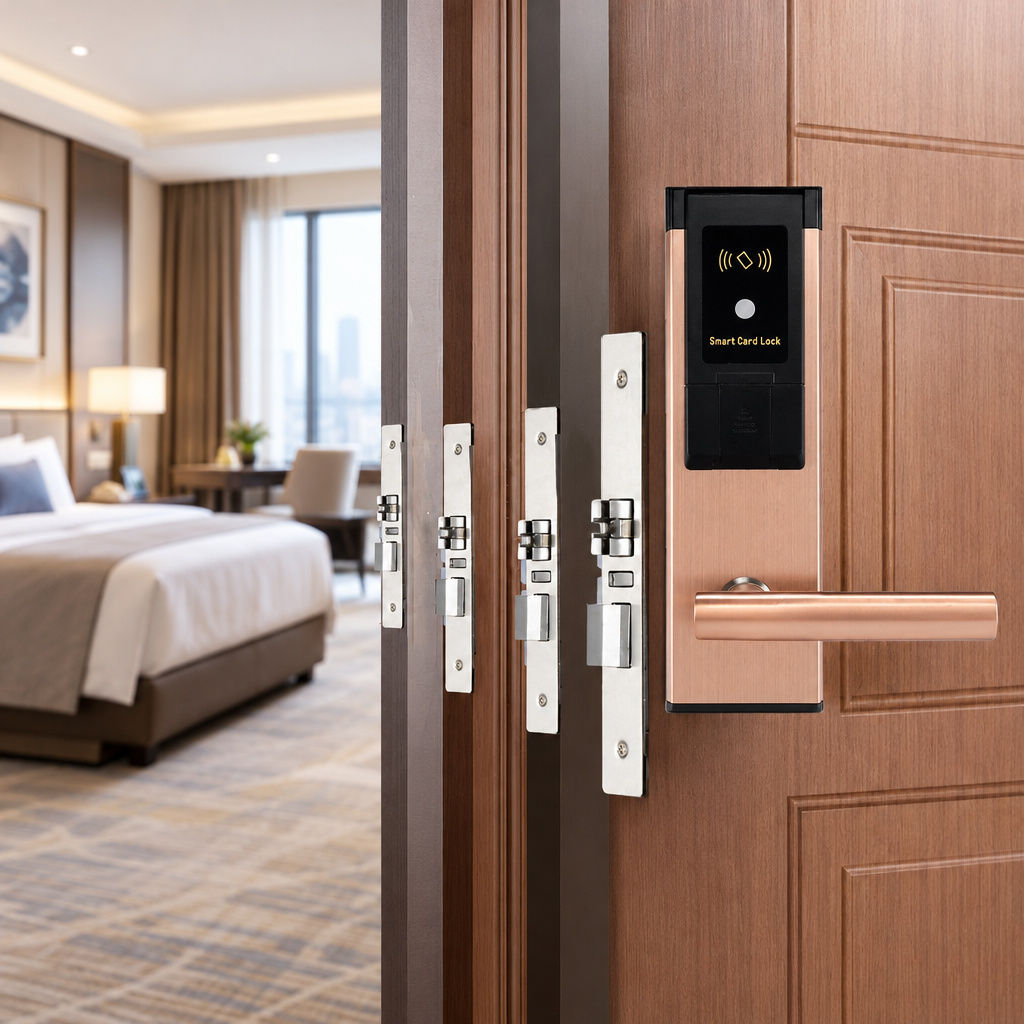
Cards also give the front desk simple control over lost credentials. In most card-based systems, encoding a replacement card can invalidate the old one, though the exact behavior depends on how the management software is configured. Test this behavior during commissioning. A commercial digital door lock with smart card access therefore suits properties with constant guest turnover.
Fingerprint Recognition and PIN Code Workflows
Smart cards work well for transient guests, but permanent staff and apartment tenants often prefer credential-free movement. Fingerprint recognition built into the lock removes the problem of employees lending keycards to colleagues, since each enrolled fingerprint belongs to one person rather than to a piece of plastic that can change hands. Fingerprint recognition can associate access with that enrolled user. Whether individual entries are recorded and attributed to that person's identity depends on the lock's logging and software features, so confirm this with the vendor if staff accountability is a priority. Staff enroll once, and the lock then recognizes them without a token.
Numeric PIN codes cover another gap: unattended check-ins at serviced apartments and co-working spaces. Managers can issue a code for a defined stay or project and change it afterward. That reduces the need for a receptionist during late arrivals, though the available scheduling features depend on the management software in use. The product data lists code entry as one of the supported access methods.
Cloud Wi-Fi Connectivity and Mechanical Key Redundancy
The product data lists Wi-Fi access and cloud data storage as specifications for this model. What those features can do in daily operation depends on the software platform behind them. Features such as a management dashboard, entry-record review, remote permission changes, or multi-site control are software-dependent, so confirm each one for the exact model and platform before you rely on it in a purchasing decision.
Seasoned engineers still plan for a physical escape route. When comparing any commercial digital door lock, verify its documented backup and emergency-access plan, since power, egress, and override designs differ between products. This model is listed with a mechanical key backup. If electronic access becomes unavailable, authorized maintenance staff can use that key instead of cutting into the hardware. Keep those keys under strict control, since they bypass every electronic credential.
Step-by-Step Selection Framework for Facility Managers
Auditing Door Profiles, Backsets, and Fire Safety Codes
Ordering hundreds of electronic locks before measuring the existing doors is one of the costliest mistakes in a renovation. A lock that does not fit the slab means returns, delays, and extra drilling. Before requesting a factory quote, run a structured physical audit that covers dimensions, existing cutouts, egress rules, and compliance:
- Measure Door Thickness and Stile Width: Confirm that the slab thickness suits the lock body and that the 60mm panel width clears any molding or glass frames.
- Verify Backset and Existing Cutouts: Check the distance from the door edge to the cylinder center, and confirm the 240mm panel covers any holes left by previous hardware.
- Confirm Free Egress Requirements: Fire and life-safety rules in many jurisdictions require people inside a room to exit easily without special knowledge. Ask your local authority or code consultant what applies to each door.
- Check Regional Compliance: The supplied product data lists CE and RoHS. Confirm that these cover your market and ask whether any additional local marks are needed.
Matching Lock Ecosystems to Hospitality, Multifamily, and Office Scenarios
Once the dimensions check out, align the lock's software ecosystem with the building's daily rhythm. Where the lock is paired with compatible front desk management software, electronic doorplates, and a guest room management system (GRMS), room status indicators and energy-saving settings can follow guest check-in and check-out. That kind of linkage is only as good as the integration behind it, so confirm compatibility for the specific model and software platform before ordering rather than assuming every lock in a product line supports the same ecosystem.
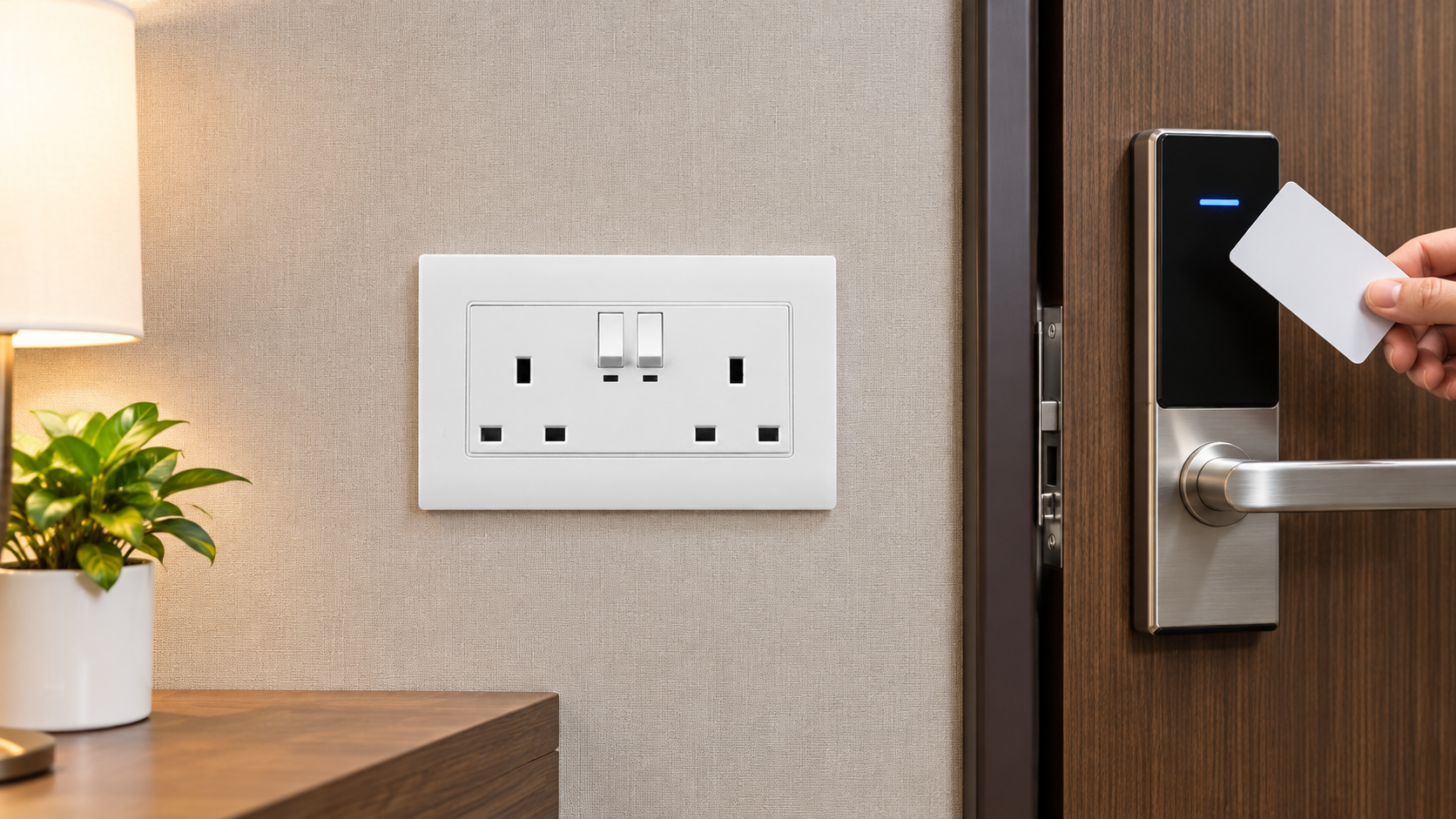
Apartment complexes and school facilities usually care more about long battery intervals and flexible user permissions than about daily card re-encoding. An office, in turn, might want different rules for business hours and evenings. If scheduled access is a requirement, confirm that the chosen software supports it before you place an order.
Calculating Total Cost of Ownership and Procurement Lead Times
Judging a commercial digital door lock by unit price alone ignores maintenance labor, warranty replacements, and shipping delays. The company states a general battery life of up to 18 months across its products, and the product data lists a warranty of 12 years at 100,000 cycles for this model. Confirm battery life and power arrangement for the exact model, since a general company figure does not guarantee the same result for every lock.
For large retrofits, working with an established manufacturer simplifies customization and delivery, because one supplier can coordinate door hardware, finishes, and lead times instead of a facility team juggling several vendors for a single renovation. For us at SUMMAO, that means 15 years of experience, a 10,000 m² automated facility, 36 inspection processes, a stated failure rate below 1%, and daily output above 500 units, with ISO9001 and ISO14001 certifications. We have supported over 5,000 hotels and apartments in more than 50 countries.
Lead times for regular orders are 7 to 10 days, while OEM/ODM orders with laser-engraved logos take 15 to 30 days. Support includes a 2-year product warranty, lifetime maintenance, and 24/7 technical assistance. Because the product data lists 12 years at 100,000 cycles under warranty, ask for written clarification of how that figure relates to the standard 2-year terms.
Best Practices for Retrofit Installation and Preventative Maintenance
Door Preparation, Installation Manuals, and Wiring Clearance
Even a precisely made stainless steel lock will wear early if it is installed crookedly on a warped frame. When the latch rubs against a misaligned strike plate, every cycle fights extra friction. Poor alignment can also cause symptoms that look like electronic faults, which sends technicians chasing the wrong problem.
Installers should follow the model's installation manual, use only the mounting components its manufacturer specifies, and confirm that the latch glides into the strike pocket without anyone lifting or pushing the door. Technicians should also route the wiring cleanly so that tightening the fixing screws never pinches the cable against a sharp edge. Test every door several times before handover, using each credential type that has been enabled.
Power Source Checks, Maintenance Routines, and Entry Record Reviews
If the chosen model uses batteries, set up a maintenance calendar after commissioning instead of waiting for low-battery alerts to sound in occupied hallways. Use the battery type specified in the lock manual, replace all cells in a set together, and never mix old and new batteries. Mixed or mismatched cells can shorten service life and, in some cases, leak inside the compartment.
When a lock signals low power through its indicator, replace the batteries during the next routine room service. Pair a twice-yearly physical check, such as wiping the card reader and tightening handle set screws, with a periodic review of entry records where the software supports them. Together these habits keep the whole access system in good condition and make faults easier to catch early.
Frequently Asked Questions About Commercial Digital Door Locks
How does a commercial digital door lock operate during a building power outage?
The answer depends on how the specific model is powered, and the supplied product data for this lock does not state its power source or outage behavior. Verify the power arrangement and outage behavior with the manufacturer before purchase. What the data does confirm is a mechanical key backup, which lets authorized staff open the door if electronic access is unavailable. It should not be read as proof that electronic functions keep running during an outage.
What is the difference between a cylindrical digital lock and a commercial mortise smart lock?
The main difference is installation format. A cylindrical lock is typically installed through cross-bored holes in the door face and a bore in the door edge, while a mortise lock sits a steel case inside a pocket cut into the door edge. Neither format guarantees a security level or a set of functions. Strength, deadbolt options, and extra features depend on the specific lock's test ratings and configuration, so check them against the datasheet. The supplied data does not identify this particular model as mortise.
Can one management platform control smart locks across multiple floors or properties?
Possibly, but it depends on the software. The product data for this model lists Wi-Fi access and cloud data storage, and it does not describe a central dashboard or multi-property control. Remote permission changes, entry-record review, and multi-site management are software-dependent capabilities, so confirm them for the chosen model and platform. In hotels, front desk software may also support room status monitoring and dynamic key card authorization, again depending on configuration.
How do coastal or high-humidity environments affect electronic door lock longevity?
Salt air and high humidity can corrode plated metals and cause short circuits in unprotected electronics. The product data describes 304 stainless steel construction and a smart chip system that is waterproof, moisture-proof, and anti-static, which points to some resistance to these conditions. However, stainless steel is not immune to corrosion in marine environments, so for direct coastal exposure ask the manufacturer for supporting test information and care recommendations.
Conclusion: Building a Resilient Access Control Infrastructure
Upgrading a facility's entry points is an investment in operational continuity, tenant safety, and staff time. Replacing aging brass cylinders or fragile consumer deadbolts with a purpose-built commercial digital door lock can reduce routine rekeying costs and give managers a clearer view of activity at every door, although mechanical backup cylinders may still need occasional rekeying or replacement. Whether you deploy a commercial digital door lock with smart card access for a high-turnover hotel or a stainless steel, cloud-connected model for an office complex, start with documented cycle and compliance evidence, protected circuitry, and a careful door audit. Those three checks keep your doors secure and easy to manage for years.
SUBSCRIBE
INQUIRY