
Hotel Door Lock System: The Architectural and Operational Guide to Modern Hospitality Access Control
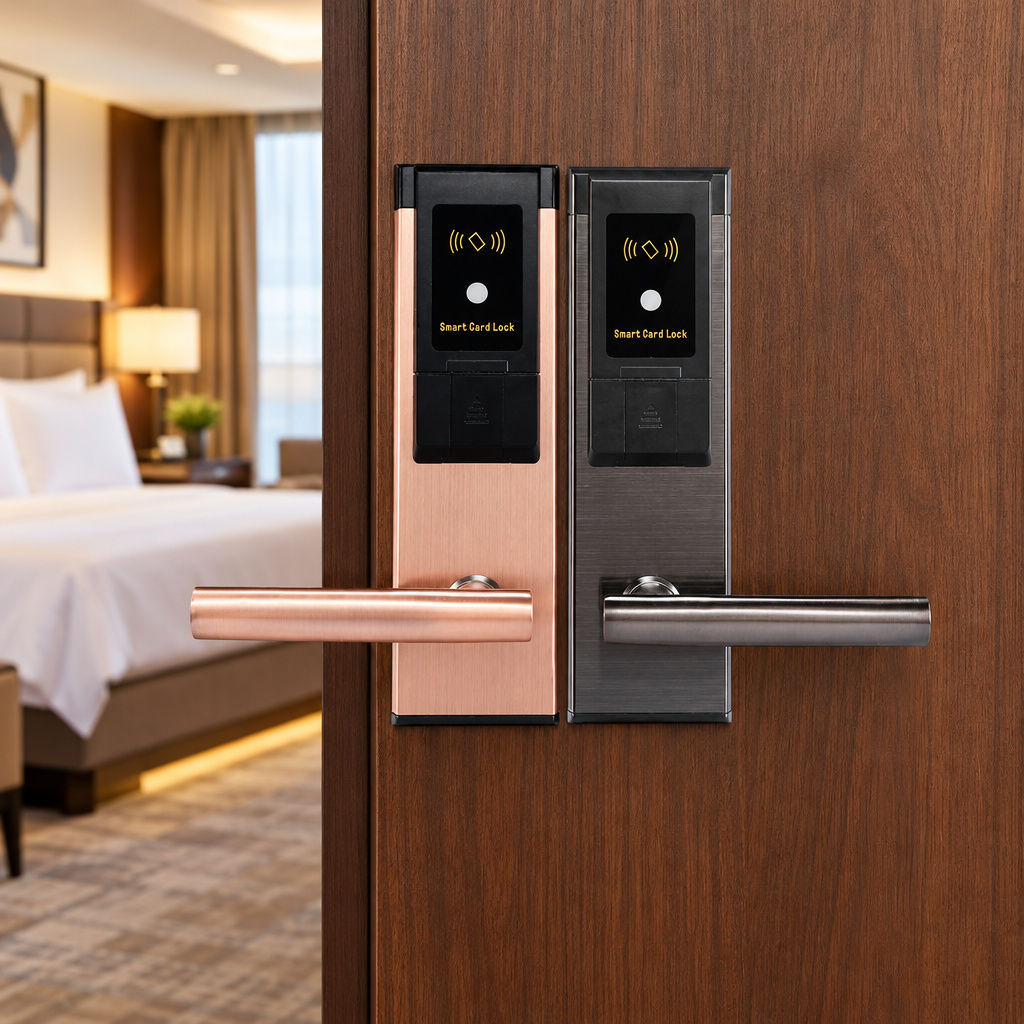
A modern hotel door lock system does far more than keep an unauthorized visitor out of a bedroom. It operates as the physical boundary of hospitality asset management, revenue control, and guest trust. Property developers and hoteliers evaluating an electronic hotel door lock system often discover that poor hardware selection transforms a quiet corridor into an operational bottleneck of dead batteries and unreadable keycards. Access hardware must handle heavy luggage strikes, abrupt latch releases, and relentless operational cycling without mechanical hesitation.
Guest room entry hardware undergoes repeated actuation under changing environmental conditions. If an access platform suffers from high failure rates, staff end up running replacement keys across multiple floors while guests wait in corridors. Reliable hospitality locking hardware functions as a silent workhorse, blending intuitive human interactions with disciplined backend permissions. Understanding how physical lock architecture connects to front desk operations allows operators to protect their physical assets, streamline staff movements, and minimize lifecycle maintenance overhead.
Understanding What a Hotel Door Lock System Includes
Defining the Modern Access Control Ecosystem
A commercial hospitality locking setup extends well beyond the physical escutcheon plate visible on the corridor door. It represents a synchronized ecosystem that balances credential security with immediate physical egress. While residential smart deadbolts prioritize personal remote connectivity, commercial lodging locks enforce role-based access rules across transient guests, contracted maintenance crews, and floor-specific housekeeping teams.
This division requires hardware built specifically for high turnover environments where authorization windows change multiple times a day. Commercial locking systems tie authorization rules to defined time windows, so an expired booking cuts off physical entry automatically. Hardware longevity and dependable mechanical clutches take precedence over delicate consumer electronics that would struggle under institutional operational demands.
Core Hardware and Infrastructure Components
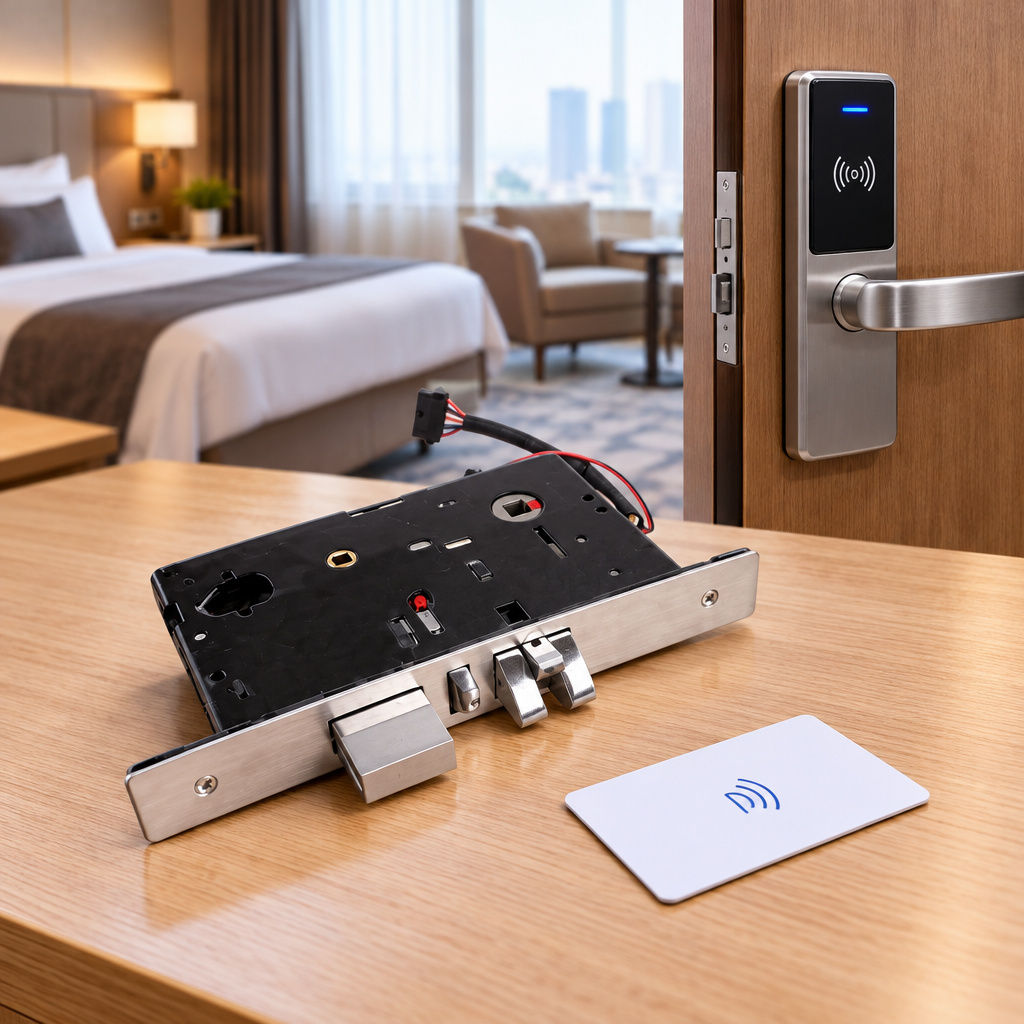
At the door boundary, the system centers on an integrated electronic lock body comprising an internal mortise mechanism, an electronic reader escutcheon, and an internal battery compartment. These field devices work alongside desktop card encoders, handheld programming units, and credential management software located at the reception desk.
The ecosystem also incorporates physical and digital credentials, including smart cards, mobile tokens, and mechanical override keys. Depending on the credential technology, front desk terminals may encode permissions onto cards, while mobile credentials may be issued through an app or digital wallet. Buyers should confirm the authentication and encryption method used by the selected system.
Standalone Offline vs. Networked Online Architecture
Historically, the industry relied heavily on standalone offline door locks running on data-on-card architecture. In these configurations, permissions travel on the credential carried by guests and cleaning staff, which removes the need to wire corridors or deploy dense networks of access points.
Online architectures, operating over low-power wireless meshes or proprietary protocols, can transmit access events and authorization updates between doors and reception in near real time. Properties must balance the lower capital expenditure and electrical simplicity of offline installations against the remote room reassignment and remote credential revocation that networked platforms may support.
Operational Workflow: How Hotel Electronic Locks Process Access
Credential Authentication and Encryption Mechanics
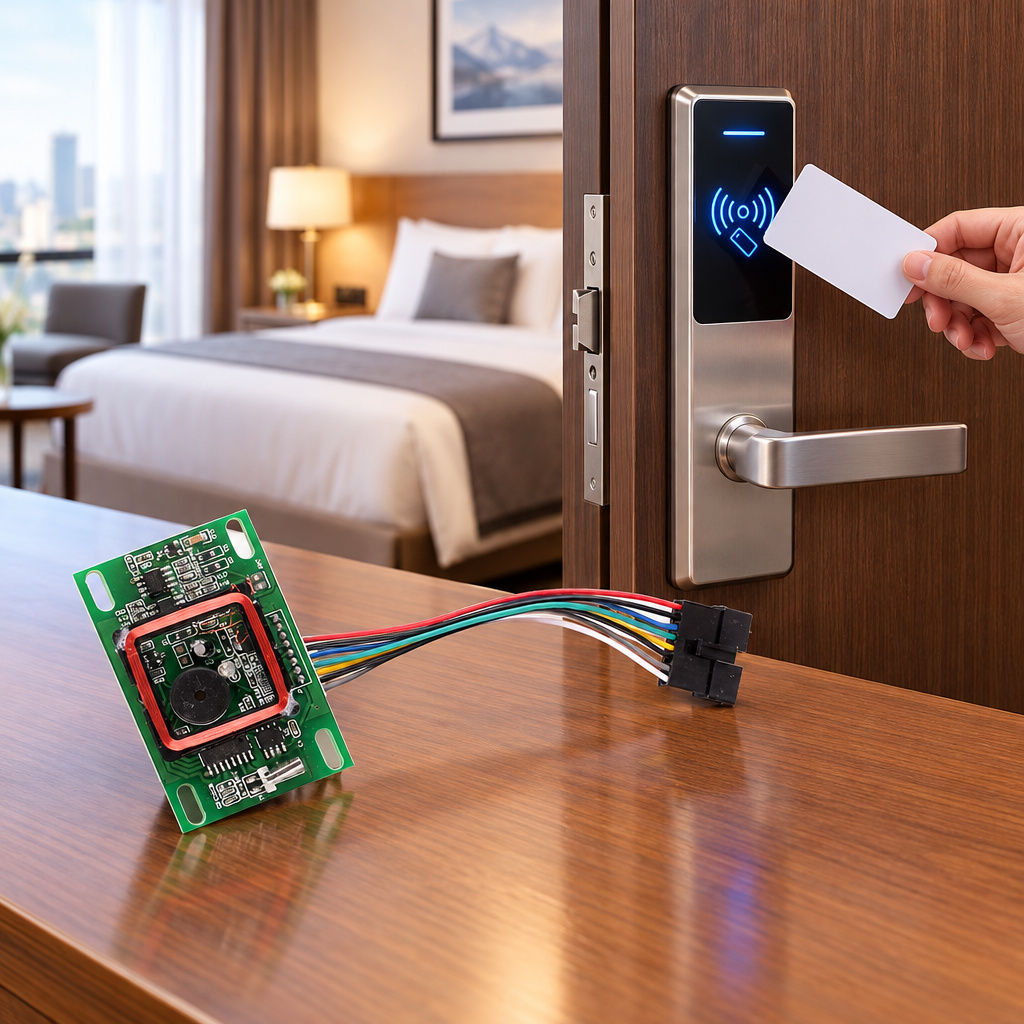
Access validation begins when a credential enters the field of the door reader. A passive smart card draws power from the reader's field, while a phone exchanges data over a radio link. Depending on the system, the reader then checks the hotel's system code, the room permission, and the validity period before releasing the lock.
Once the controller accepts the credential, a low-draw motor or solenoid typically couples the exterior lever to the latch mechanism. If authentication fails, the handle stays uncoupled in designs that use a clutch, so turning it does not retract the latch.
As a general example, a sequence might run like this: the guest presents an RFID card or phone, the reader verifies the credential data, the controller compares the current time with the check-out boundary, an actuator engages the clutch for a few seconds, and the lever then retracts the latch. Credential types, authentication steps, timing, and actuator designs vary between manufacturers and models, so buyers should confirm the exact process in the model documentation.
Time-Window Validity and Dynamic Authorization
Transient occupancy demands strict adherence to check-in and check-out times, which in offline systems are usually written into the credential itself. A guest card programmed for a two-night stay can expire at a set hour on departure day, letting the lock's internal clock decline entry without front desk intervention.
Revoking a misplaced keycard works differently depending on system architecture. Some offline systems cancel older cards once a newer card for the same room is presented at the door. Others rely on staff cards, update stations, or programming devices to carry block lists to the lock. Networked systems may support remote revocation. Operators should confirm with the supplier how and when a lost credential stops working.
Audit Trails and System Event Logging
Security disputes and internal investigations depend on access records. Many electronic locks store recent access events in internal memory, and networked or cloud-connected models may also send them to a central database. The fields recorded, the log capacity, and the retrieval method differ by model, so check the specification sheet before relying on a particular record.
Where supported, audit logs can capture events such as failed card presentations, privacy deadbolt use, and mechanical key openings. Extracting this data with handheld programming tools or a central platform gives security teams documented evidence during property loss investigations.
Comparing Hospitality Access Technologies
High-Frequency RFID and Smart Cards
Many hotel lock systems use 13.56 MHz RFID smart cards. These cards offer predictable component costs, tolerance for everyday handling, and short-range contactless reading, which makes them easy for guests of all ages to use.
Properties choose between basic low-cost cards and encrypted multi-application cards that can also serve on-site payment points or parking barriers. Cards with stronger cryptographic authentication reduce exposure to the cloning tools that compromised older magnetic stripe and weakly protected card systems.
Bluetooth Low Energy and Mobile Digital Keys
Mobile key systems use Bluetooth Low Energy transmissions between a guest's phone and the lock, allowing travelers to skip the registration desk. The room authorization token usually arrives through a hotel application or a digital wallet pass.
While mobile keys suit business travelers, they create practical edge cases when phones run out of battery or an operating system update changes app permissions. Many operators therefore run hybrid platforms where mobile unlocking coexists with physical smart cards issued on request.
PIN Keypads, Biometrics, and Mechanical Overrides
Specialized hospitality segments, such as unstaffed boutique rentals and extended-stay apartments, often deploy touch keypads to share temporary numeric PINs without a staffed check-in desk. Fingerprint readers find their main use on staff service doors, back-of-house storage, and administrative offices, where the same people enter every day.
Many electronic locks also include a mechanical key cylinder as a fallback. Buyers should confirm the cylinder design, the authorized keying arrangement, the emergency procedure, and how the lock behaves when batteries or electronics fail, since these details differ between models.
Access Technology Comparison Matrix
| Credential Technology | Security Considerations | Issuance Overhead | Hardware Deployment Cost | Common Operational Failure Points |
|---|---|---|---|---|
| RFID Smart Card | Depends on card technology, encryption, and key management | Low (Quick Front Desk Encoding) | Moderate | Card loss, bent cards, antenna damage |
| Bluetooth Low Energy (BLE) | Depends on mobile authentication and device controls | Low to Zero (Over-the-Air Delivery) | Higher (Requires BLE Readers) | Flat phone batteries, operating system updates, background app restrictions |
| Dynamic Numeric PIN | PIN sharing and code management risks | Zero (Automated SMS / Email Delivery) | Moderate | Guest code sharing, touch panel wear, user entry errors |
| Fingerprint Biometrics | Depends on sensor quality, enrollment controls, and template handling | High (Requires In-Person Enrollment) | Higher (Sensor Units) | Surface contamination, moisture, recognition variance |
| Physical Key | Depends on cylinder grade and key duplication control | High (Manual Duplication Control) | Low (Baseline Hardware) | Key duplication, lost master keys requiring re-keying |
Selecting Resilient Door Lock Hardware
Mortise Standards and Door Compatibility
The internal mortise mechanism forms the mechanical core of the door's locking hardware, and its quality affects how the lock holds up under heavy use. Projects that follow North American standards often reference ANSI/BHMA A156.13, which assigns separate operational and security grades to mortise locks. European projects typically reference their own standards, such as EN 12209 for mechanical locks. Ask the supplier which grades the exact lock model was tested to, and request the test documentation.
A grade alone does not guarantee forced-entry resistance, because the door leaf, frame, strike, and installation quality also determine how a door performs under attack. Before ordering production lock sets, facility directors must measure door thickness, backset depth, and stile clearances across every floor. Solid-core timber doors, hollow metal leaves, and mineral-core fire assemblies each have different internal profiles that dictate mounting hardware and cable routing.
Metallurgy, Structural Durability, and Finish Resilience
Door hardware in coastal resorts or dense urban properties faces constant environmental wear and harsh cleaning agents. Lower-grade castings and poorly sprung levers can show surface pitting, weakened return springs, or lever sag over years of heavy use.
Material choice affects how well hardware holds up, though no single material guarantees mechanical integrity. Stainless steel is widely chosen for corrosion resistance. Decorative finishes such as silver, gold, black, and copper depend on the coating process and should be checked for resistance to luggage impacts, hand contact, and routine chemical cleaning.
Power Delivery and Battery Maintenance Planning
Most battery-powered hotel locks run on internal alkaline cells, so room security stays functional during building power outages. Circuit design aims to keep standby consumption low while supplying enough current for motor actuation.
Battery life varies with traffic, temperature, and wireless activity. Our supplier data lists battery life of up to 18 months, which should be read as a maximum under favorable use rather than a guaranteed interval. Many locks give audible or visual low-battery warnings, which helps housekeeping teams replace batteries before a lock fails.
Low-battery warning behavior and emergency power options differ between models. Some locks offer an external emergency power contact, while others rely only on the mechanical key override. Confirm the warning thresholds, warning signals, and emergency access method in the manual for the specific model before writing maintenance procedures.
A simple routine prevents most battery lockouts. Replace all cells in a lock at the same time, use the battery type the manual specifies, and record the replacement date against the room number. Where the management software reports battery status, review it regularly so housekeeping can plan replacements floor by floor instead of reacting to individual warnings.
Egress Codes and Fire-Door Compliance
Safety compliance overrides all convenience features within hospitality architecture. The applicable building and life-safety codes determine the required egress operation. Depending on the occupancy and door assembly, the inside hardware may need to release the locking and latching functions with the permitted number of motions. Verify the exact requirement with the authority having jurisdiction and the door manufacturer.
Locks installed on fire-rated doors need fire test reports, listings, or certifications that apply to the specific door assembly and the project's jurisdiction. CE marking and RoHS compliance do not prove fire performance or mechanical endurance. CE marking indicates conformity with applicable EU requirements, and RoHS restricts hazardous substances in electrical and electronic equipment. Ask suppliers for the fire-rating documents separately.
Practical System Implementation: Multi-Modal Commercial Smart Locks
Hardware Specifications and Design Profile
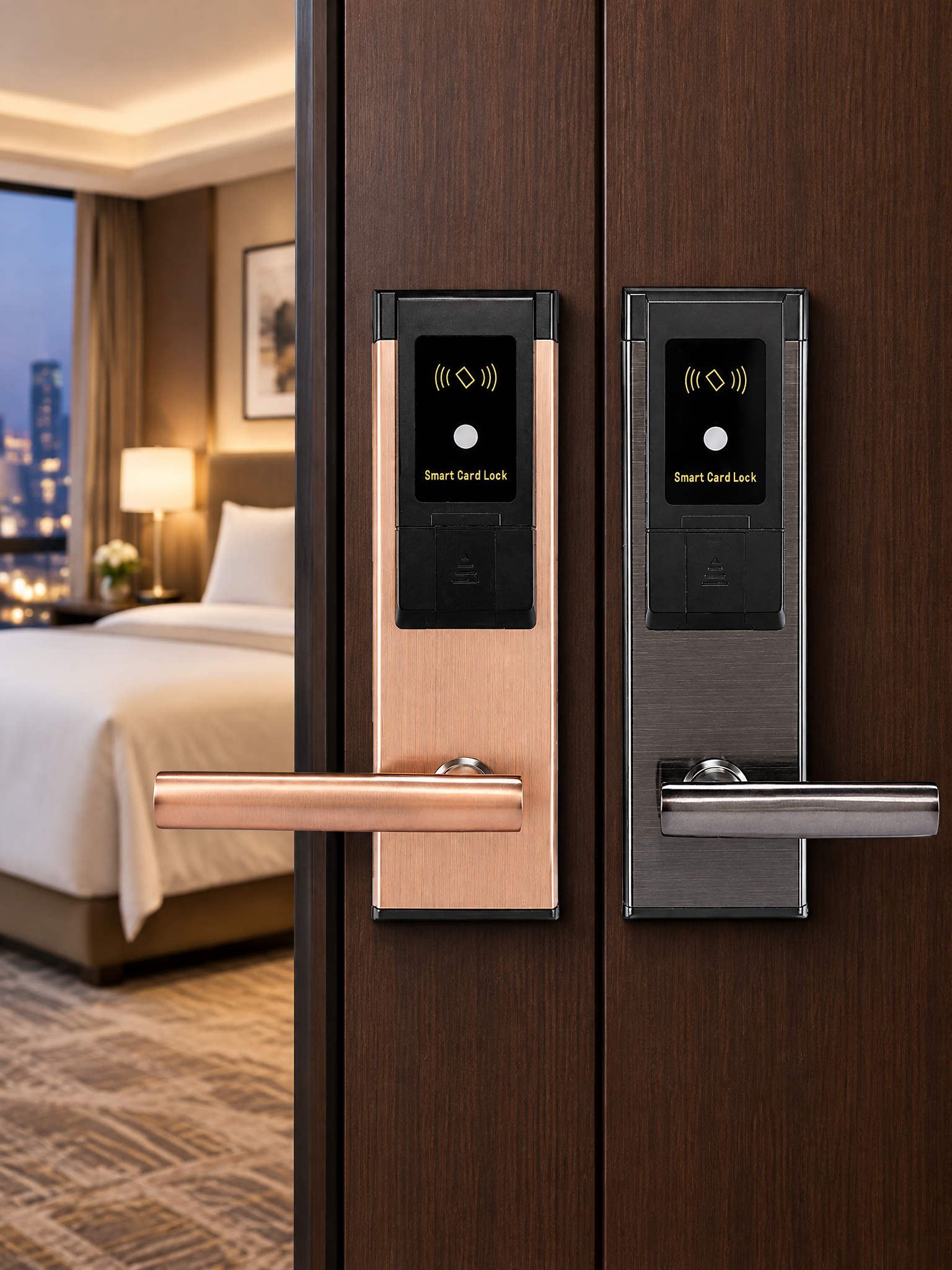
For facilities requiring multi-credential flexibility across diverse spaces, multi-modal smart locks combine hospitality card access with digital entry methods. Our production line at SUMMAO manufactures hardware for hotels, apartments, offices, and school facilities.
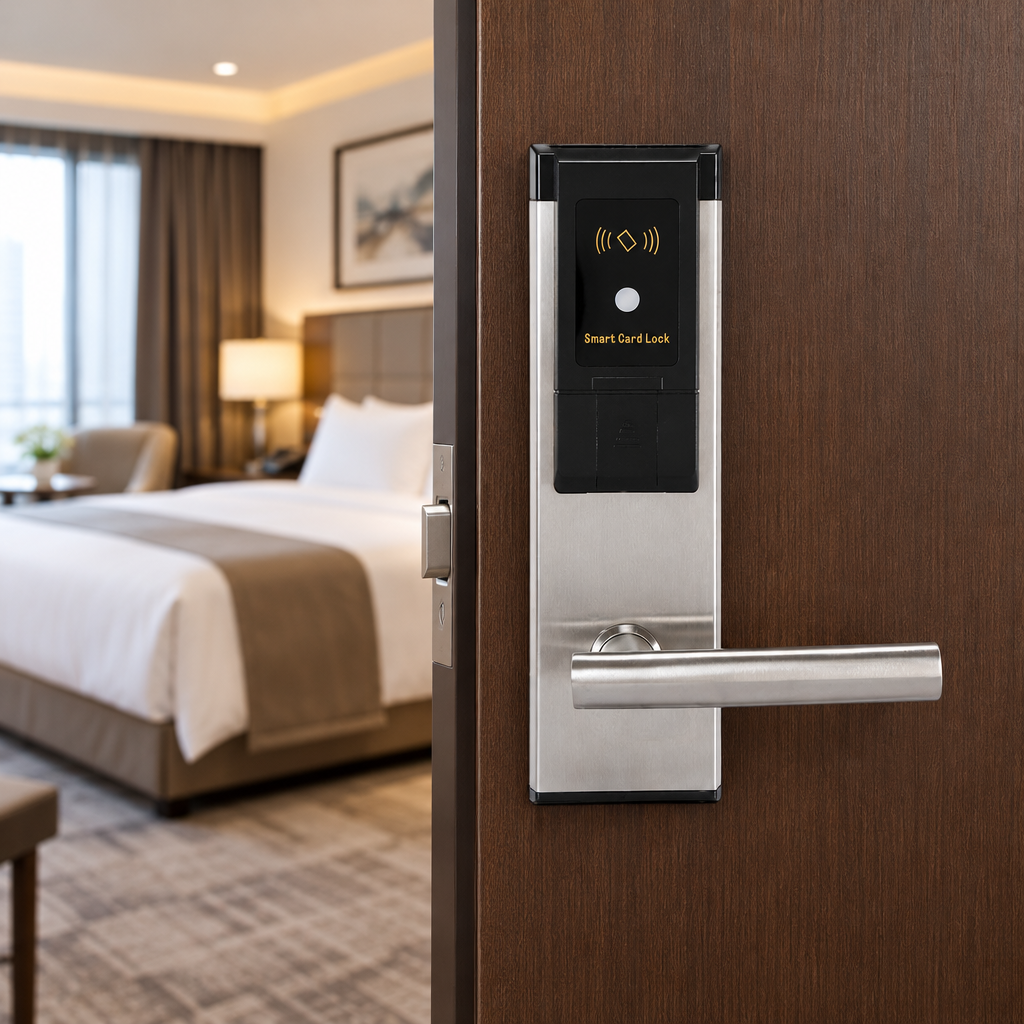
The specifications below come from our product data for the hotel door lock electronic smart door lock with smart card:
| Specification Parameter | Supplier-Listed Details |
|---|---|
| Product Name | Hotel Door Lock Electronic Smart Door Lock with Smart Card |
| External Panel Size | 240 mm (Length) × 60 mm (Width) |
| Material | Stainless Steel |
| Access Methods | Smart Card, Wi-Fi, Fingerprint, Code, Mechanical Key |
| Lock Tongue and Latch | 304 Stainless Steel Self-Elastic Lock Tongue and Anti-Theft Buckle |
| Data Storage | Cloud |
| Smart Chip System | Cloud-Connected; Described by Supplier as Waterproof, Moisture-Proof, and Anti-Static |
| Supplier-Listed Durability/Warranty Claim | 100,000 Cycles or 12 Years, Subject to Written Terms |
| Supplier-Listed Markings | CE and RoHS |
| Colors | Silver, Gold, Black, Copper |
| Application Scenarios | Hotel Rooms, Apartment Complexes, Office Entry Doors, School Facilities |
The durability and warranty line above comes from the product listing, while our company-level terms state a 2-year product warranty. Buyers should reconcile the two figures and obtain the written warranty document that applies to their order before treating either number as a commitment.
Mechanical Security and Latch Engineering
The mechanical parts behind the panel decide how a lock behaves under daily abuse. For this model, the supplier lists a 304 stainless steel self-elastic lock tongue, an anti-theft buckle, and a mechanical key backup, and the lock body diagram labels a cast steel clutch. These details describe this product only and should not be read as typical of all commercial locks.
In clutch-based designs, the exterior handle is not coupled to the latch until a valid credential is accepted. Turning the handle without authorization therefore does not retract the latch. Buyers should confirm the exact clutch behavior for this model with the supplier, and judge forced-entry resistance from door construction, lock body grade, and installation quality together.
Multi-Property Versatility: Hotels, Serviced Apartments, and Commercial Offices
Modern properties rarely fit into rigid categories. Many buildings combine hotel suites, leased serviced apartments, and shared office space within one structure. Panel size alone does not confirm that a lock fits a given door. Before ordering, check door thickness, lock body cutouts, door construction, and any fire-door assembly requirements, and confirm compatibility for this model with the supplier.
Across mixed-use properties, credential choice can follow the type of stay. Long-term apartment tenants may prefer fingerprint or PIN code entry, while short-term hotel guests usually receive smart cards. Where the management software supports it, facilities teams can manage these credentials from one interface.
Integrating Access Control into Daily Hotel Operations
Front-Desk Issuing Workflows and Key Encoding
Front desk operations need fast, error-free credential issuance during busy check-in windows. Desktop smart card encoders, usually connected by USB, write guest keys, extra cards for travel companions, and replacement cards. Encoding speed depends on the encoder and software, so test it during a pilot rather than relying on brochure figures.
Beyond guest check-in, reception software manages tiered staff credentials. Housekeeping cards can be limited to specific floors or room blocks and shift hours, maintenance cards can carry time-limited access, and master cards open all rooms across the property.
Property Management System (PMS) Interoperability
Deploying an electronic hotel door lock system without property management system integration creates extra manual data entry and more room for errors. Integration depends on which interfaces both the lock software and the PMS support, such as FIAS or a vendor API. Confirm the supported interface and any certification with both vendors before purchase.
When integration is in place, the PMS can send room assignments and stay dates to the lock software at check-in. At checkout, it can update the lock database so that credentials expire or are cancelled, depending on system architecture, and flag the room for housekeeping.
A typical integrated workflow starts when the guest's reservation is checked in on the PMS. The interface passes the room number, dates, and number of keys to the lock software, which prepares the credential data. The front desk encoder then writes the card, and in properties with a guest room management system, entering the room can trigger a welcome scene.
Energy Conservation through Guest Room Management Systems (GRMS)
Door locks can also act as the first trigger for in-room energy automation. Linking access hardware to keycard energy-saving switches or a room control system lets the property manage in-room energy use.
When a guest enters and inserts the keycard, the room controller can switch on lighting, set the HVAC to an occupied temperature, and open motorized curtains. When the guest leaves and removes the keycard, the controller can move the HVAC to a setback mode, reducing energy spent on empty rooms.
Procurement and Lifecycle Risk Checklist
Credential Security and Data Privacy Audit
Procurement managers should review the card technology and encryption of any lock system to avoid vulnerable legacy platforms. Some older card types and weak proprietary schemes can be read and copied with inexpensive handheld tools, exposing guest rooms to unauthorized entry.
IT directors should verify that cards use current cryptographic authentication and that wireless and cloud management channels use encrypted connections such as TLS. Access logs also contain personal data, so the lock database should follow applicable privacy rules and restrict who can view guest and staff entry records.
Environmental Testing and Hardware Reliability
Durability testing shows whether a lock can withstand real-world use. Ask suppliers for mechanical cycle test data and the test conditions behind it, and compare the stated cycle count with expected traffic on each door.
Field units also need protection against environmental hazards. Ask how circuit boards are protected against humidity in coastal climates and against electrostatic discharge, and request the supporting test or rating documents for the specific model.
Total Cost of Ownership (TCO) Calculation
Calculating the total cost of ownership for a locking system means looking past the per-unit hardware price. A realistic budget usually groups costs into a few categories:
- Upfront hardware: lock sets, card encoders, programming devices, and any network gateways that online models require.
- Installation: door preparation, frame or strike modifications, and extra labor on retrofits where existing cutouts do not match the new lock body.
- Running costs: periodic battery replacement at an interval that depends on actual usage, lost guest cards, software licensing, and technical support contracts.
- Downtime: staff hours spent on lockouts and the guest disruption a failed lock causes, which rarely appears on a quote but shows up in operating results.
Choosing a supplier that keeps replacement parts available helps avoid replacing whole floors of hardware when single units fail.
Structured Selection and Deployment Process
- Conduct a comprehensive door-by-door hardware audit: measure door stile widths, core compositions, swing directions, and existing mortise preps across all corridors, staff portals, and fire exits.
- Establish operational workflows for guests and internal staff: decide whether the property will deploy traditional RFID cards, mobile BLE check-in, keypads, or a hybrid multi-modal entry setup.
- Validate brand standards, fire codes, and accessible egress requirements: confirm with the authority having jurisdiction that all lock assemblies meet local fire-door requirements, the required egress operation, and accessible operation rules.
- Execute a pilot room testing phase across diverse scenarios: install trial lock units across multiple high-traffic guest rooms to test PMS synchronization, latch behavior, and card encoding reliability.
- Finalize commissioning, staff training, and preventive maintenance schedules: run hands-on training for front desk, housekeeping, and maintenance teams, and set up routine battery inspection logs across all locks.
During the pilot, record every failed read, lockout, and encoding error together with the room, the credential type, and the time. A few weeks of this log helps show whether problems come from the hardware, the installation, or staff procedures, and it gives the supplier concrete data to work from before a full rollout.
Critical Mistakes to Avoid in Hospitality Access Control
Prioritizing exterior finish over mortise quality often leads to lever sag, latch jams, and lockouts. Attractive decorative hardware with weak internal parts can undermine daily reliability.
Relying exclusively on mobile keys without a physical card backup frustrates guests with dead phone batteries or older devices, and it pushes those guests back to the reception desk.
Overlooking door thickness, backset dimensions, and hollow core reinforcement causes poor latch alignment, loose through-bolts, and weak resistance to forced entry. Ordering hardware without verifying door dimensions invites installation failures.
Neglecting battery management turns quiet hotel corridors into problem areas when dead locks block guest access. Logging low-battery warnings and replacing batteries on schedule prevents these predictable service failures.
Frequently Asked Questions (FAQs)
What is the difference between an online and an offline hotel door lock system?
An offline system stores permissions and validity periods on the credential, so doors need no network cabling. An online system connects doors to a central server through wireless technologies such as ZigBee, Bluetooth mesh, or Wi-Fi. Depending on the platform, this connection can let operators view access events, cancel lost keycards, and grant room access remotely.
Can a hotel smart lock continue to operate during a power or network outage?
Battery-powered hotel locks do not depend on building mains power, because their batteries sit inside the lock. Offline locks keep working as normal during a network outage. For networked models, confirm with the supplier which functions continue offline, since local card validation usually continues while remote features pause until the connection returns.
How does a front desk void a lost key card without physically visiting the door?
The method depends on system architecture. In some offline systems, a newer card for the same room cancels older cards when it is first used at the door. Other offline systems carry cancellation lists to the lock through staff cards or update devices. Networked systems may allow remote cancellation, so check how quickly a lost card stops working on the system you choose.
How long do electronic hotel door lock batteries typically last?
Battery life depends on corridor traffic, temperature, and wireless activity. Our supplier data lists up to 18 months, and actual life can be shorter in busy rooms or with frequent wireless use. Many locks warn staff when batteries run low, but the warning method and lead time vary by model.
Are multi-modal locks with PINs and fingerprints practical for standard guest rooms?
Multi-modal locks suit serviced apartments, extended-stay properties, and vacation rentals, where guests value keyless entry through PIN codes or fingerprints. Traditional full-service hotels still lean toward smart cards and mobile keys for short stays, while multi-modal hardware gives flexibility in mixed-use buildings, corporate suites, and staff-only areas.
What mechanical override mechanisms should hotel locks feature for emergency access?
Most electronic hotel door locks include a mechanical key cylinder as a backup, and the product described above lists a mechanical key backup. Because designs differ, buyers should confirm where the cylinder sits, how authorized keys are arranged and controlled, what the emergency procedure is, and whether the key can retract the latch when the batteries or electronics fail.
How do hotel door lock systems interface with Property Management Systems (PMS)?
Lock software connects to a PMS through whatever interface both vendors support, such as FIAS or a vendor API. When integration works, check-in on the PMS sends the room number and stay dates to the lock software for card encoding. This reduces manual data entry and the errors that come with it, but compatibility must be confirmed for each pairing of systems.
Conclusion
A well-chosen hotel door lock system works as an operational platform rather than isolated door hardware. Matching mechanical quality, credential security, and front desk workflows to the property keeps room access reliable and protects the building investment. Verifying door compatibility, lock grades, fire-door documentation, egress requirements, battery behavior, warranty terms, and PMS integration before purchase lets operators choose an electronic hotel door lock system that lowers maintenance work and gives guests the safety they expect.
SUBSCRIBE
INQUIRY