
How Does a Smart Door Lock Work: A Practical Guide to Access Technology
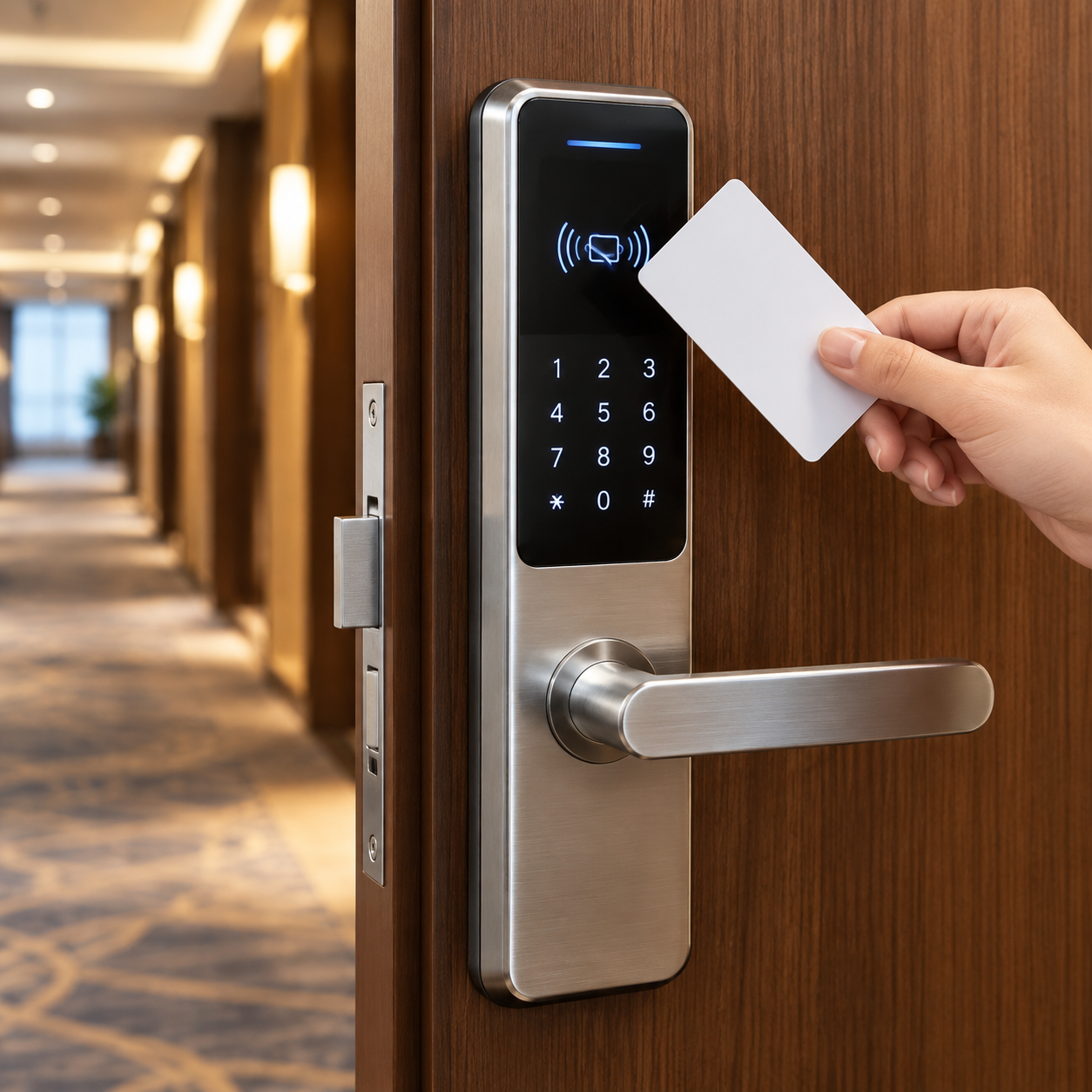
Anyone who has stood outside a hotel room juggling a plastic key card and a suitcase has probably wondered how does a smart door lock work, and why it sometimes fails at the worst moment. The answer sits at the intersection of mechanical engineering, radio communication, and software logic. Understanding that intersection matters more now, because access control has quietly become one of the most consequential decisions a property manager makes.
What Actually Happens Inside a Smart Lock
A smart lock is not one invention. It is three older technologies stitched together: an electromechanical actuator, a credential reader, and a small onboard processor. The processor checks a credential against stored permissions, then sends a signal to a motor or solenoid that retracts the bolt. That's the entire loop, repeated thousands of times a day in a busy hotel.
The credential itself can take many forms. RFID cards remain the workhorse of the hospitality industry because they are cheap to issue and easy to deactivate. Bluetooth unlocking uses a paired phone as the credential, exchanging encrypted signals with the lock's receiver. Fingerprint and facial recognition modules capture biometric data locally, convert it into a mathematical template, and compare that template to a stored reference. None of these methods store a photo or raw fingerprint image on the device, which is a common misconception worth correcting early.
Power management is the unglamorous part nobody asks about until it fails. Most commercial smart locks run on AA or lithium battery packs rather than building wiring, since retrofitting electrical lines through a door frame is expensive and often impractical in older properties. Battery life varies widely depending on usage frequency and the number of active sensors, and this is where the gap between consumer-grade and commercial-grade hardware becomes obvious.
A Short History of Electronic Access
Mechanical pin-tumbler locks dominated for over a century before magnetic stripe cards arrived in hotels during the 1970s. Those stripe cards were a genuine leap forward, letting front desks reissue access without rekeying a door, but they degraded quickly and were trivial to clone with basic equipment.
RFID technology replaced magnetic stripes through the 1990s and 2000s, offering better durability and contactless operation. The real inflection point came with the smartphone. Once phones carried Bluetooth Low Energy radios standard, locks could communicate directly with a guest's device, eliminating the physical card entirely for properties willing to invest in app infrastructure.
Biometric integration is the current chapter, though it did not arrive because fingerprint sensors became fashionable. It arrived because hotels needed a credential that could not be lost, shared, or duplicated at the front desk. Each generation solved a specific operational headache rather than chasing novelty for its own sake.
Classifying Smart Locks by Credential Type
Not all smart locks serve the same purpose, and choosing the wrong category creates friction for staff and guests alike. Broadly, the market divides into these groups:
- Card-based systems: RFID or NFC cards, the most common choice for large hotel chains due to low per-unit cost and familiarity among guests.
- Mobile-credential systems: Bluetooth or app-based unlocking, popular in boutique properties and serviced apartments targeting tech-comfortable travelers.
- Biometric systems: Fingerprint or facial recognition, often deployed in staff-only areas or premium suites where convenience outweighs the higher unit cost.
- PIN-code systems: Numeric keypads, frequently used as a backup method or in vacation rentals with unattended check-in.
- Multi-modal locks: Devices supporting several credential types simultaneously, giving properties flexibility as guest preferences shift.
Multi-modal locks have become the practical default for mid-size and large hotels, since they let a property phase in newer credential types without replacing hardware fleet-wide.
Why This Matters for Property Decisions
A general manager evaluating access control isn't really asking how does a smart door lock work at a component level. They are asking whether the system will reduce front desk workload, survive humid coastal weather, and integrate with whatever property management software they already run. Those are three separate engineering questions disguised as one purchasing decision.
Reliability under environmental stress is where many budget locks quietly fail. A lock rated for indoor residential use behaves very differently on a beachfront corridor exposed to salt air. Waterproofing ratings, typically expressed as an IP code, indicate how well a device resists dust and moisture ingress, and this rating should be non-negotiable for any exterior-facing installation.

Integration is the second pressure point. A lock that cannot talk to a front desk system forces staff to manage two disconnected records of who has access to which room, which is exactly the kind of manual reconciliation smart locks were supposed to eliminate. This is why serious deployments pair locks with centralized management software rather than treating hardware as a standalone purchase.
Comparing Core Technical Specifications
| Feature | Typical Range | Why It Matters |
|---|---|---|
| Battery life | 6–18 months | Fewer maintenance visits, lower staff labor cost |
| Waterproof rating | IP54–IP65 | Determines suitability for exterior or coastal doors |
| Unlock methods supported | 1–6 (RFID, Bluetooth, PIN, fingerprint, facial, App) | Flexibility across guest demographics and staff access |
| Response time | Under 1 second | Guest perception of reliability at the door |
| Failure rate | Below 1% in well-manufactured units | Fewer lockouts, fewer support calls |
These figures vary by manufacturer and use case, but they represent the range a buyer should expect from commercial-grade hardware rather than consumer products designed for a single household door.
Selecting the Right System for Your Property
The right choice depends heavily on guest turnover, staff capacity, and building age. A high-turnover budget hotel benefits from simple, durable RFID systems that front desk staff can reissue in seconds. A luxury serviced apartment with long-term residents might justify the higher cost of biometric or app-based credentials, since the convenience compounds over months of daily use rather than a two-night stay.
Retrofit constraints also shape the decision. Older buildings with narrow door frames or existing mortise locks may only accommodate certain lock body dimensions, which is why customization options and hardware adaptation matter more than marketing claims about features. For us, this kind of scenario-specific engineering, matching lock bodies to existing door types rather than forcing a one-size-fits-all product, tends to separate workable installations from ones that generate service calls within the first year.
Where the Technology Is Heading
Cloud-based room management is pulling smart locks into a broader ecosystem that includes lighting, HVAC, and curtain control. The lock is no longer an isolated security device; it is becoming a trigger point. A guest badge-in can now signal a room to adjust temperature or lighting automatically, which has direct energy-saving implications for large properties trying to cut utility costs without degrading guest comfort.
Facial recognition and other biometric methods are also becoming more common in contactless check-in kiosks, reducing front desk bottlenecks during peak arrival hours. Meanwhile, cloud dashboards now let regional managers monitor lock status and battery health across dozens of properties from a single interface, turning what used to be a reactive maintenance problem into a predictable one.
Frequently Asked Questions
Does a smart lock still work during a power outage?
Yes, in almost all commercial designs. Smart locks run on internal batteries rather than building power, and mechanical override keys are typically included as a fail-safe for battery depletion or malfunction.
Can someone hack a smart lock's Bluetooth signal?
Reputable commercial locks use encrypted communication protocols specifically to prevent signal interception. Risk increases mainly with cheap consumer-grade devices that skip proper encryption standards.
How often do batteries need replacing?
This depends on usage volume and credential type, but well-built commercial locks commonly reach 12 to 18 months per battery cycle under normal hotel traffic.
Is biometric data stored safely?
Fingerprint and facial data are converted into encrypted mathematical templates rather than stored as raw images, making the original biometric data extremely difficult to reconstruct.
Understanding how does a smart door lock work ultimately comes down to recognizing it as a system rather than a single gadget: a credential, a processor, a motor, and increasingly, a connection to everything else in the room. Properties that treat the lock as one piece of a larger access and automation strategy tend to get more consistent results than those chasing the newest sensor alone.
SUBSCRIBE
INQUIRY