
How to Choose Smart Lock Manufacturers: An Engineering Evaluation Guide for Commercial Projects

Commercial property directors, hospitality integrators, and security specifiers frequently evaluate smart lock manufacturers to protect substantial real estate portfolios. Selecting an access control partner from among competing smart lock manufacturers is fundamentally different from purchasing standalone consumer electronics. A residential lock failure causes mild personal friction, but a failure across several hundred guestrooms or office suites triggers cascading operational delays and expensive lockouts.
Industrial procurement requires thorough examination of mechanical tolerances, firmware protocols, physical certifications, and supply chain accountability. Navigating the global supplier base of smart lock manufacturers demands an analytical framework that separates component fabricators from true end-to-end access specialists.
The Spectrum of Smart Lock Manufacturers
Original Equipment Manufacturers Versus Design Specialists
Contracting with factories requires understanding the distinction between assembly contractors and original design fabricators. Build-to-print operations assemble standard components sourced from external third parties, while some engineering producers invest in tooling, firmware development, and testing capabilities.
When a firmware bug emerges in the field, assembly intermediaries may need to coordinate with downstream vendors for patches. Manufacturers who maintain their microcontroller source code and schematic diagrams can often isolate communication timing faults more rapidly, though update speed depends on the specific contractual arrangements and support structure. Ask potential suppliers to demonstrate their design capabilities, firmware maintenance process, tooling ownership, and testing facilities, and request supporting documentation.
Hardware Assemblers Versus Integrated Ecosystem Providers
The most persistent pitfall in large-scale access deployment is treating the physical door lock as an isolated island. Commercial environments require synchronized handshakes among corridor doorplates, in-room energy management modules, front-desk administrative consoles, and remote cloud infrastructure.
Integrated suppliers engineer their locksets to operate natively alongside guest room management systems and property management software. Deploying hardware that communicates over coordinated protocols prevents expensive network fragmentation that typically plagues properties forced to bridge incompatible third-party access modules.
Mechanical Integrity and Physical Door Compatibility
Standard Mortise Profiles and Handing Tolerances
Every architectural opening exhibits minute variations, meaning commercial smart locks must align with standard dimensional cutouts. Specifying locks that require non-standard carpentry modifications across hundreds of fire-rated doors introduces unnecessary labor expense and compromises door integrity.
- Mortise Footprint Compatibility: Professional locks are often designed to match common mortise formats. One widely offered profile uses a 24 by 240 millimeter faceplate; verifying the complete mortise dimensions, backset, and handing for your specific door preparation is essential before ordering.
- Adjustable Door Thickness Range: Professional chassis accommodate varying door thicknesses without custom spindle extensions or loose adapter plates. The SUMMAO S958MAX, for example, supports doors between 40 and 110 millimeters.
- Reversible Mechanical Handing: Reversible latch designs prevent inventory gridlocks when field crews encounter unexpected left-hand or right-hand swing orientations during installation.
Cylinder Security Grades and Forced-Entry Resistance
Electronic sophistication cannot compensate for flimsy physical metallurgy. The mechanical foundation must resist physical drilling, cylinder pulling, and violent impacts from brute-force attempts.
Lock cylinders are rated under various national and regional standards. In China, GA/T 73-2015 defines a Grade C classification for mechanical anti-theft locks. ANSI/BHMA employs a different grading framework for North American markets. When evaluating a lock such as the S958MAX, which specifies a Grade C cylinder, ask the manufacturer which standard applies and request independent test documentation that confirms performance under the relevant standard's specified tests.
The cylinder sits within an aluminum alloy chassis that provides structural support and protects sensitive internal components from external physical leverage.
Life-Safety Codes, Ingress Protection, and Fire Door Integrity
Physical door locks operate at the sensitive junction of property security and occupant egress. Locking hardware installed on emergency exits must maintain uninhibited single-motion egress, ensuring panicked occupants are never trapped inside a building.
External perimeters and exterior breezeway corridors demand rigorous environmental protection. Specifying hardware with documented ingress protection ratings shields delicate internal printed circuit boards from wind-driven moisture, particulate penetration, and high-humidity condensation cycles that degrade unsealed consumer-grade products. Verify the specific IP rating and test certification for each model under consideration.
Multi-Modal Authentication and Access Governance
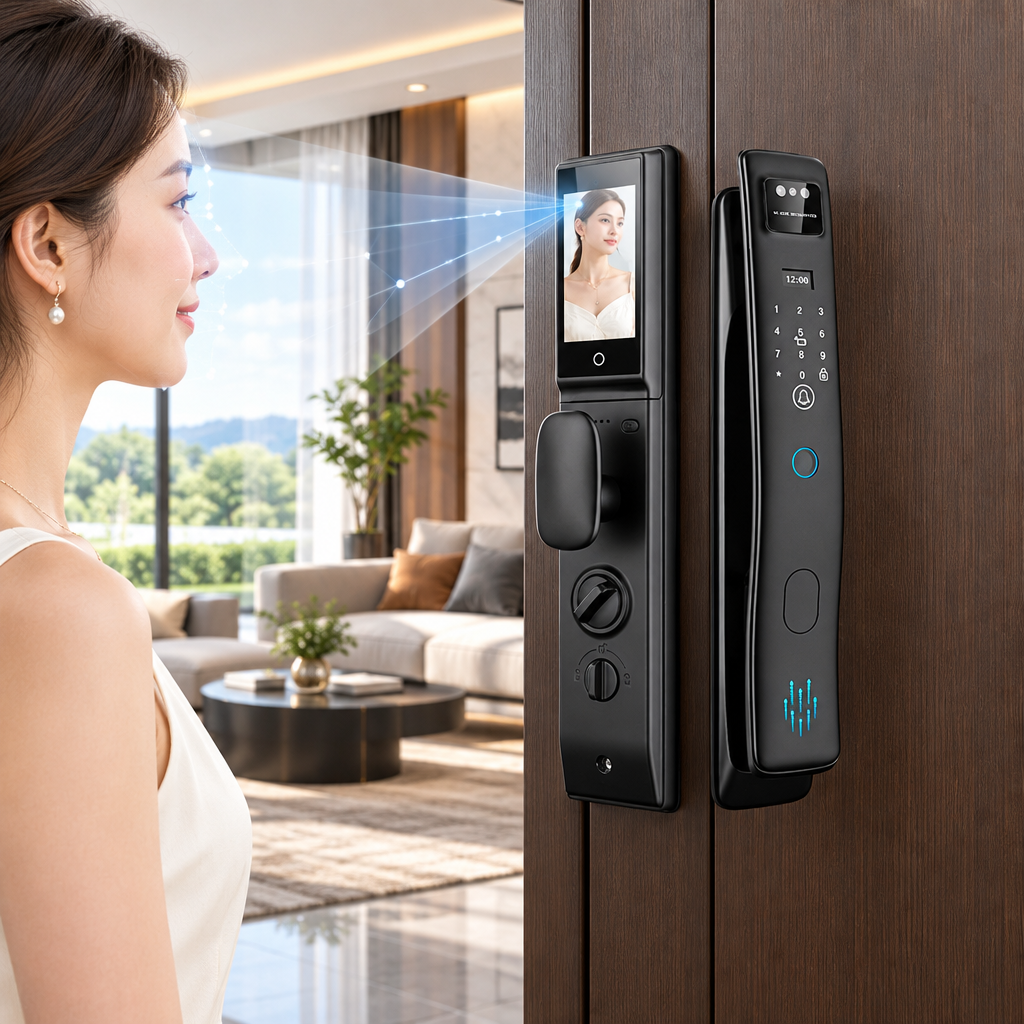
Advanced Biometric Recognition: 3D Face and Fingerprint Scanning
Biometric entry methods eliminate lost credentials while reducing friction across executive suites, shared workspaces, and residential buildings. However, optical performance varies significantly between legacy flat cameras and modern structured-light 3D facial recognition engines.
- 3D Facial Recognition: Three-dimensional facial recognition systems use depth information, which may help distinguish a living face from a flat photograph or video screen. Liveness detection and spoof resistance depend on the specific sensor and tested implementation; request independent verification of both spoof resistance and lighting-condition performance from the manufacturer.
- Ambient Light Performance: Some facial recognition systems incorporate dedicated infrared illuminators to maintain recognition in low-light conditions. Verify tested performance across the lighting scenarios relevant to your installation.
- Fingerprint Authentication: Locks may support fingerprint unlocking using optical or semiconductor sensors. Ask the manufacturer to identify the sensor technology and provide independent test evidence for presentation-attack resistance against lifted prints or replica materials.
Contactless Credentials: RFID, NFC, Bluetooth, and Virtual PINs
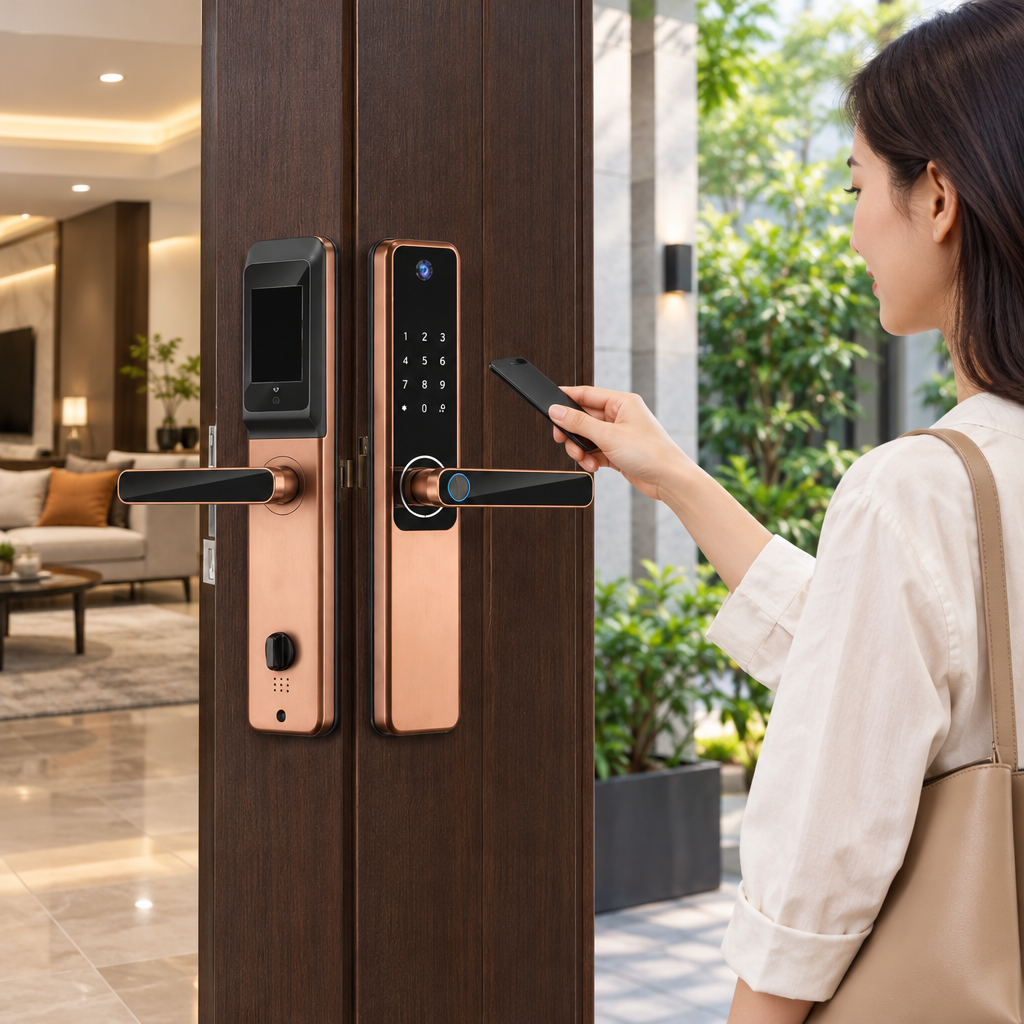
While biometrics serve permanent residents and staff members, high-turnover guest access demands flexible digital and contactless issuance. Keycards and mobile authorizations allow front-desk operators to manage high-volume arrivals without physical contact.
When evaluating card-based access, verify whether the model supports RFID, NFC, or both, and confirm the operating frequency and encryption standards used for credential security. The S958MAX supports card-based unlocking; ask the manufacturer to specify the card technology and security implementation. For remote authorization, administrators can generate time-bound algorithmic PINs or provision short-range Bluetooth mobile credentials, granting instant access that expires automatically upon scheduled check-out.
Two-Way Video Calling and Remote Intercom Integration
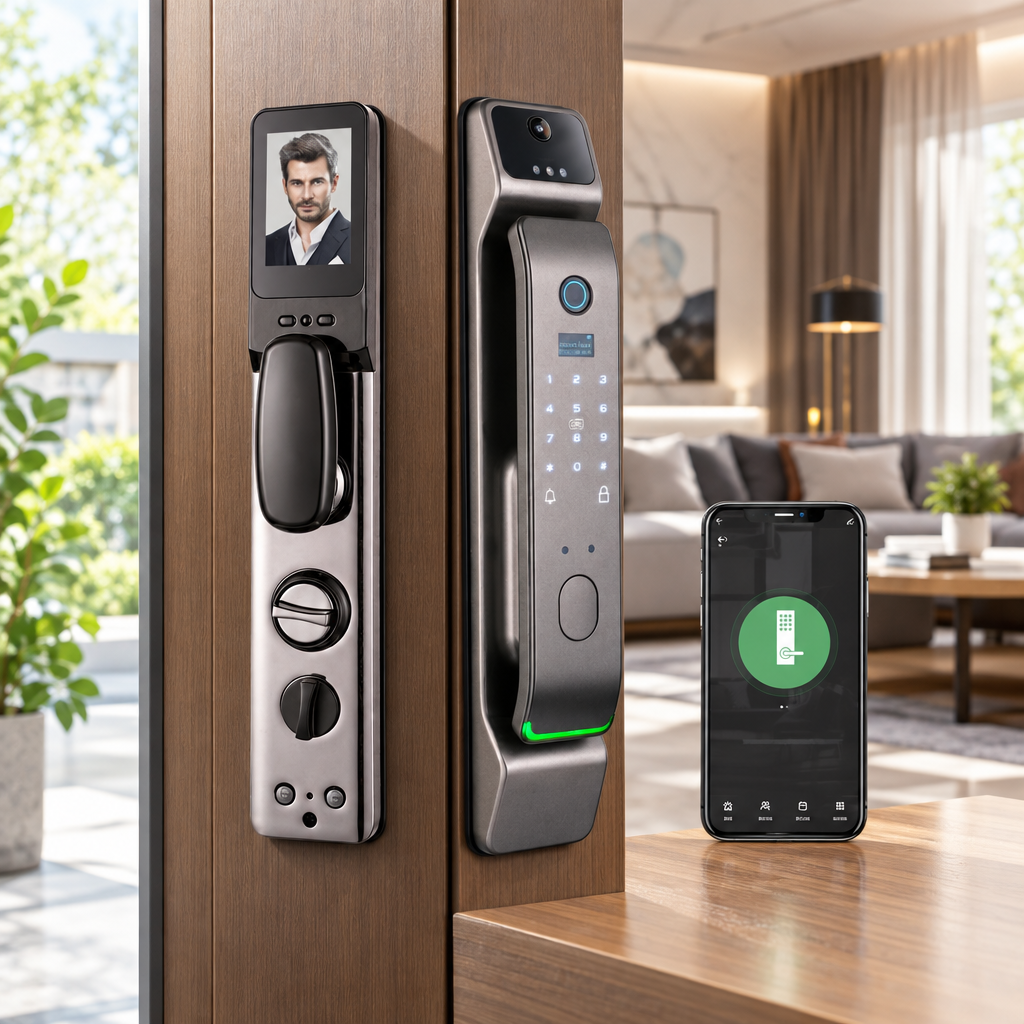
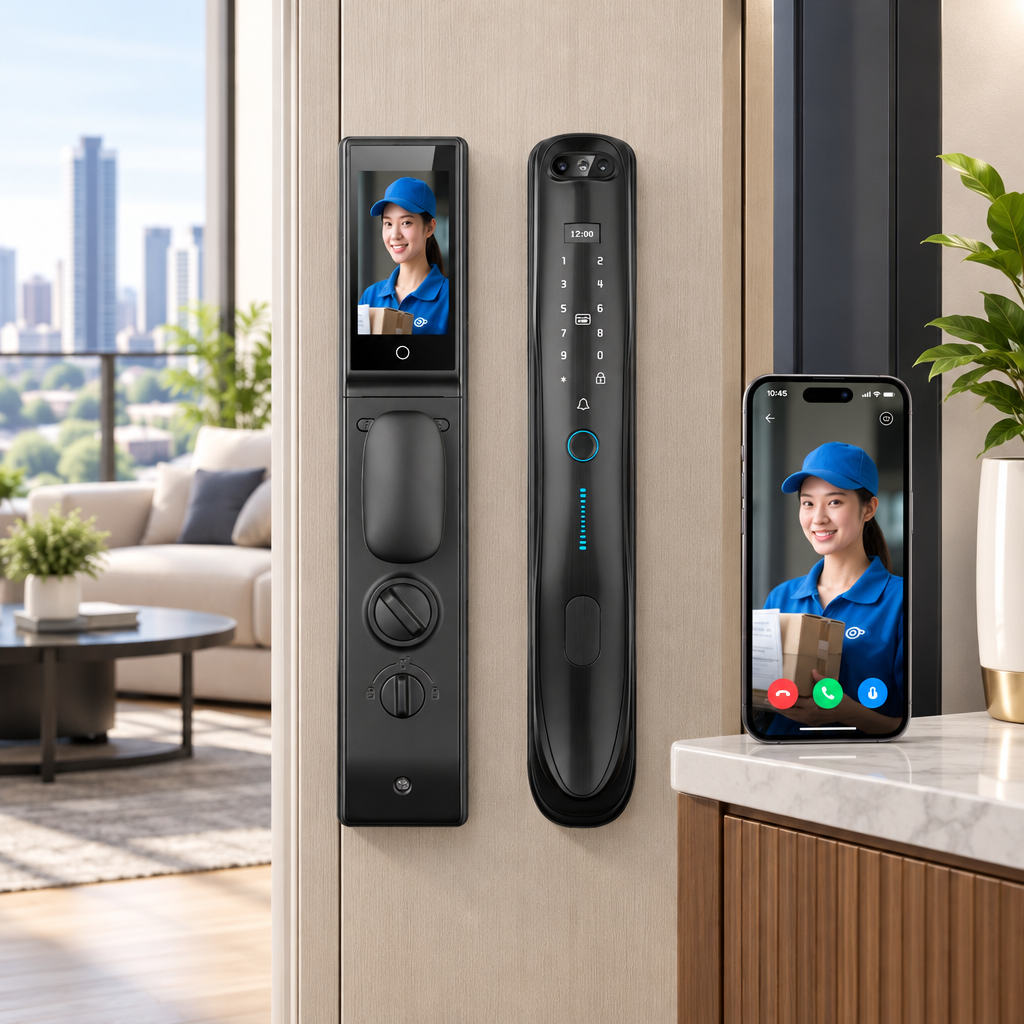
Modern door hardware increasingly unifies access verification with entry monitoring. Integrating a wide-angle camera and two-way audio intercom directly into the lock exterior removes the need for supplementary wall-mounted video doorbells.
When a visitor rings the bell, locks with integrated video capabilities can establish a real-time video stream through a dedicated smart ecosystem. Property managers or homeowners can visually inspect delivery couriers or unexpected visitors through an indoor high-definition display or a smartphone application, granting entry only after visual confirmation. The S958MAX integrates video calling through the Tuya smart app, allowing real-time visitor monitoring.
Power Architecture, Energy Efficiency, and Operational Continuity
Lithium-Ion Battery Packs Versus Alkaline Arrays
Continuous video streaming, wireless radios, and motorized multi-point mortise drives require substantial power. Battery technology varies across smart lock models, and performance under different load conditions should be verified in the manufacturer's battery and operating-condition documentation.
Some commercial locks adopt rechargeable lithium-ion battery packs to sustain motor drives over extended service intervals. The S958MAX is specified with a 7.4-volt 5000mAh rechargeable lithium-ion battery. Verify expected battery life, recharge cycles, and performance under your building's environmental conditions before specifying any power system.
Fail-Safe Redundancies and Offline Operation
Electronic components will eventually face depleted batteries, disrupted wireless channels, or lightning-induced power surges. A reliable architectural access system must never trap occupants inside or leave them locked out during unexpected system faults.
Lock hardware should include a concealed mechanical key override featuring drill-resistant hardened faceplates. An external USB port allows maintenance personnel to jump-start completely drained lithium cells using standard portable power banks, restoring instant keypad and biometric functionality on-site. The S958MAX includes both mechanical key backup and emergency USB power input.
Wireless Topology Trade-Offs: Wi-Fi, Mesh Networks, and Data Storage
Selecting a connectivity protocol requires balancing battery consumption against the need for real-time audit trails. High-density buildings must evaluate their existing network backbone before committing to a specific wireless architecture.
When evaluating smart lock manufacturers, ask which wireless protocols each model supports, what network architecture it requires, and how access logs and credentials are stored:
- Direct Wi-Fi Connectivity: Some models connect directly to local access points. Verify with the manufacturer whether the specific model requires bridge hardware, how it transmits data, and what network bandwidth video calling and logging consume. The S958MAX uses Wi-Fi for network connectivity.
- ZigBee Mesh Networks: Some manufacturers offer ultra-low current consumption and local device-to-device routing, ideal for multi-room automation environments where battery life takes priority over video bandwidth.
- Local Versus Cloud Data Storage: Verify whether access logs and valid credential hashes are stored in non-volatile onboard memory for offline operation, transmitted to cloud servers, or both. The S958MAX specifies cloud data storage; confirm whether any local caching or offline credential operation is available if required for your project.
Manufacturing Standards and Production Auditing
Automated Assembly and Quality Control Verification
Professional smart lock manufacturers should demonstrate consistent quality across high-volume production runs. Manual workbench assembly can introduce micro-alignment variations, which may cause internal gears to bind prematurely over thousands of operating cycles.
When auditing potential suppliers, ask whether they operate robotic surface-mount lines, automated torque-controlled screwdrivers, and environmental stress chambers. Request evidence showing whether the producer subjects production batches to inspection protocols covering high-temperature aging, electrostatic discharge resistance, salt-spray anti-corrosion testing, and mechanical lock-cycle simulations. These are examples of verification evidence buyers may request, not universal requirements.
Factory Footprint, Lead Times, and Delivery Schedules
For commercial projects, shipping delays directly impact hotel opening deadlines and residential occupancy permits. Production capabilities must match the project's roll-out schedule, from initial mock-up testing to phased site handovers.
Our 10,000-square-meter automated manufacturing facility and 15 years of industry experience allow production lines to output over 500 units daily, supporting 7 to 10 day standard order fulfillments and 15 to 30 day customized OEM deliveries. These manufacturing capabilities back operations across 5,000 hotels and apartments worldwide. The company holds CE and FCC product compliance marks and maintains ISO 9001 and ISO 14001 management-system certifications.
Practical Deployment Matrix: Multi-Modal Biometric Architecture
Hardware Specification Analysis
Translating procurement checklists into practical equipment choices requires evaluating how real-world locks balance mechanical durability with digital convenience. The S958MAX multi-modal lockset illustrates this engineering balance in high-demand environments.
Built inside a rugged aluminum alloy body weighing 6 kilograms, the lock houses a Grade C security cylinder matched to a 6068 mortise with a 24 by 240 millimeter faceplate. Its integrated 7.4-volt 5000mAh rechargeable lithium battery sustains 3D facial recognition, biometric fingerprint scanning, card-based access, physical keys, and active video calling through Tuya smart cloud connectivity.
Alignment Across Diverse Real Estate Portfolios
Commercial property assets present differing access challenges depending on user density, privacy expectations, and physical architecture.
- Luxury Serviced Apartments: Multi-modal biometric arrays allow hands-free access for returning residents, while integrated cameras provide real-time visitor intercom calls directly to personal smartphones.
- Boutique Hotels and Resorts: Dynamic temporary passcodes and card credentials allow seamless check-in workflows, supported by high-security cylinder engineering that protects room security during seasonal turnover.
- Executive Commercial Suites: High-precision fingerprint verification and encrypted card access prevent unauthorized personnel from entering sensitive data centers and corporate conference facilities.
Due Diligence Questions for Supplier Qualification
Verifying Mechanical Reliability and Quality Assurance
Before executing binding purchase contracts, procurement officers should request certified laboratory reports rather than relying on promotional marketing brochures.
- What is the documented mean time between failures? Request third-party laboratory verification showing the motorized latch mechanism can complete its rated cycle count without component binding.
- What salt-spray test standard does the surface finish satisfy? Ask whether exterior alloy components have been tested for corrosion resistance and request the test standard, duration, and results, which are critical for coastal real estate and humid climates.
- What specific warranty and maintenance support is provided? Confirm the availability of warranty coverage, local spare parts reserves, and ongoing technical support for mechanical components. The S958MAX includes a two-year warranty.
Software Governance, Server Integrity, and Application Programming Interfaces
Digital security is as critical as mechanical strength. A secure lock mechanism becomes a liability if software channels leak tenant access logs or suffer server outages.
- Where are authentication logs and cloud data hosted? Confirm whether the cloud backend complies with international privacy frameworks and employs end-to-end data encryption across all transit layers.
- Are open API and SDK packages provided for external management systems? Verify whether property engineering teams can bridge door events directly into central building automation or front-desk management platforms.
- What is the manufacturer's security patching policy? Establish clear operational agreements outlining how rapidly the vendor deploys firmware fixes when new wireless vulnerabilities appear. Verify in writing who holds custody of firmware source code and what update timelines the manufacturer commits to.
FAQs
What should commercial buyers look for when auditing smart lock manufacturers?
Commercial buyers should prioritize physical door compatibility, independent laboratory certifications, and true manufacturing scale over superficial aesthetic designs. Verifying mortise dimensions, door thickness ranges, cylinder security grades with their applicable standards, and factory certifications like ISO9001 ensures the hardware will endure continuous high-traffic usage.
How can project teams tell an original manufacturer from a trading intermediary?
Ask potential suppliers to demonstrate their factory operations, explain who performs customization and firmware updates, and confirm their delivery timelines based on documented project history. Request evidence of production tooling ownership, in-house testing capabilities, and recent project case studies. Verify in writing whether the supplier manufactures the product directly or coordinates with external factories, and confirm customization capabilities and lead-time guarantees with supporting documentation.
Are 3D facial recognition locks reliable for multi-family properties?
Three-dimensional facial recognition systems use depth information that may help distinguish a living face from a flat photograph. Liveness detection and spoof resistance depend on the specific sensor and tested implementation. Request independent test evidence from the manufacturer confirming spoof resistance and reliable recognition across the lighting conditions present in your building.
Why does cylinder grade matter on a smart lock?
Cylinder security grades under standards such as China's GA/T 73-2015 or ANSI/BHMA frameworks indicate performance under the applicable standard's specified tests. Even when advanced electronic components, biometric sensors, or digital radios are disabled, a certified high-security cylinder provides mechanical resistance to physical attack. Always verify which standard applies to the model you are evaluating and request the relevant test documentation.
Can smart locks link directly to room automation systems?
Commercial smart locks may integrate with hotel room control systems using protocols like ZigBee or cloud APIs, depending on the model and available interfaces. Potential integrations such as triggering welcome lighting, adjusting doorplate status displays, or controlling HVAC systems depend on the selected lock model, room-control platform, and specific configuration. Verify protocol compatibility, available integration options, and tested workflows with the supplier when selecting smart lock manufacturers and specific models for your project.
Conclusion
Securing commercial properties requires looking beyond consumer-grade specifications and building partnerships with verified smart lock manufacturers. Balancing physical structural alloys, tested mechanical cylinders, multi-modal biometric sensors, and stable power systems protects buildings against both physical intrusions and digital failures. Real estate developers, hotel operators, and commercial specifiers who evaluate smart lock manufacturers thoroughly, verify manufacturing capabilities and independent test documentation early, and ask detailed due-diligence questions will safeguard tenant safety, lower ongoing maintenance overhead, and protect their physical investments for years to come.
SUBSCRIBE
INQUIRY