
The Definitive Guide to Finding a Trustworthy Facial Recognition Door Lock Supplier for Wholesale in 2026
The global smart lock industry is at a pivotal inflection point. As we move through 2026, facial recognition door locks have transitioned from a niche luxury item to a mainstream security essential for residential, commercial, and hospitality applications. For distributors, e-commerce retailers, hotel procurement managers, and property developers, this surge in demand represents a significant revenue opportunity.
However, success in this competitive landscape hinges on one critical decision: partnering with the right wholesale supplier. Sourcing these technologically advanced devices—primarily from manufacturing hubs in China—requires navigating complex biometric algorithms, understanding minimum order quantities (MOQs), and conducting rigorous supplier vetting.
This comprehensive guide serves as your strategic roadmap. We will explore market dynamics, the technology that defines quality, and the exact step-by-step process to identify and partner with a wholesale supplier who can deliver security, scalability, and profitability.
The Explosive Growth of the Facial Recognition Lock Market
Market Size, Projections, and Global Demand
The numbers driving this industry are impossible to ignore. According to QYResearch, the global biometric door lock market was valued at approximately $2.326 billion in 2024 and is projected to reach $4.746 billion by 2031, growing at a robust Compound Annual Growth Rate (CAGR) of 10.9% . This growth is fueled by the global shift toward contactless security solutions and the integration of smart homes.
In 2024 alone, global production of biometric door locks reached 10.12 million units, with an average global market price of $230 per unit . This price point indicates a healthy mid-tier average selling price (ASP), leaving ample room for wholesale margins and retail markup. For B2B buyers, this data confirms that the addressable market is expanding rapidly across both residential and commercial sectors.
Why 3D Facial Recognition is Replacing Fingerprints
The market is shifting decisively away from traditional fingerprint scanners toward 3D facial recognition. Why? Security and convenience. Fingerprint locks often fail with wet, dirty, or aged fingers. In contrast, 3D structured light technology—similar to Apple's Face ID—projects thousands of invisible dots to map the unique contours of a face .
Leading wholesale suppliers now offer locks with liveness detection certified to ISO/IEC 30107 standards, achieving a False Acceptance Rate (FAR) of less than 0.001% . This makes it virtually impossible to spoof the lock with a photo, video, or even a high-quality silicone mask. As a wholesaler, stocking 3D vision-based locks rather than outdated 2D camera models is essential to future-proof your inventory and maintain customer trust.
Understanding the Global Sourcing Landscape
The Dominance of China's Manufacturing Hubs
China remains the undisputed global epicenter for facial recognition lock production, thanks to its integrated supply chains, advanced electronics manufacturing capabilities, and competitive cost structures . The country's strength lies in its vertically integrated supply chains, where component suppliers (sensors, AI chips, PCB assemblers) are often located within close proximity, drastically reducing lead times.
Procurement managers should focus on three primary regional hubs :
-
Guangdong Province (Shenzhen, Dongguan, Zhongshan, Guangzhou): This is the heart of high-tech innovation. Factories here excel in AI integration, 3D sensing, and rapid prototyping. They have direct access to semiconductor suppliers and major ports like Shenzhen Yantian.
-
Zhejiang Province (Wenzhou): Known for precision metalworking and traditional lock mechanics, Wenzhou-based suppliers offer robust hardware with integrated biometrics, ideal for durable commercial applications.
-
Jiangxi & Henan Provinces: These emerging tech zones offer cost-effective labor and growing infrastructure, suitable for mid-tier products and cost-sensitive buyers.
These clusters allow suppliers to source biometric sensors, encrypted microcontrollers, and camera modules locally, reducing lead times and enhancing supply chain resilience. Buyers can typically expect 15–30% lower unit costs compared to Western or Southeast Asian alternatives, without sacrificing compliance or performance .
Trading Companies vs. Direct Manufacturers
A critical distinction in wholesale sourcing is the difference between trading companies and direct manufacturers. Trading companies aggregate products from various factories and offer convenience, but they add a margin and have less control over quality and lead times.
Direct manufacturers—such as those with their own casting workshops, SMT assembly lines, and in-house R&D—offer greater transparency, better pricing at scale, and superior customization capabilities. For example, Guangdong Huarui Lock Industry Co., Ltd. , established in 2007, operates a 5,000 m² facility with its own casting and stamping metal hardware workshop, ensuring control over both electronics and mechanical durability . Prioritizing direct factory partnerships is essential for long-term reliability.
How to Evaluate and Select a Wholesale Supplier
Essential Certifications and Regulatory Compliance
Before placing an order, verify that your potential supplier holds internationally recognized certifications. These are non-negotiable for global market entry and data security compliance :
-
ISO 9001: Quality management systems, ensuring consistent production processes.
-
CE & RoHS: Mandatory for the European market, confirming safety and restriction of hazardous substances.
-
FCC: Required for wireless devices sold in the US market.
-
IP65 Rating or Higher: Guarantees the lock is dust-tight and protected against water jets, critical for outdoor installation .
-
ISO/IEC 27001: Information security management, essential for verifying secure handling of biometric user data.
-
C-Level Lock Cylinder: The highest security grade for the mechanical core, guaranteeing anti-pick and anti-drill capabilities .
For biometric data handling, GDPR and China's PIPL compliance are non-negotiable, especially when selling into Europe or operating in sensitive environments like corporate offices or healthcare facilities .
Algorithm Accuracy and Liveness Detection
The core value of a face recognition lock lies in its ability to distinguish real users from spoof attempts. Demand third-party test reports verifying a false acceptance rate (FAR) below 0.001% . Look for suppliers using ISO/IEC 30107-compliant liveness detection, which prevents photo, video, or mask-based bypassing.
Top-tier suppliers use proprietary algorithms or partner with established AI firms, rather than off-the-shelf SDKs. Key technical questions to ask :
-
What is the FAR? Industry benchmarks should be below 0.001% .
-
Does it have true 3D liveness detection? Ensure it uses structured light or ToF (Time of Flight) sensors, not just a 2D camera with IR dots.
-
Is data processed on-device? Edge processing (on the lock itself) is far more secure than cloud-based recognition, preventing data leaks.
Hardware Durability and Environmental Resistance
Smart locks must perform reliably under diverse conditions. Prioritize suppliers offering IP65-rated weather resistance and proven durability through lifecycle testing (e.g., 100,000+ unlock cycles) . Thermal stress testing between -20°C and 60°C ensures functionality across climates.
High-quality locks start with good materials: metal housings (zinc alloy, stainless steel) are preferred over plastic for durability, waterproofing, and rust resistance . The panel design should match the door's style, ensuring both safety and aesthetics.
Production Capabilities and Scalability
For wholesale buyers, a supplier's ability to scale is paramount. Tier-1 suppliers operate large-scale facilities (1,000–12,000 m²) with automated SMT lines and in-house quality control . Confirm their ability to scale production—ideally maintaining buffer stock for sudden demand surges up to 5,000 units per month.
Review their facility size, number of assembly lines, and monthly output capacity. Factories with automated SMT lines and in-house testing chambers (for temperature, salt spray, and cycle testing) indicate a commitment to quality. IATF 16949 certification indicates automotive-grade process rigor, a strong signal of operational excellence .
Top Verified Wholesale Suppliers and Performance Benchmarks
Comparative Analysis of Leading Manufacturers
To make informed decisions, procurement professionals should analyze suppliers based on verified metrics. The following data, compiled from industry sourcing guides, highlights key players in the facial recognition lock wholesale space :
| Supplier | Location | Review Score | Response Time | Annual Online Revenue | Reorder Rate |
|---|---|---|---|---|---|
| Shenzhen Easloc Technology Co., Ltd. | Shenzhen | 4.7/5 | ≤5h | $100,000+ | 22% |
| Jiangxi Krovi Information Technology Co., Ltd. | Jiangxi | 5.0/5 | ≤1h | $8,500+ | <15% |
| Guangzhou Saijia Smart Home Co., Ltd. | Guangzhou | 4.7/5 | ≤3h | $350,000+ | 23% |
| Zhongshan CAMAKT Electronic Co., Ltd. | Zhongshan | 4.9/5 | ≤2h | $65,000+ | <15% |
| Guangdong Huarui Lock Industry Co., Ltd. | Dongguan | 4.7/5 | ≤9h | $1,700+ | 50% |
| Shenzhen Cardoria Technology Co., Ltd. | Shenzhen | 4.9/5 | ≤2h | $200,000+ | 19% |
| D&D Hardware Industrial Co., Limited | — | 4.9/5 | ≤3h | $590,000+ | 25% |
Supplier Insights and Strategic Positioning
-
For Premium Quality and Fast Response: Shenzhen Cardoria Technology Co., Ltd. and Zhongshan CAMAKT Electronic Co., Ltd. stand out with near-perfect review scores (4.9/5) and ultra-fast response times (≤2 hours), making them ideal partners for high-end residential or boutique commercial projects requiring quick turnaround and premium build quality .
-
For Exceptional Customer Service: Jiangxi Krovi Information Technology Co., Ltd. boasts a flawless 5.0 rating and the fastest average response time (under one hour). However, its relatively low online revenue suggests limited scalability—best suited for niche buyers or pilot orders rather than mass distribution .
-
For High-Volume Distribution: D&D Hardware Industrial Co., Limited shows impressive market traction with over $590,000 in annual online sales and a healthy 25% reorder rate, indicating strong client retention. Their expertise in metal components and robust housing designs makes them a solid choice for outdoor or industrial applications .
-
For OEM/ODM Customization: Guangdong Huarui Lock Industry Co., Ltd. , despite slower response times, has an outstanding 50% reorder rate—one of the highest in the sector. This reflects deep trust among repeat clients, likely due to consistent delivery and large-scale production capacity (over 6,000 m² facility), making it a top candidate for OEM partnerships and bulk contracts .
-
For Balanced Quality and Value: Guangzhou Saijia Smart Home Co., Ltd. provides strong app integration (Wishome/Tuya), CE/FCC certifications, and a solid 23% reorder rate, indicating consistent customer approval. Their products feature C-level lock cylinders and 3200mAh batteries with 3-6 months battery life .
Pricing, MOQs, and Total Cost of Ownership
Understanding Wholesale Price Ranges
Pricing for facial recognition locks varies based on technology, materials, and order volume. Based on verified supplier data and market benchmarks, wholesale buyers can expect the following ranges:
-
Entry-Level / High Volume (Standard 3D Face + App): $27 - $35 per unit (MOQ: 100-500 pieces). Example: Guangzhou Saijia offers models starting at $27 for bulk orders of 1000+ pieces, with C-level lock cylinders and Wishome app integration .
-
Mid-Tier (Semi-Custom, Enhanced Sensors): $45 - $65 per unit (MOQ: 50-200 pieces). This range often includes better build quality and additional features like WiFi and larger batteries.
-
Premium / ODM (Full Customization, Multi-Biometric): $70 - $100+ per unit (MOQ: 500+ pieces). Includes proprietary algorithms, ruggedized metal casings, and features like palm vein scanning.
Navigating Minimum Order Quantities (MOQs) and Hidden Costs
MOQs are a critical factor in supplier selection. They vary significantly based on the level of customization required :
-
Stocking Units (No Customization): MOQs can be as low as 2 to 10 pieces for sampling.
-
Logo Customization (OEM): Typically starts at 50 to 100 pieces (Saijia offers logo customization at 100+ pieces) .
-
Custom Packaging: Usually requires 200 to 500 pieces.
-
Full Hardware/Software Redesign (ODM): Often requires 1,000+ pieces and includes one-time tooling fees ranging from $3,000 to $8,000.
Buyers must calculate the Total Landed Cost (TCO) , which includes unit price, tooling fees, sample costs ($80–$300 each), shipping (sea freight vs. air freight), and import duties.
Price vs. Value: Making Informed Supplier Comparisons
While upfront pricing is important, focusing solely on cost can compromise long-term performance and brand reputation. Consider this real-world comparison :
Case Study: Mid-Range Smart Lock Project (10,000 Units)
-
Option A – Low-Cost Supplier: Quoted at $48/unit, but lacks ISO certification, uses unverified facial recognition SDK, and offers no warranty on electronic components.
-
Option B – Shenzhen Easloc Technology Co., Ltd.: Priced at $58/unit, includes full GDPR-compliant firmware, IP65 rating, 24-month warranty, and provides SDK access for API integration. MOQ: 500 units.
-
Option C – Guangzhou Saijia Smart Home Co., Ltd.: Offers $55/unit with customizable app interface, multi-user access logs, and cloud-free edge processing. Reorder rate: 23%, indicating steady client satisfaction.
At first glance, Option A appears attractive. However, hidden risks—including potential compliance violations, higher failure rates, and lack of technical support—could lead to costly recalls or reputational damage. Options B and C, though slightly more expensive, deliver measurable value through compliance, durability, and post-sale support—key differentiators in competitive markets.
Ultimately, the lowest price rarely equates to the best value. Buyers should calculate total cost of ownership (TCO), factoring in warranty coverage, return rates, customization flexibility, and cybersecurity safeguards .
Logistics, Quality Control, and After-Sales Service
Shipping, Incoterms, and Lead Times
Reliable logistics are the backbone of wholesale success. Standard lead times for mass production range from 30 days (for 1,000 units) to 60 days (for 10,000+ units) , depending on customization level and factory load . Most Chinese suppliers ship via FOB (Free on Board) Shenzhen or Ningbo.
-
Sea Freight: The most economical for bulk orders, taking 25-35 days to major destinations like the US or Europe.
-
Air Freight: Faster (5-7 days) but significantly more expensive, often used for urgent samples or small batches.
-
Sample Shipping: Sample units can be shipped within 7 days under DDP terms .
Quality Assurance Protocols
To mitigate risk, implement a structured Quality Assurance (QA) protocol :
-
Pre-Production Samples: Always approve samples before mass production.
-
Third-Party Inspections: For orders exceeding 500 units, engage services like SGS or Intertek to conduct pre-shipment audits.
-
Batch Testing: Request test reports for salt spray resistance, impact durability, and battery life (expect 6-12 months under normal use).
-
Supply Chain Transparency: Traceability of critical components—especially cryptographic chips and image sensors—is vital for security and after-sales support. Top suppliers provide full bill-of-materials (BOM) transparency .
Warranty and Technical Support
A product is only as good as the support behind it. Reputable wholesale suppliers typically offer a 1 to 3-year warranty on their smart locks . Crucially, inquire about after-sales technical support :
-
Will they help troubleshoot integration issues with the app?
-
Do they provide SDKs for deeper integration?
-
Do they offer installation guidance, wiring diagrams, and training support?
-
Is there availability of overseas or local technical cooperation for faster support?
This support is vital for maintaining your own brand's reputation with downstream customers. For example, Guangzhou Saijia maintains a 94.2% positive rating and actively responds to customer feedback, demonstrating commitment to client satisfaction .
Matching Smart Locks to Door Types
Compatibility Considerations for Different Door Materials
Different doors require different lock structures and installation methods. When sourcing from a wholesale supplier, ensure they offer models compatible with your target market's door types :
-
Wooden doors / Security doors: Choose smart locks with standard lock bodies or national standard lock bodies to ensure consistent drilling size and easier installation.
-
Stainless steel doors / Copper doors: Select locks that support custom panel sizes or adjustable structures.
-
Glass doors: Require non-drilling locks or clamp-type smart locks designed for glass. Suppliers like 嘉盾智能 (Jiadun Intelligent) offer specialized 3D facial recognition glass door locks with免拆装 (tool-free) and免开孔 (no-drilling) installation .
-
Double-leaf / Mother-and-child doors: Consider locks with multi-point linkage systems (e.g., top and bottom bolts) to synchronize door panels.
By matching lock structure to door type, manufacturers reduce installation challenges and ensure reliability .
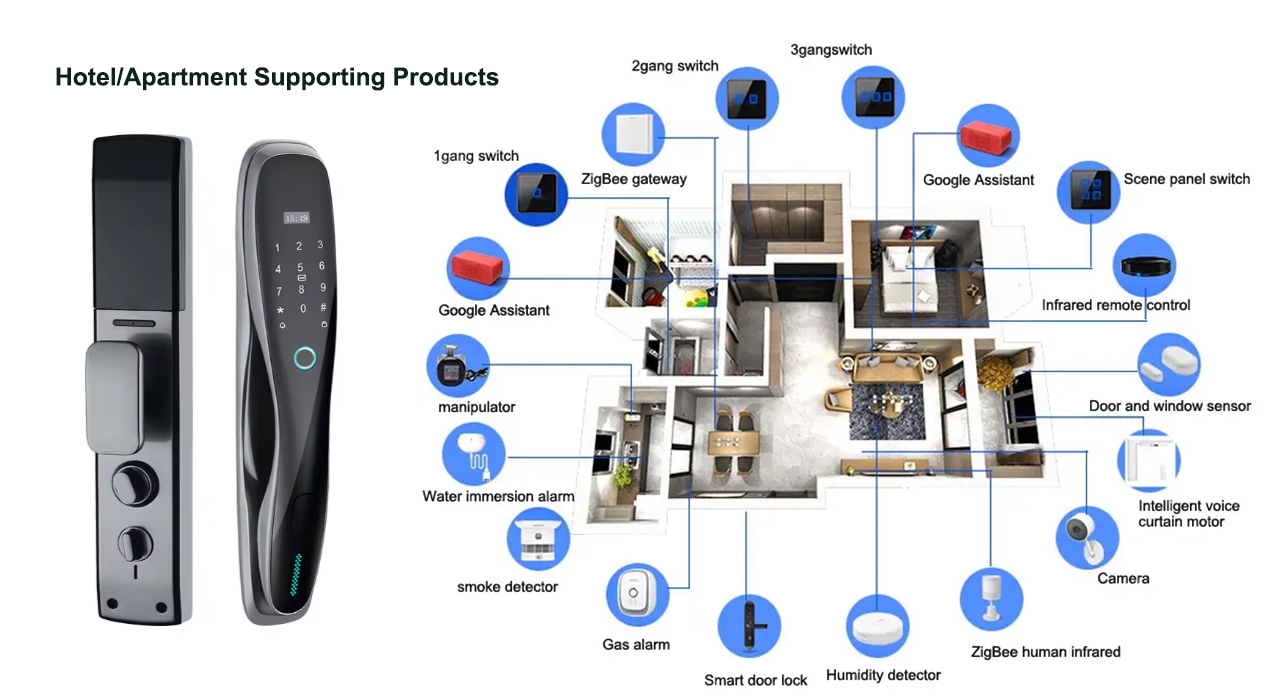
System Platform and Smart Home Integration
For higher-value projects, ensure integration with smart home systems or building intercoms. Key considerations include :
-
Unlocking methods: Fingerprint, PIN, RFID card, mechanical key, Bluetooth, mobile app, WiFi, or facial recognition.
-
System platform: Tuya, TTLock, Wishome, or standalone apps. Guangzhou Saijia offers integration with Wishome App for remote control and monitoring .
-
Security functions: Anti-peep passwords, anti-tamper alarms, lockout after failed attempts, and privacy deadbolt.
-
Firmware upgrades: Suppliers should provide regular updates to maintain system security.
Future Trends in Facial Recognition Locks
Multi-Modal Biometrics and Video Integration
The future of access control is multi-modal. Leading suppliers are integrating palm vein recognition—which reads the hemoglobin pattern in your hand—as a secondary or alternative biometric, offering an even higher level of security .
Additionally, the line between a door lock and a security camera is blurring. High-demand models now feature built-in wide-angle cameras, large HD screens, and two-way audio, transforming the lock into a fully functional video doorbell. Wholesalers should prioritize suppliers offering these converged features to meet evolving consumer expectations.
AI and Edge Computing
Next-generation locks will leverage on-device AI chips to learn user behavior, improve recognition accuracy over time, and detect anomalous activity without cloud dependency. This enhances both speed and privacy, aligning with strict global data regulations like GDPR and China's PIPL .
3D双目人脸识别 (3D binocular facial recognition) technology, as offered by suppliers like Jiadun Intelligent, captures three-dimensional facial information through depth perception, effectively preventing spoofing attempts using photos, videos, or masks—achieving financial payment-level security standards .
Frequently Asked Questions (FAQs) for Wholesale Buyers
How can I verify a supplier is a real factory and not a trading company?
Request a virtual or in-person factory audit. Look for specific manufacturing equipment like SMT (Surface Mount Technology) lines, injection molding machines, and environmental testing chambers. Cross-check their business license with the factory location and ask for live video tours . Suppliers like Guangdong Huarui, with their own casting and stamping workshops, demonstrate genuine manufacturing capability .
What is the typical warranty period for wholesale smart locks?
Most reputable OEM/ODM manufacturers offer a 1 to 3-year warranty covering electronic components and motorized parts . Always clarify whether the warranty covers replacement parts only or includes technical support for troubleshooting.
Can I get my own brand logo on the products?
Yes, this is standard OEM service. Most suppliers offer logo customization, typically starting at MOQs of 50 to 100 pieces (Saijia requires 100+ pieces for logo customization) . Custom packaging and graphic design are also available at higher MOQs (200-500+ pieces).
Do these locks work with Apple HomeKit or Google Home?
Compatibility varies. Many suppliers integrate with open IoT platforms like Tuya Smart or Wishome, which have their own apps and are compatible with Alexa and Google Assistant via voice control . Direct HomeKit integration is less common and may require custom development.
What are typical lead times for samples and production?
Prototype development usually takes 15–30 days. Sample units can be shipped within 7 days under DDP terms. Mass production lead times range from 30 days (for 1,000 units) to 60 days (for 10,000+ units) , depending on customization level and factory load .
How do suppliers handle biometric data privacy?
Top-tier suppliers implement edge-based processing—biometric data never leaves the device—and use hardware-level encryption (e.g., secure enclave chips). They also embed user consent mechanisms in firmware to comply with GDPR and PIPL regulations .
Do manufacturers support customization for commercial deployments?
Absolutely. Leading suppliers offer logo engraving, API integrations, custom form factors, and multi-lock fleet management systems. Most require a minimum order quantity (MOQ) of 5,000 units for full customization . Always request SDK documentation and UI mockups before committing.
How do I handle returns or defective units?
This should be negotiated upfront. A common wholesale practice is to agree on a defective rate allowance (e.g., 2-3%), where the supplier provides replacement parts or units for any failures within the warranty period. Clarify who bears the cost of return shipping for defective units.
Conclusion: Building Profitable Wholesale Partnerships
Finding the right facial recognition door lock supplier for wholesale is a strategic journey that blends technology assessment with supply chain management. The ideal partner is not just a vendor but an extension of your business—one that offers certified 3D biometrics, robust data security, transparent communication, and the production scalability to grow with you.
By focusing on technical certifications (FAR <0.001%, IP65, CE/FCC), analyzing supplier performance metrics (on-time delivery, reorder rates), and understanding the nuances of MOQs and customization, your brand can confidently navigate the global smart lock market. The demand for secure, contactless access is only accelerating—now is the time to secure a supply chain that delivers quality, innovation, and reliability.
SUBSCRIBE
INQUIRY