
Smart Door Lock for Hotel Room: Commercial Selection and Engineering Guide
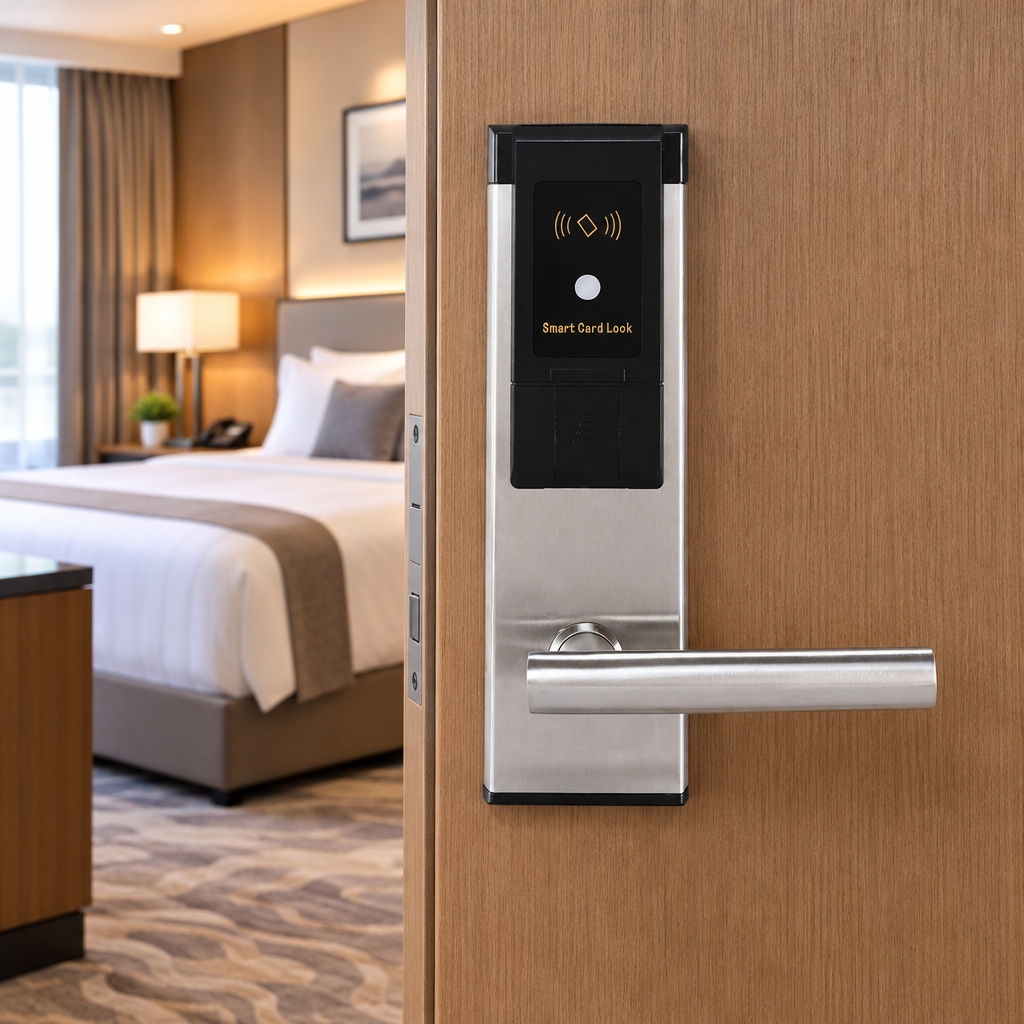
Choosing a smart door lock for hotel room doors means balancing physical durability, guest convenience, and how the lock fits into the property's management software. A disconnected electronic lock can leave the front desk unaware of failed card reads, lost keycards, or low batteries until a guest complains at reception. A well-planned hotel room smart lock system links door hardware, emergency egress mechanics, and the property database. This guide explains how hotel access works, which hardware details matter, how locks connect to PMS and GRMS platforms, and how to read the specifications of a stainless steel hotel card lock with several access methods.
Understanding Hotel Room Access Architecture
Physical Egress and Perimeter Demarcation
A guest room door has two jobs that pull in opposite directions. From the corridor, it must keep strangers out. From inside, it must open at once during a fire or power loss, even for a guest who is half asleep. Many jurisdictions require the egress-side door hardware to unlatch with one operation, but the permitted deadbolt and thumbturn configuration depends on the adopted building, fire, and accessibility codes. Confirm the complete door assembly with the local authority having jurisdiction.
Corridor doors also act as fire and acoustic separations between public hallways and sleeping rooms. Before ordering hardware, engineers should check that the mortise cutout stays within the limits of the door's fire rating. An incompatible lock body or escutcheon may make the installation inconsistent with the fire-door assembly's listing. Verify the proposed hardware against the listing and applicable requirements before installation, because a compliance gap is far harder to fix afterward.
Centralized Credential Management vs. Offline Operation
Most hotel access systems separate issuing a key from checking it. At the front desk, an encoder writes the room number and stay period to the guest credential, usually in encrypted form. The lock then checks that credential on its own. Because the door does not depend on a live connection, a failed network switch or wireless repeater does not lock guests out of their rooms.
In many card-based offline systems, the expiry time travels on the card. If a guest books three nights, the reader grants entry until the checkout time programmed at the desk on the departure day. After that time passes, the lock's microprocessor refuses the card, with no command needed from the central software. Expiry handling, clock synchronization, revocation, and room-move behavior must be confirmed for the selected model.
Evaluating Hotel Access Methods and Credential Workflows
High-Frequency RFID and Contactless Cards
Many hotel systems use 13.56 MHz contactless cards, but card frequency and format vary by lock system. Confirm compatibility with the selected lock, encoder, and issuing software. Unlike magnetic stripe cards, contactless RFID cards are not demagnetized when a guest carries them next to a phone or a magnetic purse clasp. Encoding a card takes only a few seconds, which helps keep lobby queues short during peak arrival hours.
RFID systems also let managers set separate privilege levels for staff and guests. A housekeeping card can be limited to certain floors and shift hours, while an engineering master card also opens maintenance rooms. Many locks record each card event in local memory, and staff can download that log during a security investigation. Buyers should ask how many events a given model stores and how the log is retrieved.
Mobile Key Architecture and Network Connectivity
Mobile keys let guests open their door with a smartphone over Bluetooth Low Energy (BLE) or Near Field Communication (NFC). Where the hotel has enabled digital check-in and completed its identity and payment requirements, the app may deliver a mobile key after room assignment, allowing some guests to bypass the front desk. Airport hotels and business properties with many late arrivals tend to benefit most, because tired travelers want to go straight to the room.
An always-connected Wi-Fi design can increase battery consumption compared with a reader that wakes only during credential checks, but the actual difference depends on the radio duty cycle and system architecture. Require measured battery-life data for the intended configuration.
Keypads, Fingerprint Sensors, and Backup Mechanical Cylinders
Keypads and fingerprint readers suit certain types of lodging. Serviced apartments, extended-stay properties, and executive suites often use PIN codes, because a code cannot be left behind on a restaurant table. In a resort with fast turnover, however, PIN management becomes a burden unless the property management platform generates and expires codes automatically. Fingerprint access adds an enrollment step and requires a clear privacy policy for biometric data.
A mechanical key override remains a practical necessity. A concealed cylinder lets engineering staff open the door after an electronic fault, a water leak into the lock, or a flat battery. Physical keys carry their own risk, though. Every grand master key should be logged and kept in a locked safe, so that no one can borrow and copy it unnoticed.
The table below compares these access methods from an operations point of view.
| Access Method | Issuance | Battery Impact | Primary Operational Consideration |
|---|---|---|---|
| RFID Smart Card | A few seconds at the encoder | Low (reader wakes on card) | Card loss and inventory restocking |
| Mobile BLE / NFC | Sent via app after room assignment | Moderate (low-power radio) | Smartphone operating system compatibility |
| Numeric PIN Code | Generated by software or staff | Low to moderate (keypad wake) | Code sharing and manual entry errors |
| Fingerprint Reader | Requires on-site enrollment | Moderate to high | Sensor cleanliness and biometric privacy policy |
| Mechanical Cylinder | Issued from a controlled key cabinet | None (passive mechanical) | Strict key-control logs and safe storage |
Door Hardware Engineering and Mechanical Durability Standards
Mortise Lock Body Mechanics and Latch Construction
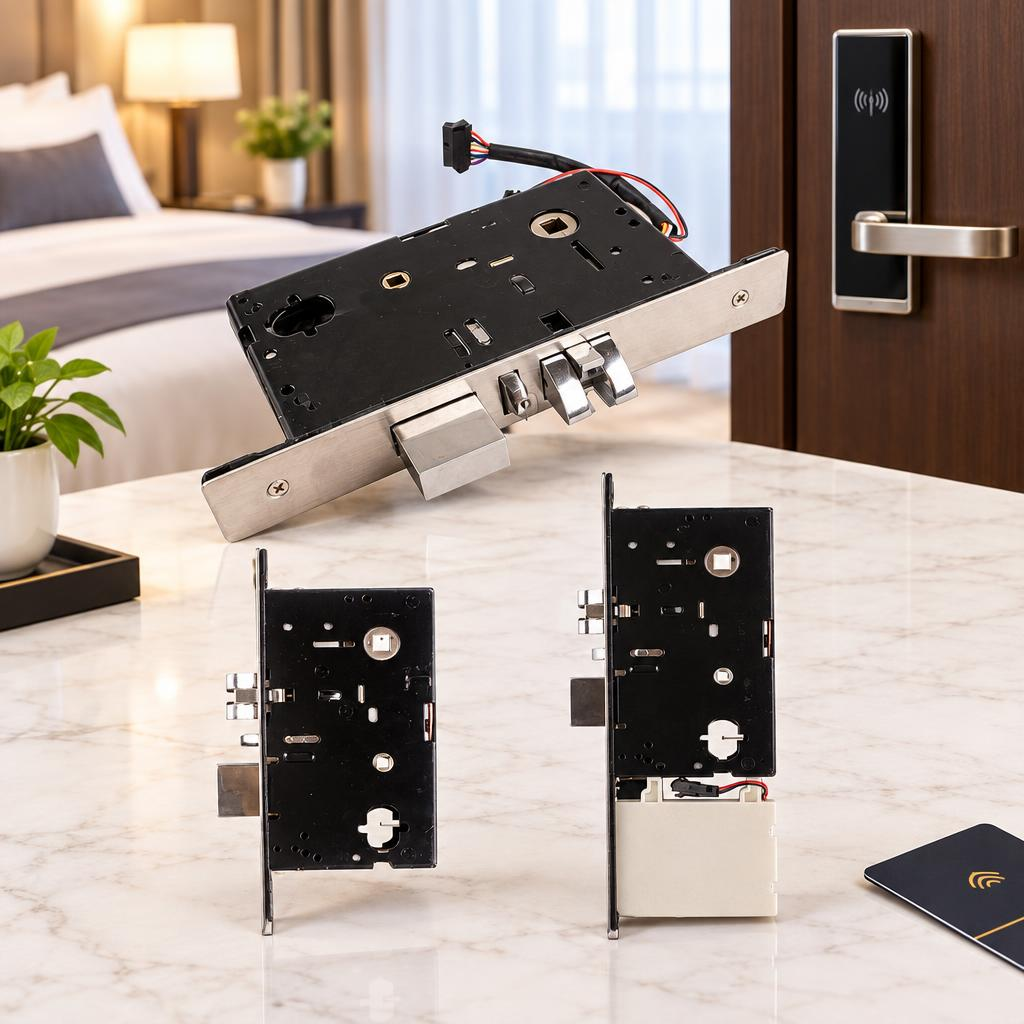
The electronic panel on a door is only as reliable as the mechanical mortise lock body behind it. Commercial hotel projects should verify the strike, latch, auxiliary guard, and deadbolt configuration against the project's security specification, fire-door listing, and applicable code.
Inside the lock body, a clutch keeps the outside handle disconnected from the latch until the circuit board approves a credential. That clutch takes the full force of anyone who leans on, yanks, or kicks the handle. Ask the supplier which materials the clutch and pins use. Material choice alone does not prove suitability for hotel traffic, so request cycle-test or durability evidence for the specific lock body.
Retrofit Feasibility and Door Dimension Verification
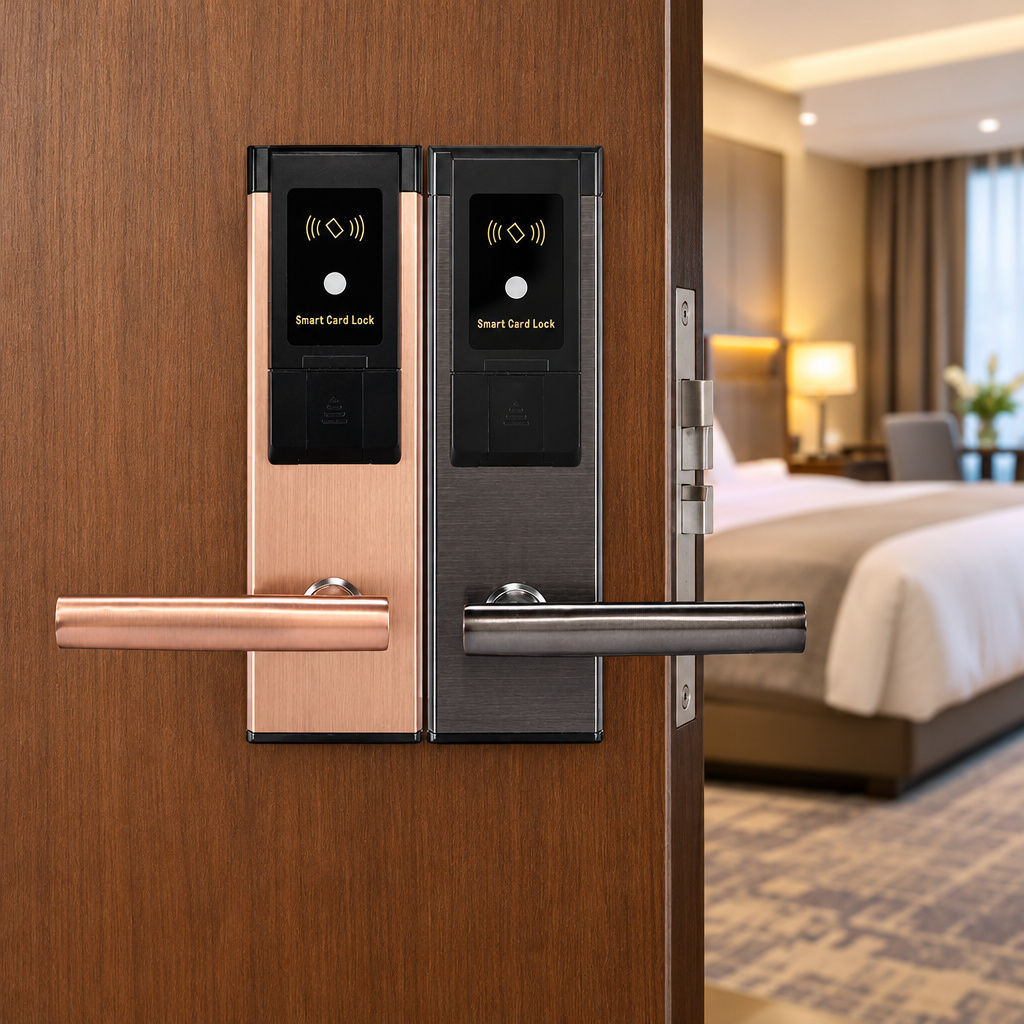
Retrofits add geometric constraints that can delay an installation schedule. The new escutcheon has to cover the old cutouts and through-bolt holes left by previous hardware. If the new panel is narrower than the old one, the hotel faces two poor options: cover plates, which look patched, or replacement door leaves, which are expensive.
For that reason, the engineering team should survey doors physically before the purchase order is final. Measuring one floor is rarely enough, because older wings often use different door stock from newer ones. Run the following checks on each door type:
- Measure door leaf thickness at the top, center, and bottom edges to confirm the core is uniform.
- Confirm the backset from the door edge to the center of the handle hub.
- Check the existing mortise pocket depth, leaving enough clearance for the electronic cable harness.
- Inspect strike alignment in the frame so the deadbolt throws fully without side-load friction.
- Confirm door handing (left-hand or right-hand) so installers do not need to reverse clutch springs on site.
Environmental Protection and Circuitry Resilience
Hotel corridors see frequent humidity swings from air conditioning cycles, wet carpet cleaning, and outdoor air. If moisture condenses inside a poorly sealed lock body, it can corrode circuit board traces over time. The symptoms usually start small, with intermittent card read failures or shorter battery life, before the lock stops working altogether.
Static discharge is a separate threat, because guests walking across corridor carpet can build up a charge that jumps to the metal handle. Design features such as conformal coating, chassis grounding, and ESD protection components are worth asking about. The supplied product data describes the smart chip system as waterproof, moisture-proof, and anti-static without naming the construction behind it, so request test evidence for the stated protection.
Integration Realities: Connecting Smart Locks to Hotel PMS and GRMS
Front Desk PMS Protocol Handshakes
A hotel lock works as one part of the front desk workflow. When a receptionist checks in a guest in the Property Management System (PMS), the PMS sends the room and stay details to the lock software through an interface, often an API or a local protocol. The encoder then writes the access data to the guest card. Each step has to complete reliably, or the queue at reception grows.
Integration problems usually come from closed protocols that tie the hotel to a single lock vendor. If the property later changes PMS or adds self-service kiosks, an undocumented interface can turn a software upgrade into a hardware project. A clean interface also handles room moves and early checkouts correctly. In many offline systems, a newly issued card cancels the previous guest's card the first time it is used at the door, so staff should understand that timing.
Guest Room Management System (GRMS) Linkage
On systems that support and configure these integrations, the lock can work with a Guest Room Management System (GRMS) to reduce energy waste. When a valid guest card opens the door, the lock or the in-room card switch signals occupancy to the room controller. The controller ends energy-saving setbacks, returns the HVAC to comfort settings, and switches on entry lighting. The lock's supplied data does not confirm these specific functions. Typical linked functions include:
- Welcome Scene Activation: Unlocking the door turns on foyer lighting and opens motorized curtains.
- Energy Conservation Setback: If the door closes and no motion follows, the room controller switches climate control to an eco mode.
- Housekeeping Status Relays: A staff card at the door updates room status on the front desk dashboard, for example from dirty to clean.
- Do-Not-Disturb Privacy Interlocks: On systems that support it, throwing the interior deadbolt lights the exterior doorplate indicator and blocks general staff cards.
Product Evaluation: Analyzing a Stainless Steel Hotel Smart Lock
Physical Architecture and Material Metallurgy
According to the supplied product data, the Hotel Door Lock Electronic Smart Door Lock with Smart Card is built from stainless steel, and its external panel measures 240 mm long by 60 mm wide. A 60 mm wide panel may suit doors with limited space around the handle. Even so, the retrofit survey described above should confirm that the panel covers existing holes before you commit to a bulk order.
The supplied specification identifies the self-elastic lock tongue as 304 stainless steel and lists an anti-theft buckle. Confirm material suitability for the site's exposure conditions, because chloride-rich coastal environments can corrode 304 stainless steel. Assess wear separately through relevant test evidence. The lock comes in silver, gold, black, and copper finishes, with custom logo branding available, so the hardware can match the property's interior design.
Multi-Modal Access and Cloud System Topology
The listed access methods are Wi-Fi, fingerprint, code, card, and mechanical key. In a typical hotel layout, the card reader handles guest room traffic. Codes or fingerprints can serve back-of-house areas such as linen rooms and manager offices, where a fixed group of staff needs entry without carrying extra cards.
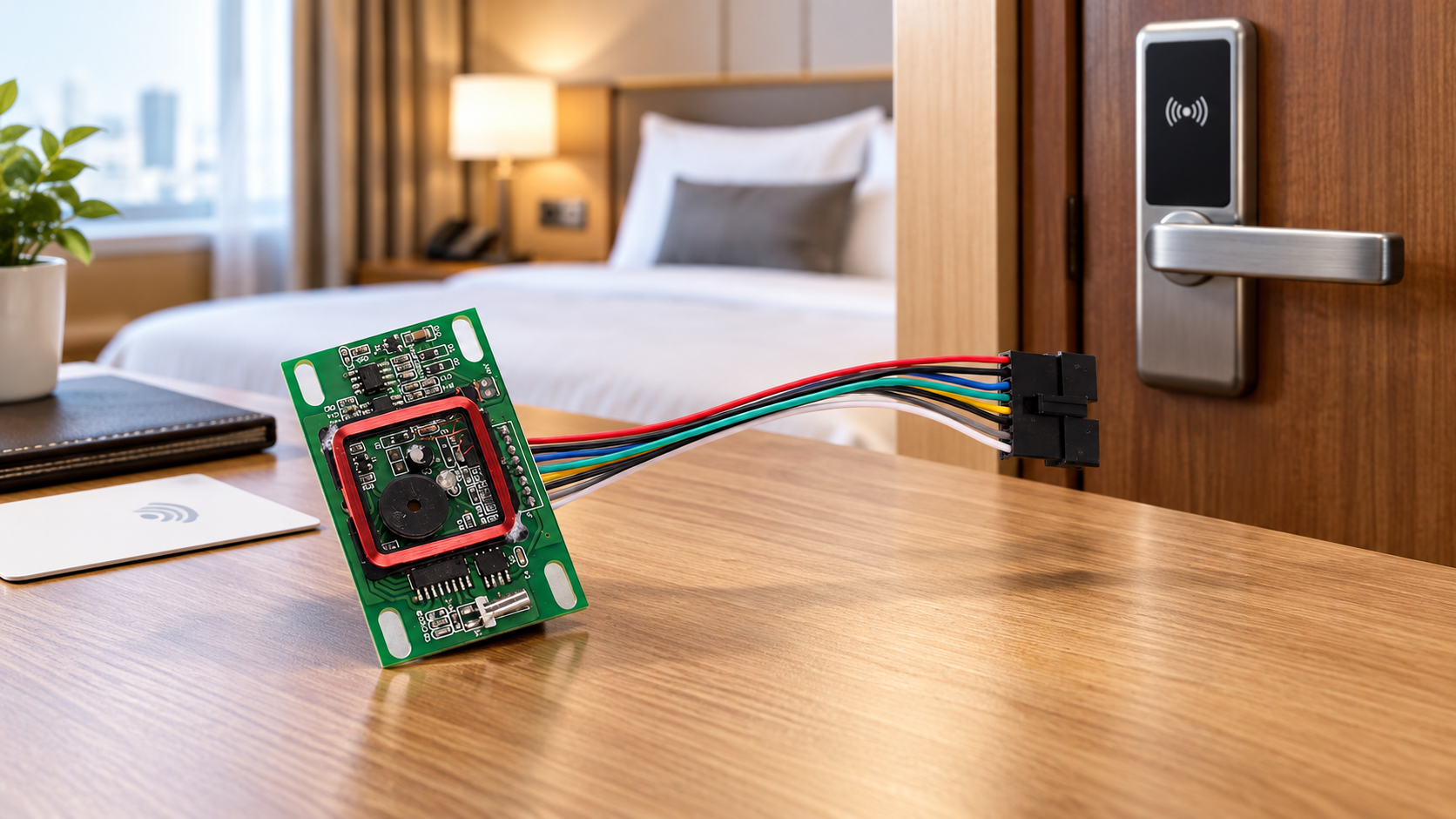
The product data describes data storage as cloud-based and lists a cloud-connected smart chip system that is waterproof, moisture-proof, and anti-static. Cloud logging can let operators with several properties review entry records from one dashboard, although the supplied data does not detail which dashboard functions are available. Buyers should ask whether each lock reaches the cloud directly over Wi-Fi or through a local gateway, and what happens to card validation when that link is down.
Clarifying Discrepancies: Lifecycle Cycles and Warranty Terms
The supplied documents contain two warranty statements that procurement teams should reconcile. The product specification lists "Warranty: 12 years @ 100,000 cycles," while the supplier's general terms state a 2-year product warranty with lifetime maintenance. These two statements should not be treated as the same promise.
The documents do not explain how the two terms relate. One plausible reading is that the 12-year, 100,000-cycle figure describes the mechanical service life of the lock body, while the 2-year term covers the product as a whole, including electronics. That reading is an assumption, not a stated policy. Before ordering, buyers should get written terms stating what is covered, for how long, and whether circuit boards and mechanical parts are treated differently.
| Evaluation Criteria | Supplied Specification | Procurement Verification Required |
|---|---|---|
| Escutcheon Size | 240 mm (L) × 60 mm (W) | Confirm coverage of existing holes on retrofit doors |
| Chassis Material | Stainless steel, with 304 stainless steel lock tongue | Request material certificates for coastal or humid sites |
| Multi-Modal Entry | Wi-Fi, fingerprint, code, card, mechanical key | Confirm which methods work without a network connection |
| Data System | Cloud data storage | Ask about encryption, server location, and data retention |
| Environmental Protection | Waterproof, moisture-proof, anti-static listed; supplier documentation cites IP65 | Request an IP test report for this specific model |
| Certifications | CE, RoHS | Request certificates matching the exact model variant |
| Warranty Term | 12 years @ 100,000 cycles (product spec); 2-year warranty (general terms) | Obtain written coverage terms for electronic and mechanical parts |
Procurement Decision Matrix and Pilot Testing Protocol
Defining Requirements Before Bulk Ordering
A hotel lock order should be judged on lifecycle cost, not unit price alone. A cheap lock that drains batteries or reads cards slowly costs money every week through staff time, guest complaints, and service calls. Standardizing on one platform across guest rooms, connecting suites, and service pantries also keeps the spare parts inventory small and staff training simple.
Supplier capacity matters on large projects, because a stalled delivery can hold back an entire floor opening. For our part, SUMMAO runs a 10,000 m² automated manufacturing facility with a daily capacity of more than 500 units. Quoted lead times are 7 to 10 days for regular products and 15 to 30 days for customized orders, which helps project teams plan phased room handovers.
On-Site Pilot Testing Methodology
Before ordering hundreds of units, install sample locks in a mock-up room. A pilot reveals problems that drawings rarely show, such as warped frames, tight latch clearances, and handles that rattle when the HVAC runs. A practical test sequence looks like this:
- Install samples on both new doors and existing retrofit doors to check the mounting template.
- Repeat representative operating cycles agreed with the supplier and project consultant, then inspect spring return, latch alignment, fastener loosening, and abnormal noise.
- Test the reader with scratched or bent cards, and with cards of other formats to confirm they are rejected.
- Disconnect the network to confirm that card access and event logging continue offline.
- Turn the mechanical override key to confirm the cylinder moves smoothly without catching internal wiring.
Frequently Asked Questions
What is the operational difference between an online Wi-Fi lock and a traditional offline hotel lock?
An offline lock checks credentials locally by reading the encrypted access period written to the card at check-in. It needs no network hardware on guest floors, which keeps installation cost down and battery consumption low. An online lock keeps a network connection to the central system. That connection lets the front desk cancel keys remotely, handle room moves without reissuing cards at the door, and see alerts such as a door left ajar.
Can this smart door lock integrate directly with existing third-party PMS platforms?
The supplied product data mentions cloud data storage but does not list specific PMS integrations. Connecting to platforms such as Oracle OPERA, protel, or Cloudbeds depends on the interface the lock software supports. Ask the supplier for interface documentation, a list of tested PMS connections, and a test setup, so you can check key issuance from your own front desk before signing a contract.
How does the lock maintain guest security if the corridor Wi-Fi or local network goes offline?
In most card-based hotel locks, validation runs on the lock itself. The lock stores its access rules in onboard memory and compares the card data with its internal clock. With this design, doors keep opening for valid cards during network or server outages. For a Wi-Fi model with cloud data storage like this one, confirm the offline behavior in writing and test it during the pilot.
How should buyers interpret the "12 years @ 100,000 cycles" specification versus product warranty?
The supplied documents do not define the 12 years @ 100,000 cycles figure. It may describe the expected mechanical life of the lock body, but that is an interpretation. The supplier's general terms separately list a 2-year product warranty. Until the supplier confirms the terms in writing, budget around the 2-year warranty and treat the cycle figure as an indicator of mechanical durability rather than a guarantee.
What maintenance routines are required to keep stainless steel electronic locks operational in humid climates?
In humid or coastal sites, wipe exterior panels with a neutral cleaner on a regular schedule, for example quarterly, to remove salt and mineral deposits. Check battery compartments at each battery change, or about twice a year, for leakage or corroded terminals. Lubricate the latch only with products the manufacturer approves, because the wrong lubricant can attract dust and stiffen the mechanism.
Conclusion: Balancing Guest Convenience, Security, and Hardware Longevity
Choosing a smart door lock for hotel room doors means looking past the finish and the feature list. A dependable hotel room smart lock combines solid stainless steel mechanics, single-motion egress from inside the room, and card validation that keeps working when the network drops. The lock reviewed here offers a 240 mm by 60 mm panel, five listed access methods, and cloud data storage. Before a bulk order, clarify the warranty terms, confirm the PMS interface, and run a mock-up room test. That groundwork gives you a smart door lock for hotel rooms that protects guests and keeps front desk work simple.
SUBSCRIBE
INQUIRY