
The Architecture of Access: Evaluating the Best Smart Door Lock with Handle
Physical security dictates how people interact with built environments. Finding the best smart door lock with handle requires looking far beyond surface aesthetics and basic keypad functionality. It demands a thorough understanding of mechanical engineering, network protocols, and material science.
A locking mechanism must grant seamless entry for authorized individuals while maintaining a rigid, uncompromising barrier against external threats. The shift away from traditional deadbolts toward integrated lever systems represents a fundamental change in architectural hardware.
Facility managers and property developers face immense pressure to balance user convenience with strict regulatory compliance. Navigating this landscape means decoding technical specifications and understanding how digital components interact with heavy-duty mechanical linkages.
Tracing the Shift from Mechanical to Digital Entry
Early access control relied entirely on the physical duplication of metallic keys. This analog approach created massive logistical bottlenecks for property managers facing high tenant turnover rates. Re-keying entire floors consumed vast amounts of maintenance labor and generated continuous security vulnerabilities.
The introduction of magnetic stripe cards solved the immediate key recovery problem but introduced rapid mechanical wear. Magnetic read heads degraded quickly from friction, and ambient magnetic fields frequently corrupted the credential data. Physical degradation remained a constant operational expense.
Modern spatial access operates on localized network protocols and sophisticated biometric recognition arrays. The transition toward integrated digital handles addresses strict life-safety codes alongside security requirements. Single-motion egress remains a non-negotiable standard in modern commercial building architecture.
The Anatomy of an Integrated Locking Mechanism
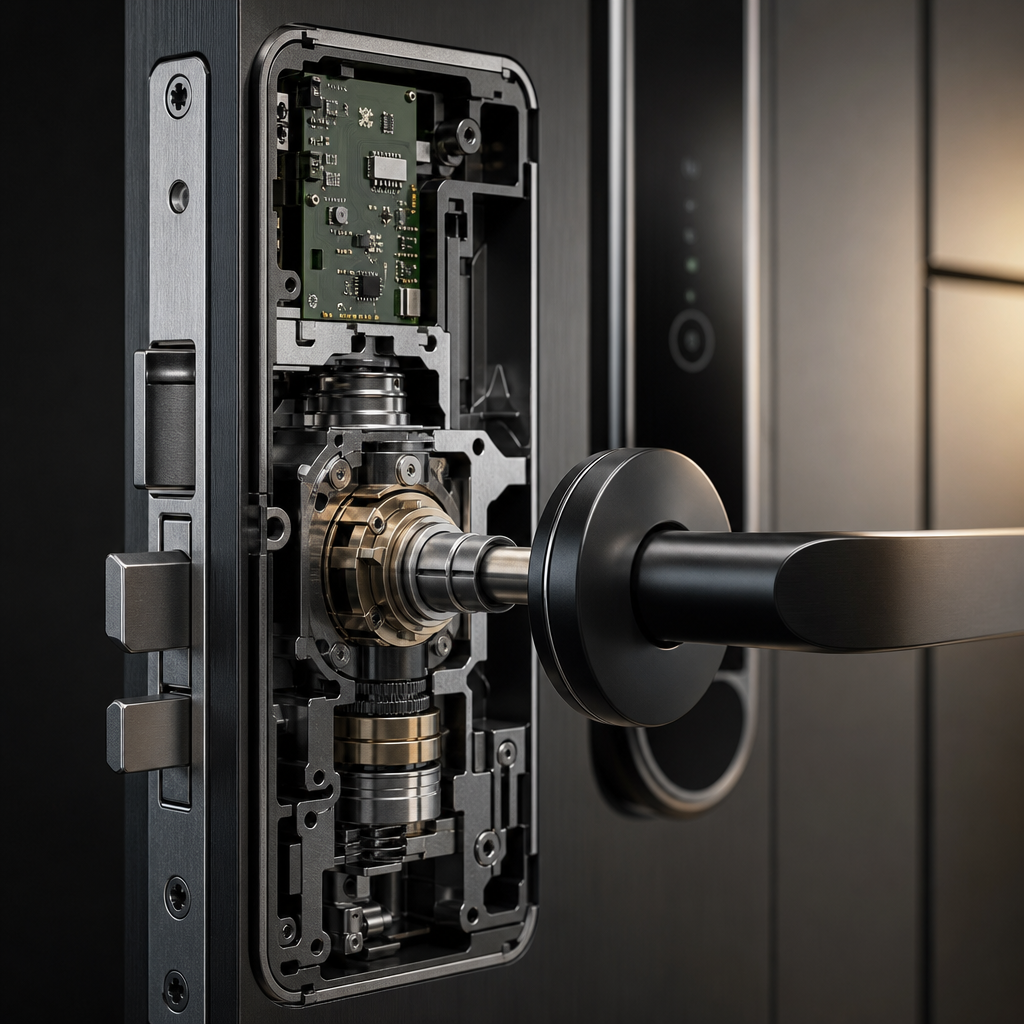
Installing a standalone smart deadbolt above a standard passage knob creates a fragmented user experience. An integrated solution houses the digital authentication module, the clutch mechanism, and the physical latch within a single, unified mortise chassis.
The most critical component within these assemblies is the electronic clutch. When the device is secured, the exterior lever depresses freely without engaging the internal spindle. This freewheeling design prevents intruders from utilizing heavy tools to force the latch open via torque.
If a rigid handle faces massive downward pressure from an attacker, internal shear pins will inevitably break under the strain. A disconnected clutch eliminates this mechanical vulnerability entirely. The force simply spins the handle without transferring any load to the deadlatch.
Core Authentication Modalities in Modern Access
Access systems now utilize multiple independent verification pathways to ensure continuous operation. Relying on a single credential format creates a single point of failure.
- Capacitive Fingerprint Mapping: Measures minute electrical conductivity across the dermis layers. This method prevents synthetic silicone spoofing and recognizes legitimate biological signatures rapidly.
- Bluetooth Low Energy (BLE): Enables authorized mobile devices to act as secure digital keys. The system performs encrypted handshakes without requiring continuous cellular data connections.
- Radio Frequency Identification (RFID): Utilizes encrypted electromagnetic fields to automatically identify proximity cards. This remains the dominant standard for high-traffic hospitality environments.
- Near Field Communication (NFC): Requires extremely close physical proximity between the credential and the reader. This microscopic reading distance drastically reduces the risk of wireless relay attacks.
Cryptographic Security and Data Transmission
A digital handle is essentially a localized computer managing a physical barrier. The methods used to store and transmit access credentials determine the actual security of the doorway. Unencrypted radio signals leave properties vulnerable to simple interception tactics.
Enterprise-grade systems utilize Advanced Encryption Standard (AES) protocols with 128-bit or 256-bit keys. When a user presents a digital credential, the lock does not simply read a static password. It executes a complex challenge-and-response mathematical equation.
To defeat replay attacks, the firmware generates dynamic rolling codes for every single interaction. Even if a malicious actor intercepts the radio frequency packet during a successful unlock, that specific data string becomes immediately invalid for future attempts.
Power Management and Operational Continuity
Internal circuitry must constantly balance processing speed with aggressive energy conservation. Wireless communication chips traditionally drain battery cells rapidly due to continuous background scanning for nearby devices.
Modern firmware architectures utilize specialized event-driven wake protocols. The hardware remains in a deep sleep state, drawing mere microamps of current from the battery pack. A capacitive touch or a specific sub-GHz frequency burst wakes the processor instantly.
Through optimized energy cycles, high-quality units maintain operations for up to eighteen months on standard alkaline or lithium cells. When voltage drops below a critical threshold, the hardware triggers local audio-visual warnings alongside network-based maintenance alerts.
Material Resilience and Environmental Tolerance
Exterior hardware faces constant assault from ultraviolet radiation, driving rain, and severe temperature fluctuations. Consumer-grade plastics warp under direct sunlight, while inferior metals succumb rapidly to galvanic corrosion.
Engineers specify high-density zinc alloy or 304-grade stainless steel for exterior casings due to their high tensile strength. These materials undergo extensive electrochemical plating processes to resist atmospheric degradation and maintain their structural integrity over decades.
Ingress protection dictates a device's ability to withstand particulate and liquid intrusion. An IP65-rated assembly prevents microscopic dust ingress while surviving direct, low-pressure water jets. This environmental sealing protects the delicate printed circuit boards housed inside the exterior escutcheon.
Integration with Building Management Ecosystems
An electronic lock isolated from the broader building network provides limited operational value. Advanced hardware communicates via ZigBee networks or proprietary frequencies to centralized management gateways located throughout the facility.
This deep integration allows physical doorway hardware to talk directly with Guest Room Management Systems (GRMS). Finding the best smart door lock with handle means looking for hardware capable of executing complex automation triggers upon successful entry.
When a valid credential actuates the handle, the internal controller broadcasts a trigger payload across the local network. The room instantly responds by adjusting the HVAC setpoints, engaging the lighting relays, and raising motorized window treatments based on occupancy.
Precision Manufacturing and Quality Control
Manufacturing precision separates commercial-grade architectural hardware from standard consumer electronics. For us, managing a 10,000-square-meter automated manufacturing facility highlights the absolute necessity of strict engineering tolerances.
Building intelligent access control for thousands of global facilities requires merging sensitive biometric sensors with heavy-duty metal casting. Through fifteen years of focused industry development, we have mapped the exact physical stress points of locking hardware.
Passing thirty-six strict inspection processes ensures consistent functionality across diverse and harsh climates. Maintaining a hardware failure rate below one percent demands robotic assembly lines and continuous environmental stress testing before deployment.
Delivering comprehensive turnkey solutions involves aligning biometrics, local network integration, and cloud management software. Hardware must consistently meet CE, FCC, and ISO certifications to satisfy the rigorous demands of commercial real estate developers and international architectural firms.
Scenario-Based Hardware Selection Guide
Different spatial environments dictate entirely different hardware specifications and software capabilities. Evaluating requirements accurately prevents over-spending on unnecessary features while avoiding critical security gaps.
| Application Environment | Primary Credential Focus | Essential System Integrations | Hardware Durability Needs |
|---|---|---|---|
| Boutique Hospitality | RFID Cards & Mobile BLE | Property Management System (PMS) | High aesthetic finish, moderate traffic |
| Serviced Apartments | PIN Codes & Biometrics | Remote Code Generation API | Heavy traffic, vandalism resistance |
| Commercial Offices | Encrypted NFC & RFID | Time-based Access Profiles | Extremely high daily cycle ratings |
| High-End Residential | Biometrics & Mobile App | Home Automation (ZigBee/Z-Wave) | Premium materials, weatherproofing |
Navigating Common Technical Misconceptions
Misunderstanding the underlying technology often leads to poor procurement decisions. Clarifying operational mechanics helps facility operators manage tenant expectations and streamline maintenance protocols.
Can a sudden power grid failure lock users out of the building?
Electronic architectural locks operate on isolated, internal direct current battery power. A localized grid blackout does not affect the authentication module or the motor. Mechanical key overrides also provide guaranteed entry during catastrophic hardware damage.
Do extreme weather conditions disable biometric fingerprint recognition?
Severe cold can temporarily alter the electrical conductivity of human skin, forcing capacitive sensors to work harder. High-end devices utilize advanced algorithms to compensate for moisture and temperature drops, though PIN codes serve as a reliable fallback during blizzards.
How do mobile digital keys function without an active internet connection?
Mobile authentication relies on Bluetooth Low Energy, which operates as a direct local handshake between the phone and the lock. The smartphone app downloads the encrypted digital certificate beforehand, requiring zero cellular reception at the physical doorway.
The Future Trajectory of Spatial Access
The access control industry continues shifting away from active user interactions toward ambient, intent-based authorization. Ultra-Wideband (UWB) technology is beginning to replace standard Bluetooth protocols in high-security environments.
UWB spatial awareness allows the hardware to calculate the exact physical distance and trajectory of the approaching user. The system can distinguish between a person walking directly toward the door and someone merely standing in the adjacent hallway.
Energy harvesting technologies are also emerging within mortise lock designs. By capturing the kinetic energy generated from the manual rotation of the lever, future systems could trickle-charge internal supercapacitors, drastically reducing battery replacement cycles.
Evaluating the mechanical foundation alongside digital capabilities ensures long-term operational success. Securing the best smart door lock with handle fundamentally transforms a static barrier into an intelligent node within a connected architectural ecosystem.
SUBSCRIBE
INQUIRY