
The Split Cloud Architecture Behind Modern Smart Door Lock System Design
Why Wiring Complexity Still Breaks Hotel Automation Projects
Most hotel automation failures never happen at the door. They happen behind the wall, in a junction box, where an electrician is trying to route six different control lines to a single room panel. A smart door lock system is only as reliable as the network carrying its signals, and that network is usually the weakest link in a property-wide rollout. Traditional room control setups rely on centralized wiring, where every switch, curtain motor, and AC unit pulls a dedicated line back to a control cabinet. That approach worked fine for small properties, but it turns into a wiring nightmare once you scale past a few dozen rooms. Labor costs climb, installation timelines stretch, and any future room reconfiguration means tearing into walls again.
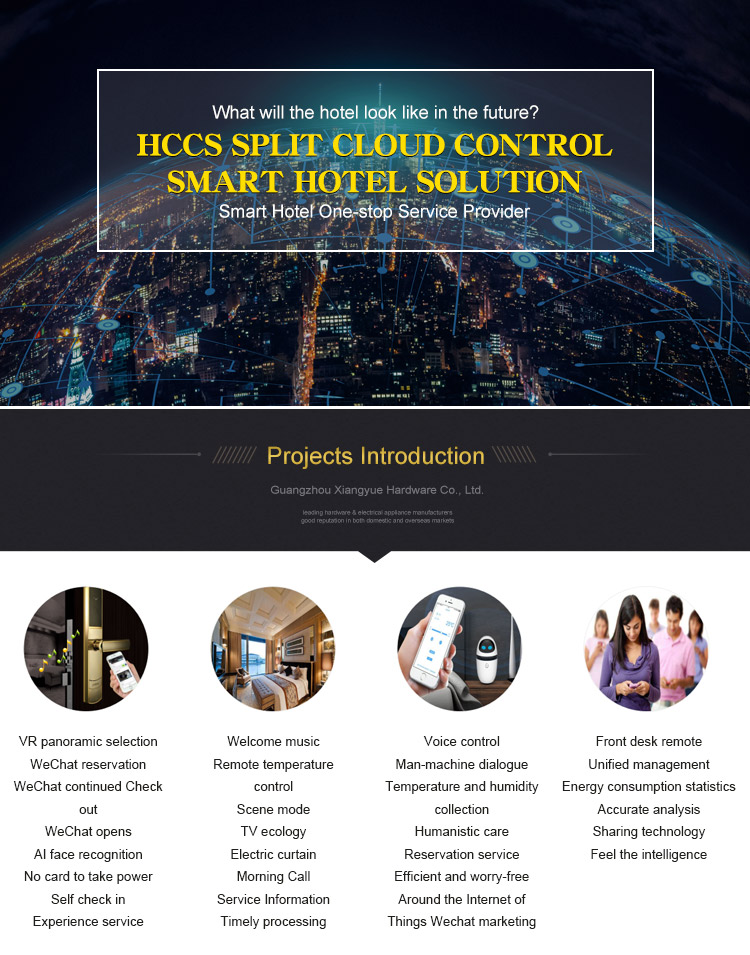
This is the exact problem that split cloud control architecture, sometimes labeled HCCS in hotel management platforms, was designed to solve. Instead of routing everything through a central hardwired hub, the system separates control logic into two layers: a cloud-based management layer that handles booking, authorization, and monitoring, and a local device layer using wireless protocols like ZigBee to link the door lock, switches, and sensors inside each room. The result is fewer physical wires, faster installation, and a system that can be reconfigured through software rather than a rewiring job.
How ZigBee Mesh Networking Actually Reduces Installation Labor
ZigBee is not a marketing buzzword, it is a low-power wireless mesh protocol built specifically for short-range device communication in environments with many nodes, which describes a hotel floor almost perfectly. Each device on a ZigBee network can relay signals to neighboring devices, so the mesh strengthens as more nodes join it. That matters in hospitality because a hotel floor might have thirty rooms, each containing a lock, a light switch, a curtain controller, and an AC panel. Wiring all of that back to a central point is expensive labor. A mesh network lets these devices talk to each other and to a floor-level gateway without pulling new cable through walls.
The practical benefit shows up during installation, not in a spec sheet. Contractors working on retrofit projects, where a hotel is renovating without gutting the building, save real time because ZigBee devices pair wirelessly rather than requiring conduit runs. According to the product documentation for this system, the split cloud design specifically targets this reduction in wiring complexity compared to traditional hardwired hotel control systems. That claim lines up with how ZigBee mesh networks are generally used across commercial building automation, so it holds up as a reasonable engineering rationale rather than an isolated marketing point.
What Guests Actually Feel When the Backend Works
Guests never see a wiring diagram, but they feel the consequences of a poorly integrated system immediately. A lock that takes several seconds to respond, a curtain that does not sync with a room preset, or a check-in process that requires a physical front desk stop, these are the guest-facing symptoms of backend architecture problems. When the smart door lock system is properly integrated with room automation through a unified BS (browser/server) architecture, the guest experience becomes noticeably smoother because every subsystem is reading from the same source of truth.
In this system, that shows up through WeChat-based mobile check-in, which lets a guest receive room access credentials directly on their phone before they ever reach the front desk. It also shows up in voice-controlled room automation, where lighting, curtains, and background music can be adjusted through a smart robot interface rather than four separate remotes. None of this is about novelty for its own sake. It is about collapsing multiple manual steps into one connected action, which is what guests actually notice during a stay, even if they cannot articulate why the room feels more responsive.
Energy Monitoring Is Where the Real Operational Savings Live
Access control gets the marketing attention, but energy management is often where a hotel's operating budget actually improves. Air conditioning and lighting left running in unoccupied rooms is one of the largest avoidable costs in mid-size and large properties. A room control system that links occupancy status, through the door lock or an occupancy sensor, to HVAC and lighting presets can cut this waste without requiring staff to manually check every floor.
This particular system includes intelligent air conditioning presets paired with real-time electricity monitoring, which lets facility managers see consumption patterns at the room or floor level rather than only at the building meter. That visibility is valuable on its own, independent of any automation, because it lets a property identify which units or which floors are underperforming on efficiency. Combined with automated presets that lower HVAC output when a room is unoccupied, the energy monitoring layer turns a passive expense into something a facilities team can actually manage and forecast.
Comparing Centralized Wiring and Split Cloud Room Control
| Factor | Traditional Centralized Wiring | Split Cloud Control (ZigBee-based) |
|---|---|---|
| Installation labor | High, requires conduit runs to each device | Lower, wireless pairing reduces cable runs |
| Renovation flexibility | Difficult, rewiring needed for changes | Easier, devices can be reconfigured via software |
| System scalability | Costly to expand across floors | More modular, gateway-based expansion |
| Point of failure | Central hub failure affects entire wing | Mesh network offers device-level redundancy |
| Front desk integration | Often separate systems, manual sync | Unified BS architecture, shared data layer |
This table reflects general engineering tradeoffs between hardwired and wireless mesh control systems in commercial buildings, not a claim specific to any single installation, since actual results depend on building layout and existing infrastructure.
Compatibility With Existing Door Lock Hardware
One question that comes up constantly during procurement: does adopting a new room control platform mean ripping out an existing lock fleet? For this system, the documentation indicates compatibility with major international door lock brands through its access control integration layer, rather than requiring a single proprietary lock model. That is a meaningful detail for hotels that have already invested in a lock system and want to add automation without a full hardware replacement.
The product specifications list a standard 50 mm backset and keyless operation, which aligns with common hotel-grade lock dimensions rather than a proprietary format. Whether a specific brand's lock integrates smoothly still depends on protocol compatibility on the lock's controller board, so property managers evaluating this kind of system should confirm compatibility with their existing hardware inventory before committing to a property-wide rollout, particularly for older lock generations that may lack the connectivity layer newer models include.
Frequently Asked Questions About Smart Door Lock System Integration
Does a wireless mesh network mean weaker security than a hardwired system?
Not inherently. Security in access control depends on encryption and authentication protocols, not on whether the signal travels through a wire or through the air. ZigBee networks used in commercial building automation include encryption at the network layer, and the actual weak point in most deployments is poor credential management, not the wireless medium itself. A smart door lock system's security posture should be evaluated based on how it handles key issuance and revocation, not the transport layer alone.
Will voice control and automation features work if the internet connection drops?
This depends on how the system separates cloud functions from local device functions. In a split architecture, core functions like door unlocking typically remain operable locally even during a connectivity interruption, while features requiring live cloud sync, such as remote booking updates or app-based check-in, would be affected until connection restores. Hotels should confirm with the system provider exactly which functions are cloud-dependent versus locally cached before relying on it for unattended check-in scenarios.
Manufacturing Consistency Matters More Than Feature Lists
A system with an impressive feature list is only useful if the physical hardware behind it is consistent across hundreds of units installed in a real property. This is where manufacturing process matters more than most buyers initially realize. A production run with inconsistent quality control introduces failure rates that show up months after installation, usually as isolated lock malfunctions or switch panels that lose ZigBee pairing intermittently, which are expensive and disruptive to diagnose at scale.
For us, this is addressed through a structured manufacturing process across a 10,000 square meter facility, using automated assembly combined with a documented inspection sequence before units ship. Locks intended for hospitality use are also generally expected to carry water resistance suited to hallway and bathroom-adjacent installations given their exposure to cleaning chemicals and humidity, which is a standard hospitality hardware consideration rather than a unique claim tied to this specific product.
Choosing a Room Control Platform That Actually Fits Your Property
Selecting a smart door lock system paired with room automation is not just a hardware decision, it is an infrastructure decision that affects renovation costs, staff training, and guest experience for years. Properties doing a ground-up build have more flexibility to choose hardwired systems if they prefer. Properties renovating an occupied building benefit far more from wireless mesh architectures like ZigBee, simply because installation disruption is lower.
Before committing, hotel operators should map out three things: existing lock hardware compatibility, the ratio of cloud-dependent versus locally-operable functions, and the realistic installation timeline given their building's wiring condition. A smart door lock system that solves access control while also unifying lighting, climate, and front desk operations under one architecture tends to deliver more measurable operational savings than treating each subsystem as a separate purchase, because the savings come from integration, not from any single component in isolation.
SUBSCRIBE
INQUIRY