
Understanding the Architecture of the Most Secure Smart Door Lock
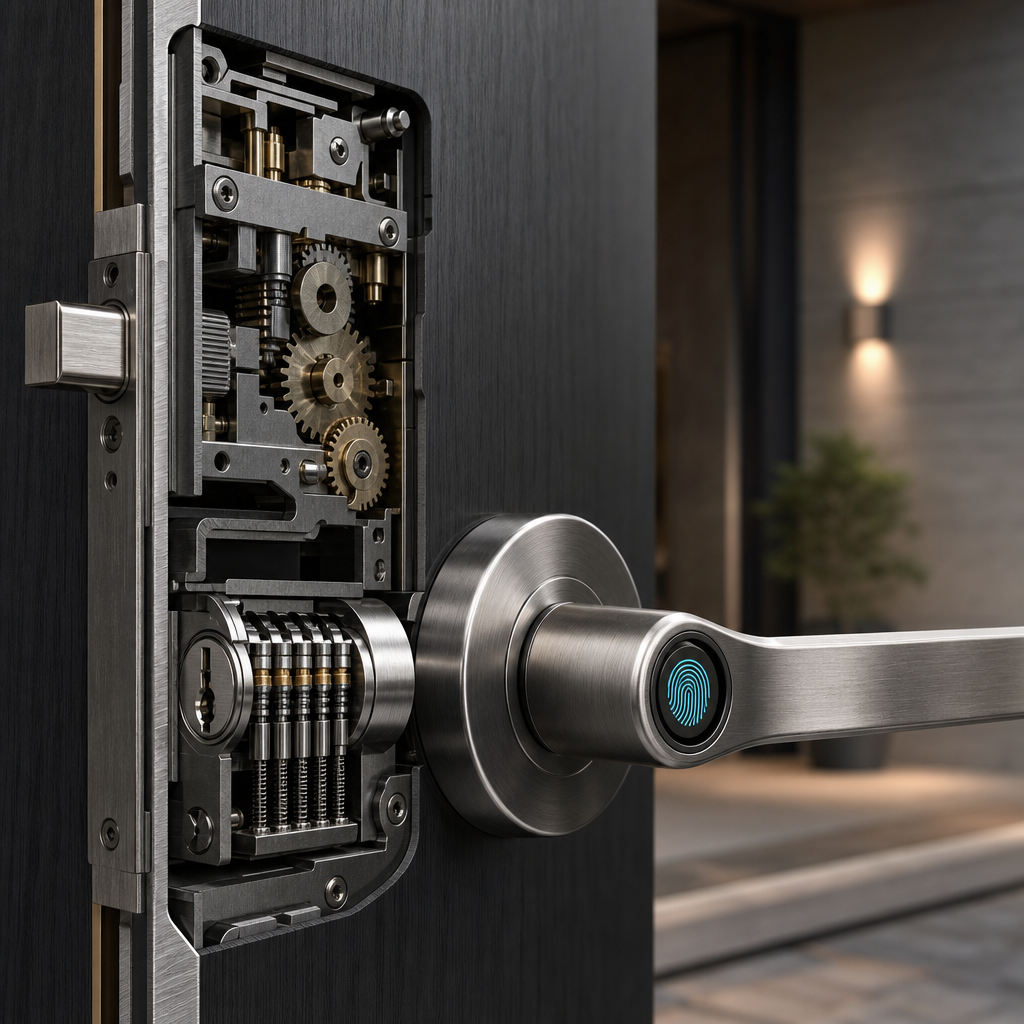
Securing a physical perimeter no longer relies solely on heavy brass and iron structural components. The modern access point represents a complex intersection of precision mechanical engineering and advanced cryptographic protocols.
Property managers and developers face a complex landscape filled with overlapping wireless communication standards. Physical intrusion methods have evolved rapidly alongside highly sophisticated digital exploits in recent times.
Identifying the most secure smart door lock requires looking far beyond external aesthetics or basic touchscreen functionality. A true high-security system must resist brute force kinetic attacks while simultaneously rejecting packet-sniffing data breaches.
This analysis dissects the underlying architecture governing high-security access control infrastructure. We examine the hardware tolerances, encryption standards, and specific authentication methods defining reliable locking mechanisms today.
Decoding Access Control Vulnerabilities
Access control systems fail when developers underestimate the persistence of unauthorized actors. Vulnerabilities typically emerge at the intersection between physical hardware boundaries and wireless communication interfaces.
Mechanical locks traditionally suffered from unauthorized key duplication and physical bypass techniques like lock bumping. Adding digital connectivity introduces entirely new attack vectors, shifting the security burden toward software architecture.
A poorly implemented wireless module broadcasts authentication handshakes in plaintext across open airwaves. Threat actors capture these signals using inexpensive radio frequency scanners, replaying the sequence to trigger the unlocking motor.
Hardware deficiencies also expose internal circuitry to direct environmental manipulation. Intruders often attempt to force a system reboot by applying high-voltage electric shocks directly to the exterior keypad housing.
Understanding these specific failure modes provides the necessary baseline for evaluating hardware resilience. Engineers must design overlapping security layers that independently verify user identity and physical integrity.
Evolution from Mechanical Tumblers to Digital Encryption
The foundational concept of mechanical security remained largely static for over a century. Pin tumbler mechanisms relied entirely on physical key geometry aligning internal brass pins along a sheer line.
Commercial facilities eventually recognized the logistical nightmare of managing hundreds of physical metal keys. This operational friction drove the initial development of magnetic stripe cards and early radio frequency identification modules.
Early electronic locks operated entirely offline, storing access credentials within localized internal memory banks. Managing these isolated systems required security personnel to physically visit each door to update access permissions manually.
The integration of low-power wireless protocols fundamentally changed how facilities manage access rights. Doors became active nodes within a broader network, receiving dynamic authorization tokens distributed remotely through centralized platforms.
Modern architectures now blend physical biometrics with encrypted cloud-based authorization networks. This evolution transforms a static piece of metal into a dynamic gatekeeper capable of real-time situational awareness.
Core Components Dictating Hardware Resilience
Digital encryption holds little value if the physical lock housing shatters under a blunt force impact. Mechanical integrity remains the primary deterrent against opportunistic physical intrusions and forced entry attempts.
Hardware resilience relies on the metallurgical composition of the internal mortise and the exterior escutcheon plates. Zinc alloys offer cost efficiency, but high-security environments demand forged stainless steel or hardened brass alloys.
Evaluating mechanical strength involves examining standardized testing metrics developed by regional engineering institutes. These independent frameworks subject locking mechanisms to thousands of cycles and heavy kinetic impacts.
The Role of Mortise Grades and Cylinder Materials
The internal mortise houses the critical gearing mechanisms responsible for extending and retracting the deadbolt. High-grade mortise assemblies utilize hardened steel internal components designed to resist severe rotational torque.
Lock cylinders remain a prime target for physical drilling and destructive extraction techniques. Security-focused cylinders incorporate hardened steel inserts positioned strategically to deflect drill bits away from the primary tumbler pins.
Anti-pick and anti-bump pins feature complex physical geometries, such as spool or mushroom shapes. These specialized variations bind against the cylinder wall when manipulated by unauthorized tension tools, preventing rotation.
Deadbolt Configurations and Strike Plate Reinforcement
A reinforced lock housing provides minimal protection if the door frame itself splinters during an attack. The structural relationship between the extending deadbolt and the receiving strike plate dictates true barrier strength.
High-security deadbolts feature a minimum one-inch throw length, extending deeply into the adjacent door frame. Many incorporate internal hardened steel roller pins designed to spin freely, preventing saw blades from cutting through the bolt.
Strike plate installation requires replacing standard short screws with heavy-duty mounting hardware reaching the inner wall studs. This simple mechanical reinforcement distributes kinetic impact force across the broader architectural framing of the building.
Cryptography in Modern Access Authentication
Physical strength delays an attacker, but cryptographic security prevents the digital authorization token from being compromised. Wireless communication between a smartphone and a lock must remain completely opaque to external observers.
Advanced systems utilize asymmetric cryptography to establish a secure communication tunnel before transmitting any sensitive data. This mathematical framework ensures that even if a signal is intercepted, the underlying payload remains entirely unreadable.
The encryption keys themselves cycle continuously during a single authentication session. This dynamic rotation prevents attackers from recording a successful unlock command and replaying it later to gain unauthorized entry.
Localized Storage vs Cloud Reliance
Access control systems diverge significantly in how they store and verify user credentials. Cloud-reliant architectures ping remote servers for permission every time a user attempts to open a door.
This remote dependency introduces critical vulnerabilities during unexpected network outages or localized power failures. Users find themselves locked out simply because the hardware cannot reach the external authorization server.
High-security protocols mandate localized storage for primary access credentials within a secure hardware enclave. The system processes biometric data and digital keys directly on the device, ensuring uninterrupted operation regardless of network status.
Mitigating Relay Attacks and Signal Interception
Relay attacks represent a highly sophisticated method for bypassing proximity-based unlocking features. Attackers use amplified antennas to trick the lock into believing the authorized smartphone is physically nearby.
Engineers combat this vulnerability by implementing strict time-of-flight measurement protocols within the wireless handshake. The system measures the microsecond delay in signal return to calculate the precise physical distance of the credential.
If the response time exceeds the expected physical boundary, the system automatically terminates the authentication attempt. This hardware-level distance verification effectively neutralizes external signal amplification tactics.
Biometric Authentication Mechanisms Evaluated
Biometric scanning transforms unique human physiological traits into complex mathematical unlocking credentials. This approach eliminates the persistent risks associated with lost keycards or easily guessed numerical passcodes.
Optical fingerprint scanners capture a high-contrast two-dimensional photograph of the user's epidermal friction ridges. These early sensors suffer from high false acceptance rates when confronted with high-quality silicone molds or printed images.
Capacitive sensor technology measures the minute electrical resistance between the ridges and valleys of human skin. This electrical mapping significantly increases security by verifying the presence of conductive human tissue during the scan.
The most secure smart door lock implementations now utilize multispectral imaging to examine subdermal blood flow patterns. These advanced arrays look beneath the surface of the skin, making external physical spoofing nearly impossible.
Facial recognition modules must differentiate between a flat photograph and a three-dimensional human face. Structured light sensors project thousands of invisible infrared dots to construct a precise topographical map of facial geometry.
Contextual Application Scenarios
Hardware requirements shift dramatically depending on the daily operational realities of the installation environment. A residential front door experiences vastly different traffic patterns compared to a commercial office vestibule.
Matching the appropriate authentication technology to the specific architectural use case prevents premature hardware failure. Security administrators must balance frictionless user throughput with strict data retention protocols.
High-Traffic Commercial Facilities and Hospitality
Commercial environments demand continuous operational uptime and seamless integration with existing building management frameworks. These systems must support hundreds of daily authentication events without draining internal battery reserves prematurely.
Designing systems for large-scale hospitality requires a distinct architectural approach to hardware reliability. For us, managing a high-volume automated manufacturing facility means enforcing strict environmental tolerances during the engineering phase.
We ensure components achieve an IP65 waterproof rating while maintaining a hardware failure rate strictly below one percent. This rigorous testing guarantees that multi-modal unlocking systems function reliably across extreme global climates.
Hospitality platforms utilize dynamic digital authorization distributed securely directly to a guest's mobile device. This decentralized credentialing eliminates physical check-in lines while maintaining a strict cryptographic audit trail of all access events.
Decentralized Residential Management
Multi-family residential complexes face the challenge of securing shared perimeter access alongside private living spaces. Property managers require localized control panels capable of issuing temporary access tokens for maintenance personnel.
Residential systems benefit heavily from modular communication arrays supporting low-power mesh networks. This topology allows individual apartment doors to route security alerts through neighboring locks, ensuring reliable remote monitoring.
Hardware deployed in these environments must prioritize long-term battery efficiency above continuous wireless polling. Systems enter a deep sleep state, waking only when physical interaction triggers the localized proximity sensors.
Evaluating Technical Specifications for Deployment
Selecting appropriate access hardware requires translating marketing claims into standardized engineering specifications. Administrators must evaluate components across multiple technical domains to ensure holistic perimeter security.
Understanding the intersection of mechanical durability, cryptographic standards, and environmental resistance prevents costly deployment errors. The following parameters represent the baseline requirements for enterprise-grade access control hardware.
-
Mechanical Certification Profiles:
- Grade 1 heavy-duty commercial mortise assemblies.
- Drill-resistant hardened steel cylinder inserts.
- Solid brass or stainless steel exterior escutcheon plates.
-
Cryptographic Security Standards:
- AES-256 bit encryption for all wireless data transmission.
- Secure hardware enclaves for local credential storage.
- Dynamic token rotation for digital access keys.
-
Authentication Hardware Modalities:
- 3D structured light facial recognition modules.
- Multispectral biometric fingerprint sensors.
- NFC modules with encrypted sector reading capabilities.
-
Environmental Operational Tolerances:
- IP65 or higher ingress protection against dust and water.
- Operational temperature ranges supporting extreme climates.
- Fire-rated mechanical egress functionality for emergency evacuation.
Frequently Addressed Security Misconceptions
Do smart locks lose all functionality during a localized power grid failure?
Enterprise-grade locks operate on independent high-capacity battery arrays, remaining entirely functional during structural power losses. Many incorporate concealed physical keyways or emergency power terminals to accept temporary external voltage from portable batteries.
Are biometric data profiles stored securely on external network servers?
Strict privacy protocols mandate that biometric templates remain permanently tethered to the local device hardware enclave. The system only transmits an anonymous mathematical confirmation token to the management software, never the actual biometric image.
Can hackers bypass a lock by intercepting the local Wi-Fi network traffic?
Secure access nodes isolate their primary authentication protocols from the broader local area network infrastructure. They utilize encrypted point-to-point wireless handshakes, rendering external network traffic monitoring completely ineffective for gaining entry.
Do smart components weaken the physical mechanical strength of the door?
Premium digital hardware encases the sensitive computational modules behind heavy-duty structural metal plates. The internal mechanical gearing often exceeds the structural integrity found in traditional, non-connected locking cylinders.
The Forward Trajectory of Access Protocols
The boundary separating physical hardware from digital security infrastructure continues to dissolve rapidly. Upcoming hardware iterations will prioritize contextual awareness, utilizing advanced sensor fusion to anticipate legitimate access requests.
Ultra-wideband communication modules represent a significant leap forward for precise proximity detection protocols. This technology allows doors to map the physical trajectory of an approaching user with centimeter-level accuracy.
Privacy-focused edge computing will push complex decision-making processes directly to the door processor. This localized intelligence reduces latency while ensuring sensitive movement data never traverses public network routing channels.
Finding the most secure smart door lock ultimately requires balancing mechanical density with software agility. The future of access control belongs to systems that adapt fluidly to emerging threats without sacrificing user accessibility.
SUBSCRIBE
INQUIRY