
What Separates a Reliable OEM Facial Recognition Door Lock Factory From the Rest
Anyone searching for an OEM facial recognition door lock factory is usually trying to answer one blunt question: does the face-scanning claim on the spec sheet hold up once the lock sits on a real door, or is it just a camera bolted onto old 2D matching software. That distinction decides whether a batch order performs consistently across a hotel chain or turns into a stream of warranty tickets.
Beyond a Flat Photo: How 3D Recognition Actually Works
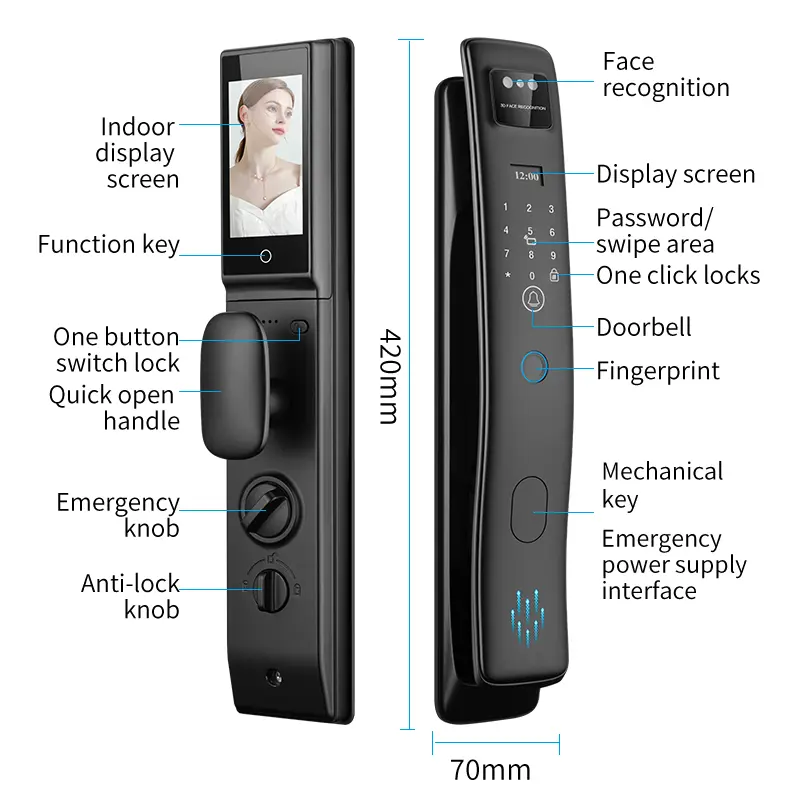
A standard 2D face-matching camera stores a flat image and compares new pixels against it, which is why a printed photo or a paused video call has fooled cheaper systems for years. 3D facial recognition works differently: the front panel houses a sensor array intended to read facial depth information rather than relying only on a flat image. On the S958MAX, that array sits alongside the camera lens rather than replacing it, so the lock is designed to use shape data as well as a picture.
Why Depth Data Resists Simple Spoofing
Depth mapping matters because it changes what an attacker needs to defeat the lock. A flat image does not provide the same depth profile as a real face, so systems built around depth detection are generally harder to fool with a simple photo than basic 2D matching systems. That one design choice turns facial recognition from a novelty feature into something a property manager can actually rely on for a front door.
Video Calling as a Backup Verification Layer
Biometric matching isn't the only line of defense here. The lock's built-in camera doubles as a video intercom through the Tuya app, so an unregistered visitor triggers a live call to the resident's phone instead of a locked door and a guess. That covers the scenarios buyers actually deal with day to day: a hotel guest expecting a package, an apartment resident with an occasional visitor, or an office manager confirming a contractor before granting access. Seeing the person first, then deciding, is a more forgiving fallback than face-matching alone.
Matching Hardware to Real Doors
None of this works if the hardware doesn't physically fit the door it's sold for, which is where working with an OEM facial recognition door lock factory becomes less about marketing claims and more about physical fit. This lock is built around a 6068×24×240mm mortise and fits doors between 40mm and 110mm thick, covering many residential and commercial door standards without a custom mortise order. The aluminum alloy body and Grade C cylinder are specified for tamper resistance, and at 6kg the unit appears substantial enough to suggest a full-featured internal assembly rather than a stripped-down shell.
| Specification | Detail |
|---|---|
| Model | S958MAX |
| Material | Aluminum alloy |
| Lock Cylinder | Grade C |
| Connectivity | Wi-Fi, Tuya App |
| Battery | 7.4V 5000mAh rechargeable lithium-ion |
| Door Thickness | 40–110mm |
| Mortise Size | 6068×24×240mm |
| Weight | 6kg |
Battery life on camera-equipped locks is a fair concern, since a screen and a lens draw more current than a simple keypad ever would. The rechargeable 5000mAh pack and a built-in USB emergency port are the practical answer, letting a drained battery be temporarily powered on site instead of forcing a full teardown. For us, that kind of detail is what separates a factory that assembles locks from one that engineers around how they actually fail in the field.
FAQ
Does 3D facial recognition still work in the dark or with a mask on?
This depends on whether the sensor module includes infrared assistance, and that detail isn't always listed on a spec sheet. If low-light entryways are part of the deployment, it's worth confirming directly with the factory rather than assuming depth-sensing alone solves visibility, since depth mapping and night vision are two separate engineering problems.
Is 3D face matching noticeably slower than a fingerprint scan?
Capturing depth data can take slightly longer than reading a single flat image, but in practice the difference is usually small. Most users won't perceive a major delay between placing a fingertip on a sensor and standing in front of a camera under normal lighting.
Sourcing from an OEM facial recognition door lock factory ultimately comes down to whether the depth-sensing hardware, the fallback video verification, and the physical door compatibility were engineered together, rather than bolted on separately. A lock that gets those three things right is one a hotel or apartment operator can deploy at scale without relearning its limitations the hard way.
SUBSCRIBE
INQUIRY