
What to Look for in the Best Smart Door Lock for Hotels and Homes
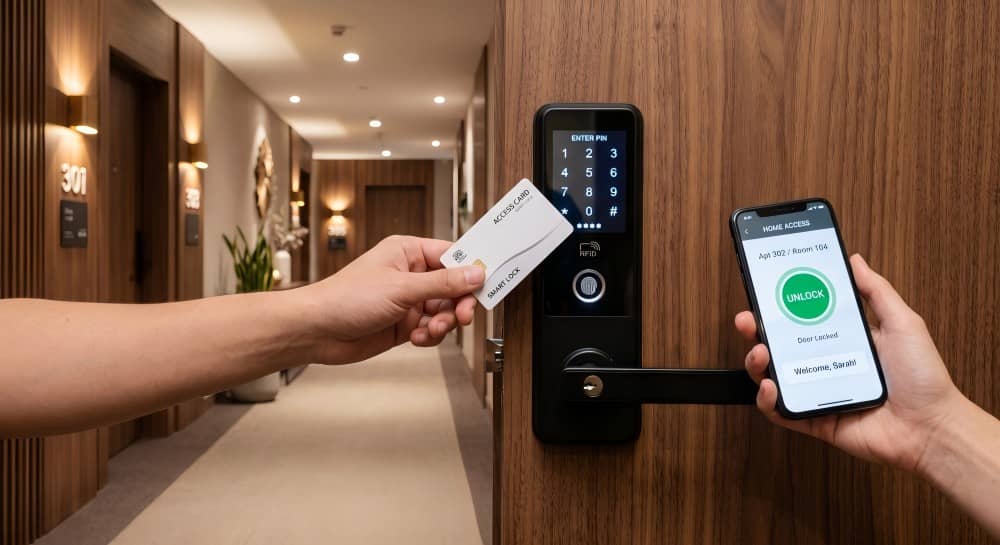
A door lock decides who gets in and who stays out, so the stakes are higher than a marketing headline suggests. Anyone searching for the best smart door lock is usually trying to solve a specific problem: lost keys, slow check-ins, or a front desk that cannot track who currently holds access to a room. The market is crowded, from Bluetooth deadbolts for a single front door to RFID systems running across a 200-room hotel. Choosing well means understanding what each unlock method, battery spec, and certification actually does, rather than assuming more features automatically mean better security.
Why the Right Lock Depends on the Door
A lock built for a private apartment rarely suits a hotel corridor. Homeowners want a quick, private handoff to family or a cleaner, and they check the app once a week at most. Hotels need something closer to an audit trail: who opened room 214, at what hour, using which credential. That difference in intent shapes almost every spec on the sheet.
Think of it the way a locksmith thinks of pin tumblers versus mortise systems. Both keep a door shut, but one is built for repetition under heavy daily traffic and the other for occasional, low-volume use. A lock rated for a family home might fail early in a property running hundreds of unlock cycles a day, simply because it was never tested for that load.
Unlock Methods: Convenience Without Losing Access Control
Most smart locks now support more than one way in, and each method solves a different friction point. A guest checking in at midnight benefits from a mobile key sent before they even reach the lobby. A housekeeping team benefits from RFID cards that can be deactivated instantly if lost.
Common unlock methods on the market include:
- RFID cards – fast, familiar to hotel guests, easy to reissue
- Bluetooth/App control – lets guests skip the front desk entirely
- PIN codes – useful as a backup when a phone battery dies
- Fingerprint or facial recognition – reduces reliance on any physical credential
- NFC – works with phones and some access cards already in a guest's wallet
No single method is universally "best." A boutique hotel targeting a tech-forward guest may lean on app-based entry, while a large serviced apartment complex often keeps RFID as the primary method simply because it is simple to issue, revoke, and manage across many users.
Battery Life and Weatherproofing Numbers That Matter
Battery life is one of the most underestimated specs on a smart lock, and it is also one of the easiest to verify before buying. A lock that drains batteries every few weeks turns into a maintenance headache across a large property, since someone has to physically visit each door.
Many commercial-grade smart locks list battery life in the range of several months to well over a year under typical use, though this depends heavily on how often the lock is opened and which sensors or wireless functions stay active. It is worth asking a supplier for real cycle-test data rather than a single best-case number.
Water and dust resistance matter just as much, especially for exterior doors or coastal properties. An IP65 rating means the enclosure is dust-tight and resistant to water jets, which can be a useful benchmark for locks exposed to rain or humidity. Locks without a published IP rating should be treated with caution for outdoor use.
Security Grades and Certifications Worth Checking
Beyond convenience, a lock still has to do its original job. In North America, ANSI/BHMA hardware standards are widely used to compare durability and security performance across many types of locks and exit devices. A hotel corridor door should be using hardware rated for heavy-duty commercial use, regardless of how advanced its app looks.
Regional certifications add another layer of confidence. CE and FCC markings indicate compliance with applicable regulatory requirements for Europe and the United States respectively, while ISO 9001 and ISO 14001 speak to how consistently a manufacturer manages production quality and environmental processes. None of these certifications guarantee a lock is the best smart door lock for every scenario, but their absence is a reasonable reason to keep looking.
Smart Lock vs Traditional Lock at a Glance
| Feature | Traditional Key Lock | Smart Lock |
|---|---|---|
| Access tracking | None | Logs each unlock event |
| Lost credential response | Rekey the whole lock | Deactivate one card or code remotely |
| Guest check-in speed | Requires physical key handoff | Mobile key sent before arrival |
| Maintenance | Mechanical wear over years | Battery replacement, firmware updates |
| Integration with room systems | Not possible | Can trigger lighting, HVAC, curtains |
This comparison is not an argument that traditional locks are obsolete. A small residential side door with low foot traffic may never need the added complexity. The gap widens as the number of doors, guests, or staff turnover increases.
Beyond the Door: Linking Locks to Room Control
A door lock rarely operates alone in a modern hotel. Once a guest's credential opens the door, that same event can trigger lighting to turn on, HVAC to shift out of energy-saving mode, and curtains to open, all without a separate switch. This kind of linkage is what room control systems, sometimes called GRMS setups, are built to manage.
For a property, the value shows up on the utility bill as much as in guest comfort. If HVAC automatically drops into a low-power mode when a room is unoccupied, and a card unlock brings it back to a comfortable temperature only when a guest actually enters, the energy savings compound across dozens or hundreds of rooms over time. For us, this integration between locks, switches, and front desk software has been a core focus, since a lock disconnected from the rest of the room rarely delivers its full value on a hotel-scale deployment.
Common Questions About Smart Door Locks
Do smart locks work during a power outage?
Most standalone door locks run on internal batteries rather than building power, so a power outage does not automatically lock guests out. It is still worth confirming the specific battery backup and mechanical override key exist for any lock under consideration.
Can a smart lock be hacked more easily than a traditional key?
Any electronic device carries some risk, but reputable locks use encrypted communication between the app or card and the lock body. Choosing a lock with recognized certifications reduces this risk considerably compared to uncertified alternatives.
How long do smart locks typically last before needing replacement?
Mechanical wear on the latch and motor is usually the limiting factor rather than the electronics. A lock tested through a high number of open-close cycles, alongside a low reported failure rate, tends to outlast one without that testing history.
Is Bluetooth or RFID better for a hotel?
Neither is strictly better. RFID is generally easier to standardize at scale since it does not depend on a guest's phone battery or Bluetooth pairing, while Bluetooth adds convenience for guests who prefer skipping the front desk.
Matching the Lock to the Property
There is no single spec sheet that defines the best smart door lock for every building. A homeowner might prioritize a simple app and a reliable PIN backup, while a hotel manager needs multi-modal access, detailed logs, and integration with front desk software tracking room status in real time. The right choice comes down to matching unlock methods, durability ratings, and battery performance to the actual traffic that door will see, not to whichever model has the longest feature list on paper.
SUBSCRIBE
INQUIRY